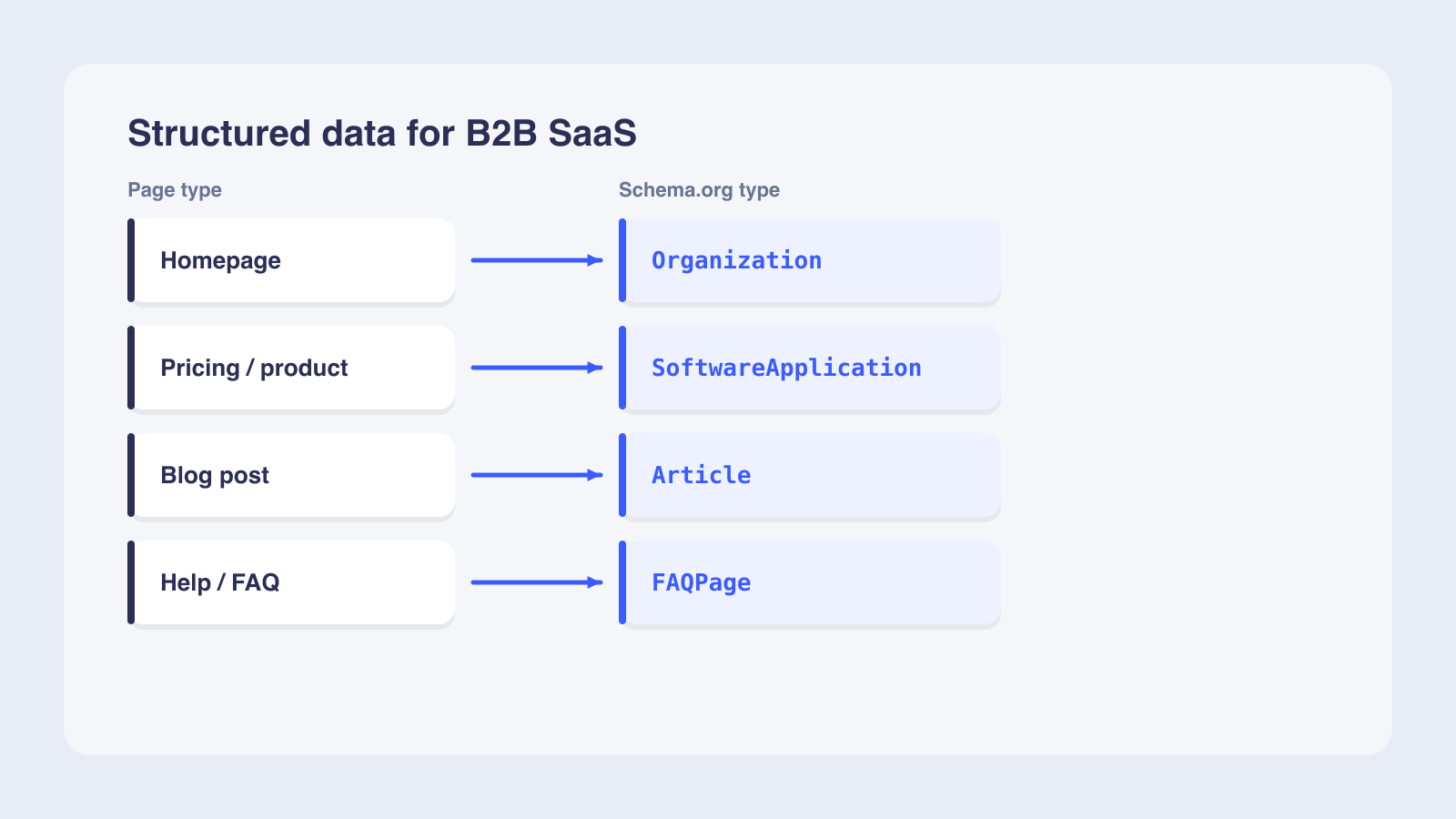
The five structured-data types that matter most for B2B SaaS are Organization, SoftwareApplication, FAQPage, BreadcrumbList, and Article, all delivered as JSON-LD, the format Google recommends. Together they tell search engines and AI models what your company is, what your product does, how your content is structured, and how your site is organized. SoftwareApplication is almost always the right choice over Product for SaaS, because it supports applicationCategory, operatingSystem, and featureList. Tie your schema together with stable @id references so engines see one connected entity graph rather than isolated blocks, keep your markup in visible parity with the page (especially ratings), and validate with Google's Rich Results Test and the Schema.org validator before you ship. Structured data makes you eligible for rich results and easier for AI engines to cite, but it does not guarantee either.
The five schema types that matter most for B2B SaaS websites are Organization, SoftwareApplication, FAQPage, BreadcrumbList, and Article. These types tell search engines and AI models what your company is, what your product does, how your content is structured, and how your navigation works.
This guide covers how each type works, how to implement them in JSON-LD, and how they connect to AI search visibility. When buyers ask ChatGPT, Perplexity, or Gemini for a software recommendation, accurate schema gives those models the entity data they need to name your product in the answer.
What is structured data for B2B SaaS websites?
Structured data is standardized markup that tells search engines what your page content means. Schema.org provides the vocabulary, JSON-LD is the delivery format, and together they make your SaaS site machine-readable. For B2B SaaS, this matters because AI engines like ChatGPT, Perplexity, and Gemini increasingly rely on structured data to understand and describe your product when buyers ask category-level questions.
Structured data vs schema markup: the distinction
People use structured data and schema markup interchangeably, but they refer to different layers. Schema markup is the code you add to a page (JSON-LD, Microdata, or RDFa). Structured data is the information that code represents: your company name, product features, pricing, and content relationships. You write schema markup to produce structured data that engines can parse.
Why JSON-LD is the format Google recommends
Google recommends JSON-LD because it is easier to implement and maintain at scale. It is less prone to user errors and can be placed in a script tag without altering visible HTML. Google's structured data documentation names JSON-LD as the preferred format, and it is by far the most widely used of the three markup syntaxes, ahead of Microdata and RDFa.
Google's structured data documentation confirms JSON-LD as the preferred format and notes that data-vocabulary.org markup is no longer eligible for rich results.
How structured data feeds AI search for SaaS
When a buyer asks an AI model what the best CRM for small teams is, the model retrieves web pages, extracts entities, and synthesizes an answer. Structured data makes extraction more accurate because it labels each entity explicitly. A SoftwareApplication schema block tells the model your product name, category, pricing, and features in a format it can parse with confidence. Without it, the model guesses from unstructured text and may misattribute details or skip your product entirely.
Quick test: paste your product page URL into Google's Rich Results Test at search.google.com/test/rich-results and note which schema types are detected and which required properties are missing.
How does structured data improve B2B SaaS visibility in AI search?
Structured data improves B2B SaaS visibility through two channels: traditional rich results in Google Search and AI citations in synthesized answers from models like ChatGPT and Perplexity. Both channels depend on the same foundation: accurate, complete schema that helps engines build entity graphs connecting your brand, product, and content.
Entity graphs: how schema connects your SaaS brand
An entity graph is a machine-readable map of relationships between things. When your Organization schema uses sameAs to link to your LinkedIn, G2, and Crunchbase profiles, and your SoftwareApplication schema references that Organization as its publisher, you create a connected graph. AI engines use these connections to verify your identity and understand your product's place in the market. Without sameAs references, your brand exists as an isolated node that AI models may not recognize.
Rich results vs AI citations: two visibility channels
Rich results are the visual extras Google shows in search results: star ratings, pricing, and knowledge panels. AI citations are mentions of your brand inside synthesized answers. Schema markup is common on high-ranking pages, so sites without structured data compete at a structural disadvantage for both channels.
AI search visibility increasingly depends on entity clarity, which is why understanding how AI engines evaluate your brand is the first step in closing that gap.
E-E-A-T signals structured data reinforces
E-E-A-T (Experience, Expertise, Authoritativeness, Trustworthiness) signals are Google's quality framework, and structured data reinforces all four. Person schema attributes content to named authors with credentials. Organization sameAs references connect to authoritative third-party profiles. Review schema surfaces verified customer feedback. Article schema with datePublished and author signals freshness and accountability. These signals help AI engines decide whether your content is worth citing.
Structured data makes your entities machine-readable, but entity clarity alone does not guarantee AI citations. AI Visibility Mapping identifies which buyer queries your brand is missing in AI-generated answers, giving schema deployment a measurable target beyond rich result eligibility.
SoftwareApplication vs Product: which schema should B2B SaaS use?
For SaaS companies, SoftwareApplication is almost always the right choice over Product. SoftwareApplication supports properties that Product does not: applicationCategory, operatingSystem, softwareVersion, and featureList. These properties are the first filter an answer engine applies when building a shortlist. The qualifying test is whether a buyer can install it, log into it, or call it over an API. For SaaS, that test almost always passes.
| Aspect | SoftwareApplication | Product |
|---|---|---|
| Best fit | SaaS and apps you install, log into, or call via an API | Physical goods or generic products |
| Key SaaS properties | applicationCategory, operatingSystem, softwareVersion, featureList | Not supported |
| Shared properties | offers, aggregateRating, review | offers, aggregateRating, review |
| brand property | Not native | Supported |
Organization vs WebSite: homepage roles
Your homepage needs both Organization and WebSite schema, but they serve different roles, and AI search optimization and SEO strategies require distinct entity signals. WebSite schema is currently used by Google Search to specify the site name, not to enable sitelinks or the search box feature in results. Organization schema carries your company identity: logo, contactPoint, areaServed, and sameAs references to LinkedIn, G2, and Crunchbase. Use both on your homepage, with Organization as the primary entity and WebSite as a supporting type.
Article vs BlogPosting: does the distinction matter?
Article and BlogPosting are nearly identical schema types, and Google treats them the same for rich result eligibility, so the practical difference is minimal. Use Article for thought leadership content and case studies; use BlogPosting if your CMS generates it automatically.
How do you implement JSON-LD structured data on SaaS pages?
Implementation follows a simple pattern: identify the page type, select the matching schema, fill in properties from visible content, and validate before deploying. Many SaaS sites still under-use structured data, which leaves significant room to improve.
Map schema to page types
Each page type on your SaaS site maps to a primary schema type, and the mapping is straightforward, as the table below shows.
| Page type | Primary schema | Key properties |
|---|---|---|
| Homepage | Organization + WebSite | name, logo, sameAs, url |
| Product or feature page | SoftwareApplication | name, applicationCategory, offers, operatingSystem |
| Pricing page | SoftwareApplication + Offer | offers.price, priceCurrency, priceValidUntil |
| Blog post | Article or BlogPosting | headline, author, datePublished, publisher |
| Support or FAQ page | FAQPage | mainEntity (Question and Answer pairs) |
| Any page with navigation | BreadcrumbList | itemListElement, name, position |
Use stable @id references
Stable @id references stitch your entities together into a connected graph. Your Organization @id (for example, a URL ending in #organization) should be referenced by SoftwareApplication's publisher property, and your Article schema should reference the same Organization @id in its publisher property. This creates a web of relationships that AI engines can traverse, rather than isolated schema blocks that each describe a single page. A SoftwareApplication block that points back to your Organization looks like this:
{
  "@context": "https://schema.org",
  "@type": "SoftwareApplication",
  "name": "Your Product",
  "applicationCategory": "BusinessApplication",
  "operatingSystem": "Web",
  "offers": {
    "@type": "Offer",
    "price": "49.00",
    "priceCurrency": "USD"
  },
  "aggregateRating": {
    "@type": "AggregateRating",
    "ratingValue": "4.8",
    "bestRating": "5",
    "ratingCount": "127"
  },
  "publisher": { "@id": "https://yourcompany.com/#organization" }
}
Validate before deploying
Run your JSON-LD through two tools before publishing. Google's Rich Results Test at search.google.com/test/rich-results checks eligibility for rich result features and flags missing required properties. The Schema.org Markup Validator at validator.schema.org catches specification errors the Google tool might miss, such as invalid enum values or wrong property types. After deployment, check Google Search Console's reports for errors and warnings.
What do B2B SaaS teams get wrong about structured data?
The first thing B2B SaaS teams get wrong is marking up content that is not visible on the page. The second is adding review markup that violates Google's policies. The third is deploying bloated plugin-generated schema that does not match page reality.
Visible parity violations
Google's policies require visible parity between structured data and page content. If your schema says you have a 4.8-star rating from 127 reviews, those reviews must be visible on the same page. Hidden or mismatched markup can trigger manual actions that remove rich result eligibility.
Invalid review markup
Self-serving reviews are restricted by Google's policies. If your G2 or Capterra ratings live on those platforms, use the sameAs property in your Organization schema to point to them, rather than copying aggregateRating into your own schema. Copying third-party ratings into your own schema without displaying those reviews on your page violates the visible parity rule and risks a manual action.
Bloated plugin-generated schema
More schema is not better. WordPress plugins often generate overlapping JSON-LD blocks per page with conflicting or duplicate properties. They may set no clear primary type and produce stale data that does not match current page content. Focus on entity clarity and accuracy over volume, as schema accuracy matters more for AI citations than schema quantity.
What should you do next with structured data?
Structured data deployment is not a one-time task. You need a measurement loop that tracks both traditional rich result performance and AI mention rates, then iterates based on what the data shows.
Set up your measurement loop
Monitor Google Search Console for rich result impressions, clicks, and CTR after deployment. The reports group items for each schema type you have implemented into valid and invalid statuses, with critical and non-critical issues shown separately.
Track AI mention rates by testing prompts across ChatGPT, Perplexity, and Gemini. Check whether your brand appears in AI-generated answers when buyers ask category-level questions, as outlined in VisibleAuthority's GEO guide for AI search optimization. Structured data feeds these models, but you need to measure whether it is working.
Run a 30-day schema sprint
Start with a structured 30-day sprint: map your current AI visibility, deploy core schema types across your main page templates, and measure before-and-after mention rates. VisibleAuthority's 30-Day Visibility Sprint delivers this same sequence through mapping and content deployment, with a testing loop that gives you measurable before-and-after results in AI mention rates.
Frequently asked questions
What is the difference between SoftwareApplication and Product schema for SaaS?
Does FAQPage schema still help in 2026?
Can I use aggregateRating from G2 or Capterra in my structured data?
How do I validate structured data before publishing?
Does structured data guarantee rich results?
Next steps
Map your page templates to the five core schema types, tie them together with stable @id references, and validate before you ship. Then measure whether the markup is actually helping you get named in AI answers. Request a visibility audit to see where your brand stands across ChatGPT, Perplexity, Gemini, and Claude, and which schema gaps are holding it back.
We'll run your category through the major models and map exactly where you appear, where competitors win, and what it takes to become the recommendation.