
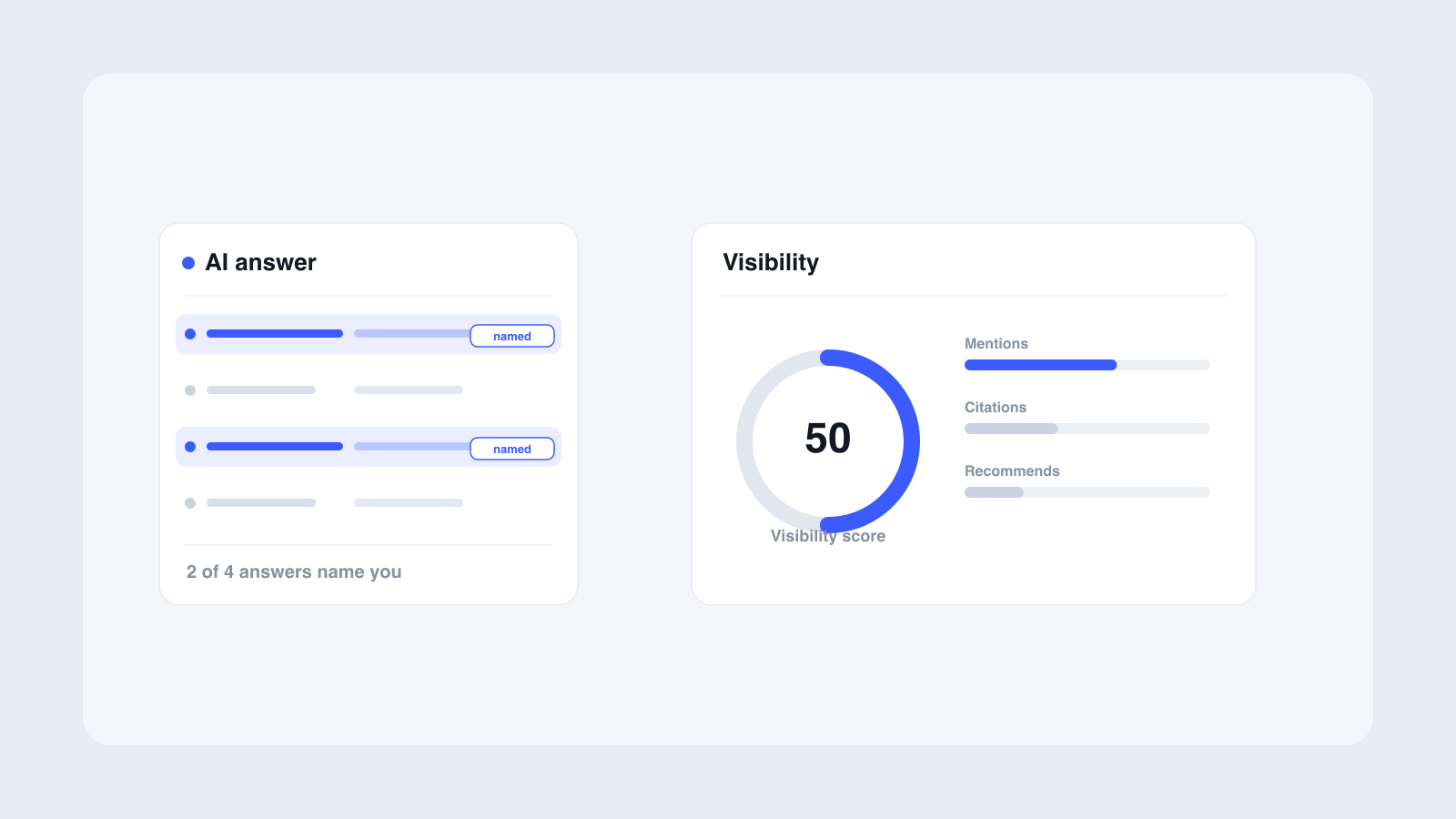
AI search visibility is how often and how favorably your brand is mentioned, cited, or recommended when buyers ask AI assistants like ChatGPT, Perplexity, Gemini, and Claude about your category. It matters for B2B brands because buyers increasingly build vendor shortlists inside these answers before they ever visit a website. If your brand is not named in the AI's response, you are invisible at the exact moment a buyer is forming their first impression.
Picture a CMO at a mid-stage SaaS company opening ChatGPT and typing, What are the best project management tools for a 50-person software team? The AI generates a shortlist of five tools with a one-line summary for each. Your product has a strong G2 profile, ranks on page one of Google for relevant keywords, and serves thousands of customers. The AI never mentions you. The buyer never clicks through to your site because they never learn you exist.
That gap between ranking well on Google and being named inside AI answers is what this guide addresses. Understanding what is AI search visibility and why does it matter for B2B brands starts with a clear definition, moves through the mechanics of how AI models select brands, and ends with a practical plan you can act on this week.
What Is AI Search Visibility? Definition and Core Concepts
AI search visibility is the frequency, accuracy, and prominence with which your brand appears in AI-generated answers across models like ChatGPT, Perplexity, Gemini, Claude, and Google AI Overviews. It measures whether your brand gets named, cited, and recommended when buyers ask AI assistants for vendor recommendations, not where you rank on a search results page.
AI visibility has two core layers: mentions and citations. A mention means your brand name appears in the AI's answer. Ask what's a good tool for X and the model lists five names. Visibility is whether you are one of them. A citation means your domain is linked as a source the model pulled from. Many AI answers footnote the pages they used, and a citation means your URL sits in that list.
Being cited is not the same as being recommended. A brand can appear as a source but still not make the AI's recommended shortlist. The distinction matters because buyers act on recommendations, not footnotes. Being cited as one of eight sources is not the same as being the tool the buyer is told to try.
Two related disciplines work to improve this visibility. Answer Engine Optimization (AEO) focuses on structuring content so AI-powered search tools surface it as a direct answer, shifting priorities from keyword density toward semantic clarity, structured data, and authoritative sourcing. Generative Engine Optimization (GEO) focuses on enhancing brand visibility within AI-generated answers by optimizing for citations. Both matter, and they complement each other.
AI models discover brands through a two-stage process. During discovery, they surface brands discussed in user-generated content like Reddit threads, G2 reviews, and social media posts. During authority, they verify those mentions with structured, factual content from your website, Wikipedia, or documentation. If no one is talking about your brand in third-party channels, the model is less likely to discover you in the first place.
How AI Search Visibility Differs from Traditional SEO
Traditional SEO measures where you rank on a Google results page for specific keywords. AI search visibility measures whether your brand gets named and recommended inside AI-synthesized answers, a fundamentally different signal.
The shift is from links on a page to answers in a conversation. In traditional SEO, you optimize for position one through ten on a search results page. In AI visibility, you optimize to be the brand the model selects when it synthesizes an answer from many sources. There is no position or ranking involved. The model does not return ten links. It names a few.
A brand can rank organically for thousands of keywords but appear in only a small fraction of AI-generated answers. Per Semrush's AI Visibility Index, only 2.1% of pages ranking in Google's top 10 traditional results appeared in ChatGPT's AI-generated answers, while 44.3% appeared in at least one AI platform's answer, according to analysis of Semrush data. The vast majority of AI-cited sources are not the same pages winning traditional SEO, which means a distinct strategy is required.
Traditional SEO rewards keyword volume and backlinks. AI visibility rewards topical authority, structured explanations, direct answers to buyer questions, and being mentioned across multiple third-party sources that AI models trust. Content built for click-through on a results page often fails in AI search because it was never designed for machine readability. For a deeper comparison of how these two approaches differ, see our guide on GEO vs SEO differences and whether you need both.
Key Components of AI Search Visibility
AI search visibility breaks down into several measurable components that together paint a full picture of how your brand shows up when buyers ask AI for help. Each component answers a different question about your position in the answer.
- Brand mentions: How often your company name appears in AI-generated answers across a defined set of buyer prompts.
- Citations: How often your domain is linked as a source within those answers.
- Recommendation or shortlist inclusion: Whether the AI names your brand as a recommended option, not just a cited source.
- Positioning vs competitors: How the AI describes your strengths and weaknesses relative to alternatives.
- Sentiment: Whether the AI frames your brand positively, neutrally, or negatively.
- Share of voice across models: How frequently you appear across ChatGPT, Perplexity, Gemini, and Claude, not just one platform.
Cross-engine consensus is rare. Research from Is My Brand in AI found that on seven open-ended questions where all four engines answered, they agreed on only 32% of the brands they recommended and 1% of the sources they cited. Every question had at least one brand all four engines named, but six of seven had no shared source at all. This means measuring visibility on just one platform gives an incomplete and misleading picture.
A single blended visibility percentage hides which component is actually holding you back. You might be strong on Perplexity and invisible on ChatGPT, and the fix for each is different. Report per surface, track each metric separately, and watch the trend over time rather than any single answer. To get started with measurement, see our guide on how to measure your brand visibility in AI search.
Why AI Search Visibility Matters for B2B Buying Journeys
B2B buyers increasingly ask AI assistants to compare vendors, summarize capabilities, and generate shortlists, meaning your brand's first impression with a buyer may now happen inside an AI answer, not on your website.
The structural shift is significant. Buyers who previously spent days conducting Google searches now ask conversational AI systems to compare vendors, summarize technical capabilities, and produce initial shortlists. This compresses the traditional research phase dramatically. G2 has reportedly found that AI chatbots are now the number one source shaping which vendors get considered. Separately, research from madx.digital indicates that 85% of buyers think more highly of a vendor an AI recommends.
AI answers tend to recommend a small number of brands per query. If you are not in the shortlist, you are invisible at the exact moment a buyer is forming their initial impression. Per Walker Sands research, AI Overviews appear on approximately 50% of search results where enterprise B2B brands rank. In categories where AI-generated answers are already pervasive, like cybersecurity and martech, buyers are forming impressions inside AI summaries right now. Not being mentioned means not being considered.
The traffic from AI referrals may look small today, but it converts several times higher than organic search because buyers who arrive from AI assistants have already compared the category and made a decision. You can be shaping a deal long before anyone clicks through to your site. For practical strategies to improve your brand visibility on ChatGPT, Gemini, and Perplexity, our platform-specific guide walks through the tactics that move the needle.
What Low AI Visibility Looks Like in Practice
Low AI visibility means that when a buyer asks an AI assistant for the best tools in your category, your brand is simply not named, even if you rank well on Google and have strong customer reviews.
The scenario above illustrates a pattern VisibleAuthority encounters consistently in AI Visibility Mapping engagements: a brand with strong Google rankings, a robust G2 profile, and thousands of customers is absent from AI shortlists. The diagnostic question is not whether your product is good enough. It is whether AI models can discover and verify your brand when synthesizing answers for buyers.
The pattern repeats across engines. A brand missing from ChatGPT's shortlist is likely missing from Perplexity's and Claude's as well, even though each engine returns different recommendations. Three models, three different shortlists, zero mentions of your brand. This is not random variation; it reflects a structural absence in the sources AI models use to build their answers.
This happens because AI models surface brands discussed in user-generated content like Reddit threads, G2 reviews, and social media posts. If no one is talking about your brand in these channels, the model is less likely to discover you. And if your own content is not structured for machine readability, the model cannot verify what it does find. Research from tryanalyze.ai found that if a brand is missed once, it tends to be missed again approximately 88 to 90% of the time across observations. The problem is architectural, not random, and it compounds unless you actively address it.
If you suspect competitors are showing up where you are not, our guide on why ChatGPT recommends competitors and how to fix it walks through the specific signals AI models use to choose one brand over another.
Your First Steps: A Simple Plan to Start This Week
You can begin improving your AI search visibility this week with four practical steps: audit your current visibility, check that AI crawlers can access your content, create answer-first content for your top buyer questions, and monitor your visibility across at least two AI models.
Step 1: Audit your current visibility. Ask ChatGPT, Perplexity, Gemini, and Claude the top 10 questions your buyers ask about your category. Record whether your brand is mentioned, cited, or recommended. This gives you a baseline. Keep it simple. You can do this manually in an afternoon.
Step 2: Check that AI crawlers can access your content. Many sites unknowingly block LLM crawlers like GPTBot, ClaudeBot, and PerplexityBot in their robots.txt file, per research from thrivestack.ai. If these crawlers cannot index your content, your brand cannot be cited in synthesized answers. Check your robots.txt and ensure these crawlers are not blocked. For technical guidance, see our technical SEO for AI search visibility guide.
Step 3: Create answer-first content. Write content that directly answers the questions buyers ask AI assistants. Instead of broad topic pages, create focused, structured answers to specific questions like What is the best tool for [use case]? Include clear comparisons, specific use cases, and plain-language explanations. Every page built for AI visibility should open with a direct, compact answer before elaborating. This structure is a requirement for machine readability. To build the authority signals AI models look for, see our guide on building topical authority for AI search.
Step 4: Monitor across at least two AI models. Because cross-engine consensus is low, tracking visibility on just one platform gives an incomplete picture. Check your brand's appearance across ChatGPT and Perplexity at minimum, and ideally Gemini and Claude as well. Run your prompts on a fixed weekly schedule to detect changes before they compound into larger gaps. For a structured approach to getting cited, see our guide on getting your website cited by ChatGPT and other AI search engines.
VisibleAuthority maps AI visibility across ChatGPT, Perplexity, Gemini, and Claude and runs a 30-Day Visibility Sprint to produce measurable before-and-after improvements in AI mention rates. The sprint covers mapping, content deployment, and optimization through our AI Visibility Testing Loop. If you want to see where your brand stands right now, book a free AI visibility audit to get a baseline across all major AI models.
Conclusion and Key Takeaways for B2B Strategy
AI search visibility is the new frontier of B2B brand discoverability. Buyers are forming first impressions inside AI answers, not Google results pages. Being ranked on Google is no longer enough on its own.
The decision rule for B2B teams is clear: measure visibility per component (mentions, citations, recommendations) and per model before investing in fixes. A single blended score hides which engine and which surface need attention first. Brands that cannot identify the specific gap cannot close it.
Walker Sands projects that generative AI will influence more than 75% of B2B search queries within the next one to two years. Brands that can identify exactly where they are missing mentions, citations, and recommendations across their buyers' priority models will be the ones buyers actually consider. Those that cannot measure the gap will continue losing deals they never knew they were in.
Ready to see where your brand stands? Book a free AI visibility audit with VisibleAuthority to see exactly where your brand appears and where it does not across ChatGPT, Perplexity, Gemini, and Claude.
FAQ: AI Search Visibility for B2B Brands
What is AI search visibility for B2B brands?
How is AI search visibility different from traditional SEO?
Which AI platforms should B2B brands care about for visibility?
Why is my brand not showing up in AI search results?
How can I start improving my AI search visibility this week?
We'll run your category through the major models and map exactly where you appear, where competitors win, and what it takes to become the recommendation.