
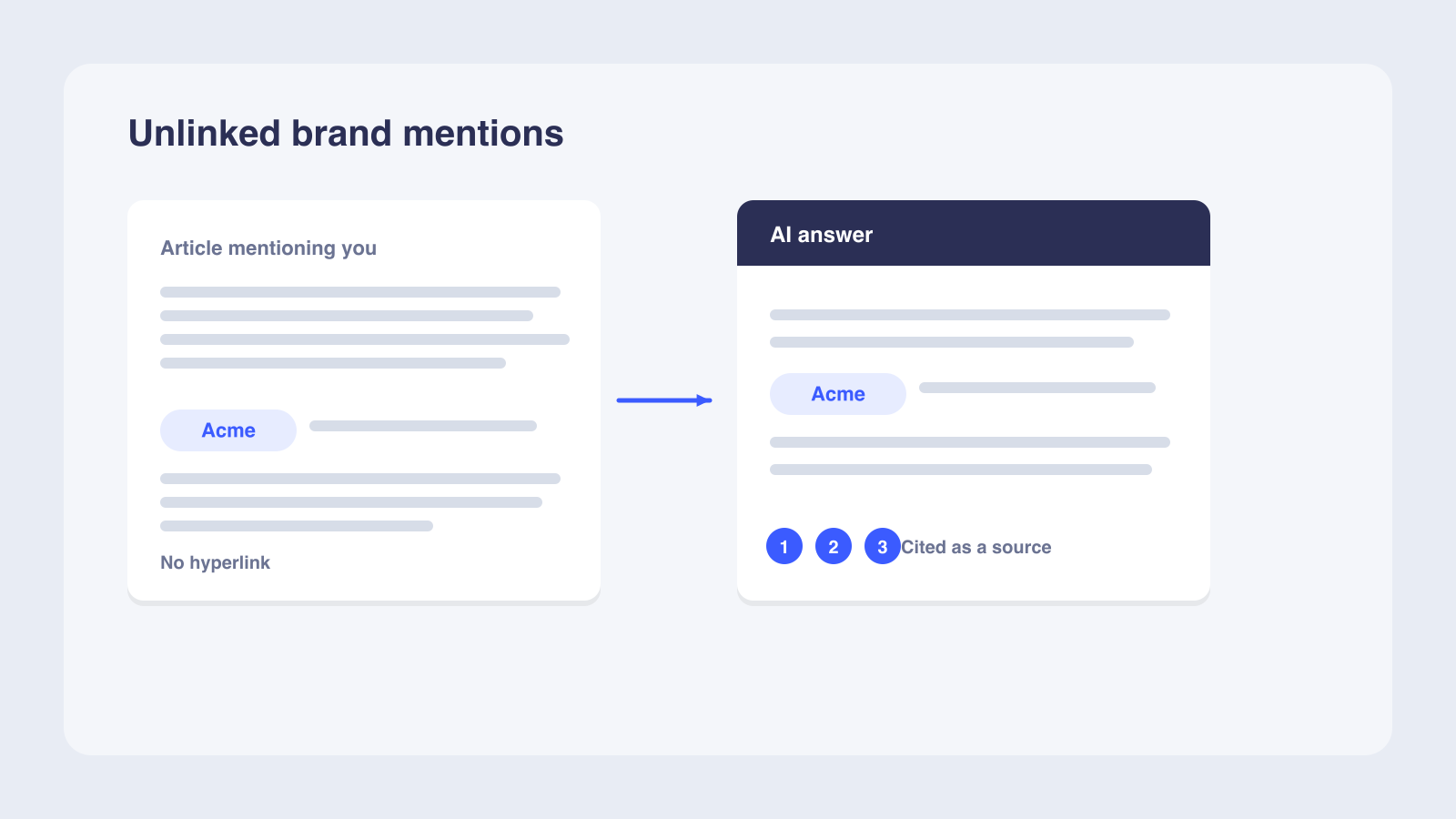
Unlinked brand mentions are references to your company on third-party pages with no hyperlink back to your site. For traditional Google rankings they carry no direct value, because they pass no PageRank. For AI search they matter a lot: answer engines like ChatGPT, Perplexity, Gemini, and Claude build entity authority from how often and how consistently your brand is named across trusted sources, so mentions can decide whether you get named in an answer even when they are not links. The practical move is to earn consistent mentions in the formats AI engines favor, listicles, comparisons, and reviews, request a followed link only when the site has strong authority, and keep your brand described the same way everywhere so engines treat you as one entity.
Unlinked brand mentions are references to your company on third-party pages without a hyperlink to your site. Are unlinked brand mentions valuable for SEO and AI search? For traditional Google rankings, the direct answer is no; they do not pass PageRank. For AI search visibility, the answer is yes: mentions are a strong signal for whether your brand gets named, and for that outcome they can matter more than links, because answer engines weigh entity recognition over link equity.
What counts as an unlinked brand mention?
The definition
The simplest test: if a page names your company, product, or domain but gives no clickable path to your site, it counts. As Google's John Mueller has noted, if there is no link to your pages, it is not really a link there. The distinction matters because traditional SEO and AI search treat these two signals very differently.
Where mentions appear
Unlinked mentions show up on industry publications, review sites, forum threads, podcast transcripts, and social media posts. Common examples include:
- A software reviewer names your product in a comparison roundup without linking to your homepage
- A G2 review lists your tool in a category list, even without a link to your pricing page
- Reddit threads discuss your software
- Podcast show notes spell out your company name
Mention versus citation in AI search
In AI search, a mention means the engine names your brand in its answer. A citation means it links to your page as a source. The two are separate events driven by different signals.
A brand can appear frequently in AI answers without any of its pages cited as a source, and vice versa. The mention-citation gap is real and observable across ChatGPT, Gemini, Perplexity, and Claude.
How do Google and AI assistants read unlinked mentions?
Google's position
Google does not use unlinked mentions for PageRank or link graph understanding. John Mueller has indicated that drawing context from plain-text mentions is tricky, so a mention without a link does not feed the link graph the way a backlink does.
How AI engines process mentions
Retrieval-enabled experiences in tools like ChatGPT, Perplexity, Gemini, and Claude can pull cited sources into answers at run time, while the underlying models are trained separately on large text corpora. Across both paths, the common behavior a marketer can observe is whether the brand gets named in an answer and whether a source page gets cited. One likely reason mentions carry weight is that training pipelines often strip HTML markup, so a plain-text mention and the anchor text of a link can look similar to the model. Either way, mention frequency and consistent context function as authority signals in ways links alone cannot replicate.
For a deeper look at how LLMs decide which brands to recommend, the mechanism is entity association, not link graph analysis.
Why entity consistency matters
Consistent brand naming across sources helps AI engines associate your brand with the right category in their understanding of the topic. When a buyer asks a relevant question, that entity association increases the chance your brand appears in the answer. The signal is entity recognition, not PageRank. The observable outcome is whether your brand is correctly categorized and mentioned when you test AI assistants with relevant questions.
Here is how the two signals compare across the channels you are optimizing for:
| Signal | Traditional Google SEO | AI search and answer engines |
|---|---|---|
| Unlinked brand mention | No direct ranking value; passes no PageRank | Builds entity authority; influences whether you are named |
| Followed backlink | Passes PageRank and link equity | Can earn a citation, but entity recognition still decides naming |
| What it mainly drives | Rankings and referral clicks | Whether your brand is named and cited in answers |
| How you earn it | Link building and digital PR | Consistent mentions across trusted third-party sources |
How do you find unlinked mentions and earn more?
Monitoring tools
To find existing unlinked mentions, use a brand-monitoring tool such as Google Alerts, Mention, or Brand24, or the brand-mention features inside Ahrefs and Semrush, which surface pages that name your brand without linking to you. For AI-specific tracking, track which pages AI engines cite for your prompt set and compare them to your traditional backlink profile, since the two often diverge.
Quick test
Search your brand name in ChatGPT and note what it gets wrong. If the model misclassifies your product, names a competitor instead, or omits you entirely, that gap points to where you need more third-party coverage. The test takes under a minute and tells you exactly where mention-building should focus.
Earning and reclaiming mentions
Prioritize outreach using the six factors Search Engine Land's guide recommends weighing: the site's authority and relevance, the placement and context of the mention, its traffic and conversion potential, content freshness, author relationship potential, and the page's own traffic and visibility. Recent mentions are usually easier to convert, but evergreen pages that keep earning traffic are worth pursuing too. Earn new coverage through digital PR and original data.
Target listicles, comparisons, and reviews, which are among the formats AI engines cite most often. Keep your brand description consistent across all listings so AI engines recognize your brand as a single entity.
When should you request a link versus let the mention stand?
The decision depends on which channel you are optimizing for. A followed link adds traditional SEO value; a bare mention adds AI entity authority. The two outcomes target different channels.
- Request a link when the mentioning site has high domain authority and the mention is recent. A followed link still adds traditional SEO value that a mention alone cannot.
- Let the mention stand when the goal is AI visibility. The mention itself signals entity authority to AI engines, and adding a link does not increase that signal.
- Keep cited pages current. AI engines like Perplexity favor recently updated pages, so refresh content and update last-modified dates after changes.
- Start with VisibleAuthority's 30-Day Visibility Sprint to map where your brand is missing in AI answers, deploy answer-first content, and measure before-and-after mention rates.
Frequently asked questions
Do unlinked brand mentions help SEO rankings?
Do unlinked brand mentions help with AI search?
Are brand mentions as good as backlinks?
How do I get my brand mentioned in AI answers?
Next steps
If your brand is missing from AI answers, the fastest way to find out is to test. The 30-Day Visibility Sprint maps where your brand appears and disappears across ChatGPT, Perplexity, Gemini, and Claude, deploys answer-first content, and measures before-and-after mention rates. You get a clear picture of what AI engines say about you today and what changes move the needle. Request a visibility audit to see where you stand across all four major AI models.
We'll run your category through the major models and map exactly where you appear, where competitors win, and what it takes to become the recommendation.