
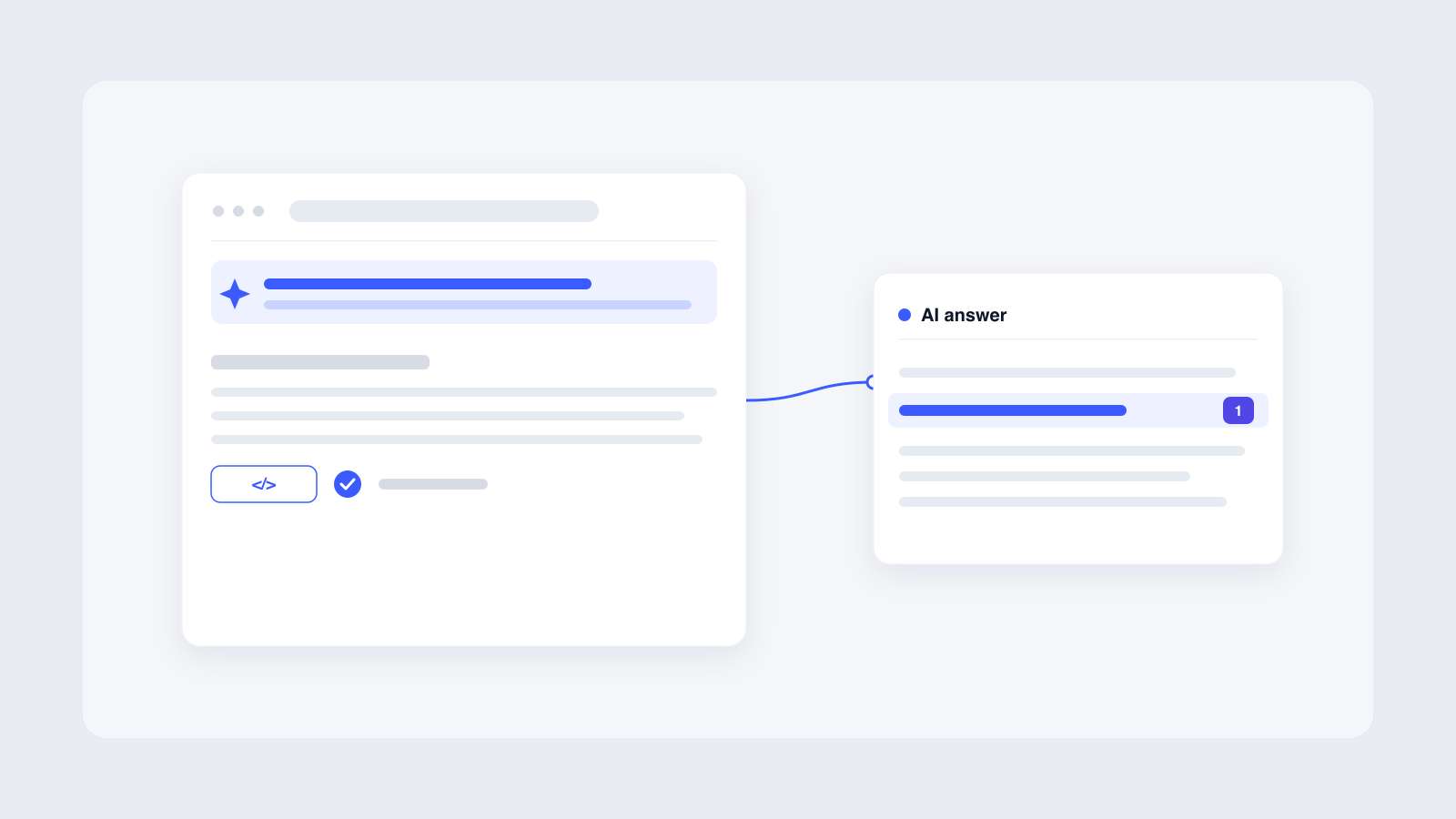
To optimize your website for AI search, make sure AI crawlers can reach your pages, lead every page with a direct answer in the first 150 to 200 words, structure content with clear headings and specific sourced statistics, add matching schema, build external validation on sites like G2 and Capterra, and track citations across ChatGPT, Perplexity, Gemini, and Claude. Traditional SEO stays the foundation, while GEO adds answer-first formatting, entity clarity, and multi-platform citation tracking on top.
AI search has disrupted the discovery layer. B2B buyers now ask ChatGPT, Perplexity, Gemini, and Claude which tool to buy, and the models synthesize answers from retrieved web content, citing a handful of sources. If your brand is not surfaced in those synthesized answers, you are absent from the model's selected response at the moment of decision. This guide answers the central question on every B2B SaaS founder's mind: How can I optimize my website for AI search? We walk through Generative Engine Optimization (GEO) and Answer Engine Optimization (AEO), the technical and content shifts required, and a practical checklist to earn citations across major AI platforms.
At VisibleAuthority, we specialize in Answer Engine Optimization for B2B SaaS companies with $10K to $200K MRR, AI tool startups, and sellers of high-ticket digital products. We help brands get named and recommended inside AI-generated answers from models like ChatGPT, Perplexity, Gemini, and Claude. The shift from traditional search rankings to AI recommendations is the core of what we do, and this guide distills our field-tested methodology into actionable steps you can apply today.
What Is AI Search and Generative Engine Optimization (GEO)?
AI search represents a fundamental shift from link-based results to synthesized conversational answers generated by Large Language Models (LLMs). Instead of presenting a list of blue links for users to click through, platforms like Google AI Overviews, ChatGPT, Perplexity, Claude, and Gemini retrieve relevant web content and compose a direct answer, citing a small number of sources.
Generative Engine Optimization (GEO) is the strategy for optimizing content to appear in those AI-generated answers. Answer Engine Optimization (AEO) is a complementary framework focused specifically on getting brands named and recommended inside AI responses. The terms are often used interchangeably because the underlying discipline is the same: earning citations and mentions within synthesized answers rather than competing for ranked positions.
The landscape in 2026 is fragmented across multiple platforms, each with its own retrieval architecture and citation behavior. Per a Semrush index analysis of 126 million US AI search prompts between January and April 2026 across ChatGPT, Gemini, Google AI Mode, and AI Overviews, ChatGPT cites an average of 15 sources per response while Gemini cites around 3. That gap means a mid-tier brand has a genuine route into ChatGPT's answers, while Gemini is closer to winner-takes-all. Understanding these platform differences is the foundation of any GEO strategy.
Why Optimize for AI Search? The Shift from SEO to GEO/AEO
Traditional SEO targets rankings and clicks. GEO and AEO target citations, mentions, and recommendations within synthesized answers. The distinction matters because in an AI answer, there is no list to choose from. The model has already selected its sources, and it typically names between three and fifteen. Brands that are not selected are absent from that particular answer, even if they rank well in traditional search results.
This shift has profound implications for B2B SaaS companies. A brand can be cited constantly across ChatGPT, Claude, and Perplexity while showing zero presence in Google Search Console. That is not a glitch; it is how the ecosystem now works. AI assistants build answers from different indexes and different signals than Google, so a top Google ranking is a weak predictor of whether AI will cite you.
Zero-click searches are rising as AI answers reduce traditional click-through rates, making citation visibility critical. When buyers ask an AI model which tool to use, they often get a complete answer without ever visiting a website. Being cited as a recommended option inside that answer is the new visibility win.
AI models also generate multiple concurrent related queries through a process called query fan-out, expanding the surface area for citations. This means a single buyer question can trigger several retrieval passes, each potentially surfacing different sources. Traditional SEO best practices remain relevant since Google's generative AI features are rooted in core Search ranking systems, but they are no longer sufficient on their own.
How AI Search Engines Work: Crawling, Indexing, and Answer Generation
Every major AI search engine works in two stages: retrieve a candidate set from the live web or an index, then select a small number of sources to ground and cite the answer. Optimizing only for stage one is the most common mistake, because stage one is where SEO habits transfer and stage two is where they do not. The selection step is far narrower than search results, and it is not consistent between engines.
The technical process behind this is called Retrieval-Augmented Generation (RAG). AI models retrieve relevant web pages from a search index, then synthesize answers from that content with citation links. Each platform retrieves content differently: Google AI Overviews uses Google's search index, ChatGPT uses OAI-SearchBot and Bing's index, Claude uses Brave Search, Perplexity uses its own proprietary index, and Gemini uses Google's search index.
The crawler ecosystem has expanded well beyond Googlebot and Bingbot. OpenAI, Anthropic, and Perplexity each operate multiple bots for different jobs. Search inclusion uses OAI-SearchBot, Claude-SearchBot, and PerplexityBot. User-requested retrieval uses ChatGPT-User, Claude-User, and Perplexity-User. Potential-training access uses GPTBot and ClaudeBot. Gemini grounding uses Google-Extended. Optimizing for one platform does not guarantee visibility on others due to these different retrieval architectures.
A critical finding from a study of more than 500 million fetches by Vercel and MERJ is that major AI crawlers pull raw HTML and do not execute JavaScript, while Googlebot and Gemini do render it. If your content depends on client-side rendering, AI assistants may see an empty page. Confirm access by reviewing server logs for AI crawler activity.
Technical Optimization for AI Search Bots
Technical readiness is the first layer of GEO. If AI crawlers cannot access and parse your pages, nothing else matters. Start by ensuring AI bots like GPTBot, OAI-SearchBot, and ClaudeBot are not blocked in your robots.txt file. Test access across robots.txt, meta robots directives, and firewall rules using server logs to confirm AI crawler access.
The llms.txt debate has generated noise, but the guidance is clear: Google explicitly states it does not use llms.txt files or special AI markup for Google Search or its generative AI features. Other AI platforms may benefit from clear content structures, but the practical recommendation is to focus on semantic HTML instead. Well-structured HTML with logical heading hierarchy does more for AI extractability than any file-based hack.
Structured data and Schema Markup help AI bots identify entities and content types. Implement FAQPage, Article, Organization, and Product schema using JSON-LD to give machines explicit labels for visible page content. Google says structured data can help it understand a page, while its AI-features guidance says no special schema is required for AI Overviews or AI Mode. Use the most specific type that matches your visible content.
XML sitemaps should be current and submitted to Google Search Console for efficient crawling and indexing. Site speed, mobile usability, and page experience remain ranking factors that carry over to AI search eligibility. Google requires that a page must be indexed and eligible to be shown with a snippet to appear in generative AI features. On JavaScript SEO, Google can process JavaScript content but warns it is generally more complex, so follow standard JS SEO best practices and ensure critical content renders in raw HTML.
Reducing duplicate content avoids wasting crawl budget on URLs that don't matter. AI crawlers strongly prefer fresh content. Per Seer Interactive's July 2026 follow-up study, 75% of cited pages were updated within the last year and 93% within the last three years. Keeping your content current signals relevance to both traditional and AI search systems.
Content Optimization for AI Extractability and Authority
Answer-first content is the core of Content GEO. Lead with clear, concise answers before expanding into detail. LLMs extract the most easily parseable information first, so a direct answer placed under the heading that states the reader's question gives both people and retrieval systems a self-contained passage. Support it with evidence, boundaries, and examples.
Logical heading hierarchy with H1, H2, and H3 tags helps AI models understand content structure. Descriptive, scannable headings make it easier for models to navigate your content and extract relevant passages. Topical depth and completeness build relevance and authority around key entities, so cover topics comprehensively rather than surface-level overviews.
E-E-A-T (Experience, Expertise, Authoritativeness, Trustworthiness) matters for AI citations. Google rewards unique, first-hand perspectives over commodity content that anyone could produce. Google's guidance is direct: create the content yourself based on what you know about the topic, and don't just recycle what others on the internet have already said. Adding specific, sourced statistics increases citation probability, as AI systems reference content with specific, sourced data more often than vague generalizations.
The Aggarwal et al. study tested presentation changes on sources already available to its generative-engine pipeline. It found that adding relevant citations, quotations, and statistics could improve source visibility, with gains of up to 40% across queries in that benchmark. The operational lesson is to publish claims that another system can verify. Name the source, date, sample, and scope beside the claim, then measure live retrieval and citation separately.
Building a strong knowledge graph around key entities requires consistent entity naming, structured data, and topical clustering. Our AI-Optimized Content System creates comparison, recommendation, and answer-first content that AI models use to cite and recommend your brand. It builds and tests those content structures for citation performance across major AI models, refining them based on live prompt testing rather than assumptions.
Building Trust and Citability for AI Search
External validation signals contribute directly to AI trust and citation preference. High-quality backlinks, brand mentions, and reviews all tell AI models that your brand is recognized and authoritative. Being present on review platforms and community forums where AI models look for third-party validation is essential.
Reviews on platforms like G2, Capterra, and Trustpilot significantly boost citation probability for product queries. Community platforms also play a role, though citation behavior is volatile. AI answers are non-deterministic, meaning the same prompt on the same engine can return different sources an hour apart, so building consistent external validation across multiple platforms creates a more reliable trust signal.
Audit which competitors get cited by asking AI platforms the same questions your audience would ask, then noting patterns. Factual accuracy, clear expertise demonstration, and consistent brand information across the web all build AI trust signals. Brand recognition and a strong online reputation increase the likelihood of being named and recommended in AI-generated answers.
Measuring and Monitoring Your AI Search Visibility
Google Search Console's Generative AI performance report tracks visibility in Google AI Overviews and Discover. For other platforms, use AI visibility trackers and manual prompt testing across ChatGPT, Perplexity, Claude, and Gemini to monitor brand mentions and citations. Google Search Console cannot see ChatGPT, Claude, Perplexity, or Copilot, so AI visibility needs its own measurement across three layers: crawl, citation, and recommendation.
Key metrics to track include citation frequency, brand mention rate, query coverage, and position within AI-generated answers. More specifically, four metrics matter: visibility (how often you appear across your prompt set), share of voice (your mentions as a percentage of the competitive set), citations (how often your domain is used as a source versus simply being named), and sentiment (how you are characterized). These move independently, and the gap between them is diagnostic.
AI search metrics are volatile. AI Overviews prevalence has fluctuated over time, requiring ongoing monitoring rather than one-time checks. A manual testing protocol involves picking ten prompts a real buyer would type, opening each engine in a logged-out or incognito window, and recording whether you are mentioned, which competitors are, and which domains get cited as sources. Log it in a spreadsheet with the date and the engine.
Our AI Visibility Testing Loop continuously tests AI prompts across models, tracks brand mentions, and refines content to improve AI recommendations. Sample weekly, judge monthly, and change one variable at a time. The loop closes when a content or citation change shows up as a sustained move in share of voice rather than a one-week spike.
Your AI Search Optimization Action Plan: A GEO Checklist
Work through each step in order to build a comprehensive GEO strategy.
- Audit AI visibility: Ask AI platforms questions your buyers ask and document where your brand appears or is missing.
- Technical setup: Verify robots.txt allows AI bots, submit XML sitemaps, and implement structured data (FAQPage, Article, Organization schema).
- Content audit: Identify commodity content and replace it with unique, expert-driven, answer-first content with sourced statistics.
- Entity optimization: Ensure consistent entity naming, build topical clusters, and strengthen knowledge graph connections.
- External validation: Build presence on G2, Capterra, Trustpilot, and relevant community platforms to boost citation probability.
- Measurement setup: Enable Generative AI performance reports in Search Console and establish a regular AI prompt testing routine.
- Iterate: Review performance data monthly, refine content based on citation patterns, and expand topical coverage.
For readers who want measurable AI mention improvements fast, our 30-Day Visibility Sprint is a structured engagement that delivers before-and-after results in AI visibility through mapping, content deployment, and optimization. It combines our AI Visibility Mapping, AI-Optimized Content System, and AI Visibility Testing Loop into a single focused sprint designed for B2B SaaS companies and AI tool startups.
Common questions about AI search optimization
Do traditional SEO best practices still matter for AI search?
Do I need an llms.txt file to appear in AI search results?
Can my content be cited by AI even if it doesn't rank on page one?
Is optimizing for one AI platform enough?
How often should I update content for AI search?
We'll run your category through the major models and map exactly where you appear, where competitors win, and what it takes to become the recommendation.