
Does schema markup help a website get cited in AI search answers? The honest, evidence-backed answer is: not directly. Adding JSON-LD, Microdata, or RDFa to your pages will not trigger AI models like ChatGPT, Perplexity, or Google AI Overviews to cite you more often. The common assumption that 'add schema, get cited by AI' is oversimplified, and the published evidence does not support it.
Executive Summary: The Direct vs. Indirect Role of Schema in AI Citations
This article examines three pillars of evidence to separate fact from marketing myth. First, Google's official position on structured data and generative AI search. Second, the largest controlled study to date, published by Ahrefs in May 2026, which tracked nearly 6,000 pages. Third, the technical mechanisms that explain why AI models read visible HTML but ignore embedded markup. We also draw on observations from our own AI Visibility Testing Loop, where continuous prompt testing across multiple AI models has confirmed the same pattern: AI systems extract the words a human reader sees, not the machine-readable payload behind them.
Schema markup remains a best practice for overall SEO, entity recognition, and rich-result eligibility. It is not, however, a direct citation lever for AI search answers. The rest of this article lays out the evidence, explains the technical reasoning, and identifies the strategies that actually drive AI citations in Generative Engine Optimization today.
Google's Official Position on Schema and AI Search
Google Search Central published its guidance on generative AI features in May 2026, and the message is unambiguous. The documentation states: "You don't need to create new machine readable files, AI text files, or markup to appear in these features. There's also no special schema.org structured data that you need to add." That quote comes straight from Google's Search Central documentation, and it aligns with everything Google has said about AI Overviews eligibility.
Google also addressed llms.txt, the proposed AI equivalent of robots.txt. Their position: creating one "will neither harm nor help your site's visibility or rankings in Google Search." The file is ignored entirely. Google frames schema as a tool for understanding content and qualifying for rich results, not as an AI citation mechanism.
At a mid-2025 Search Live event, Google engineer Gary Illyes told attendees to "simply use normal SEO practices" for AI Overviews, as reported by Search Engine Roundtable. No GEO, no LLMO, no special markup required. Eligibility for AI Overviews comes down to being indexed and snippet-eligible, which is standard SEO.
Bing takes a different stance. Microsoft confirmed in March 2025 that Copilot and Bing Chat use schema.org markup to understand page content, making it the most schema-friendly AI platform. OpenAI and Anthropic, however, have not published documentation on how their crawlers handle structured data. Any ChatGPT-specific or Claude-specific schema claims you see in vendor materials are unverifiable.
Empirical Evidence: What Studies Show About Schema and AI Citations
The Ahrefs controlled study, published May 11, 2026 by Louise Linehan, is the cleanest causal test to date. It tracked 1,885 pages that added JSON-LD schema between August 2025 and March 2026, matched against approximately 4,000 control pages that never added schema. The results were clear, and they were not what the AEO industry expected.
- Google AI Overviews citations: -4.6% (statistically significant, roughly 1 in 2,500 odds of chance)
- Google AI Mode citations: +2.4% (not statistically significant, indistinguishable from zero)
- ChatGPT citations: +2.2% (not statistically significant, indistinguishable from zero)
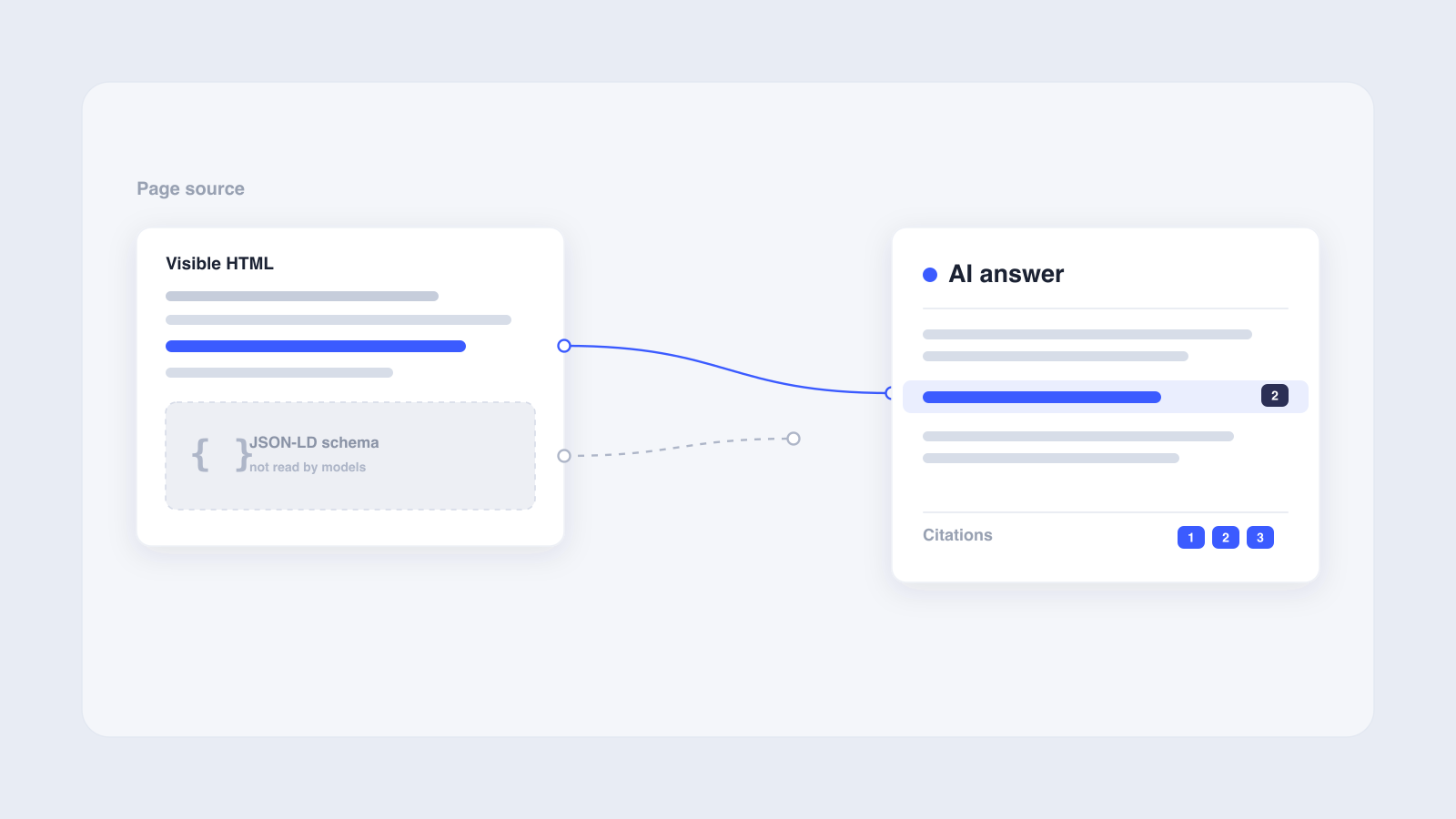
The study's summary was blunt: "not much really changed." More importantly, the research found that AI systems extracted a page's visible HTML and ignored JSON-LD, Microdata, and RDFa when deciding what to cite. Models read the words on the page, the same text a human sees, not the machine-readable markup payload. This finding is consistent with the Ahrefs study's technical analysis and with our own observations from the AI Visibility Testing Loop.
The searchVIU test reinforced this conclusion. It confirmed that ChatGPT, Claude, Perplexity, Gemini, and Google AI Mode do not read JSON-LD during live retrieval. The markup you embed in a script tag is invisible to the model's reading layer.
One smaller experiment pointed in a different direction. Molly Nogami and Benjamin Tannenbaum published a controlled test in September 2025 on Search Engine Land that built three nearly identical single-page sites: one with well-implemented schema, one with poorly implemented schema, and one with no schema.
Only the well-implemented schema page appeared in a Google AI Overview. It also ranked for six keywords in traditional search, reaching as high as Position 3. The poorly implemented schema page ranked for 10 keywords but generated zero AI Overview appearances. The no-schema page was crawled but never indexed, eliminating it from both rankings and AI Overviews entirely.
The authors were careful with their language. They wrote: "We don't consider these results to be absolute proof that well-implemented schema plays a role in AI Overview presence." They acknowledged the tiny sample size and planned follow-up testing, including swapping schema between pages. Earlier work by Nogami analyzing 100 healthcare sites found a slight correlation between schema use and AI Overview visibility, but it was not statistically significant.
A December 2024 Search/Atlas study found no correlation between schema volume and AI citation frequency. Taken together, the evidence is mixed but leans clearly one way: one small controlled test hints at a link between schema quality and AI Overview inclusion; larger studies find no link; no platform has published quantifying data showing schema drives citations.
How Schema Markup Influences AI Understanding and Why It Still Matters
Schema markup does not directly drive AI citations, but it plays a real indirect role in how search engines and AI systems comprehend your content. Three technical mechanisms explain this relationship.
First, entity disambiguation. JSON-LD helps search engines build entity relationships in knowledge graphs by clearly identifying what a page is about, who wrote it, and how it connects to other entities. When Google understands that your page refers to a specific product, organization, or person, that clarity can indirectly influence how AI models interpret your brand or topic.
Second, LLM tokenization and Retrieval-Augmented Generation. AI models process visible text tokens during retrieval. They read the rendered HTML, not the structured data fields embedded in script tags. Schema is invisible to the model's reading layer, which is why the Ahrefs study found no meaningful citation uplift from adding JSON-LD.
Third, structured data formats like FAQPage and Article schema. These can help AI extract information more easily in theory, but Google removed FAQ rich results entirely on May 7, 2026, ending all eligibility. Google had already narrowed FAQ rich-result eligibility to government and health sites in August 2023. Nine schema types have been deprecated since 2023, including two that most AEO guides still list as essential.
Schema is still crucial for conventional rich results (where still applicable), improved crawlability, enhanced entity recognition, and better user experiences. It remains a foundational element of technical SEO for AI search visibility. Ship the handful of types your content actually is, then stop. Do not expect markup alone to earn you AI citations.
Strategies That Actually Drive AI Search Citations (GEO)
If schema does not directly drive AI citations, what does? The evidence points to a different set of levers entirely. The SIGIR '26 paper "What Gets Cited: Competitive GEO in AI Answer Engines" identified 18 citation factors spanning content match, completeness, trustworthiness, readability, competitive standing, and freshness. Structured data format is absent from all 18 factors.
A 2026 preprint study found that pages with concrete, attribute-rich data (prices, ratings, specifications) outperformed pages with only generic page labels, mainly on product and review pages. This aligns with the AEO Content data showing that pages with no schema but ranking in positions one through three had a 61% AI Overview inclusion rate, compared to just 9% for schema-complete pages ranking outside the top three. Pages with both complete schema and top-three ranking reached 65%.
The gap between 61% and 65% is the entire contribution schema makes to AI Overview inclusion when you already rank well. Four percentage points. Meanwhile, the gap between ranking in the top three and not is 52 percentage points. Organic ranking position dwarfs schema as a citation driver.
Cyrus Shepard's May 2026 meta-analysis, described as the most rigorous public attempt to weight AI citation factors by strength of evidence, puts the real levers at the top: URL accessibility, search rank, fan-out rank, preview control, and query-answer match. Schema does not appear among them. E-E-A-T (Experience, Expertise, Authoritativeness, Trustworthiness) serves as the critical framework for AI citation worthiness.
Practical priorities: lead with direct answers to the questions buyers ask AI models. Build topical authority for AI search through related entity clusters, which correlated with a 14 percentage point lift in AI Overview inclusion. Earn brand mentions across trusted sources, because off-page mentions track AI visibility far better than markup does. Schema plays a supporting role within this broader strategy, not a leading one.
This is exactly why our AI-Optimized Content System focuses on creating comparison, recommendation, and answer-first content that AI models actually cite, rather than markup tweaks. The content is the signal. The markup is scaffolding.
Platform-Specific Considerations: Google AI Overviews vs. Other LLMs
Different AI search environments interact with schema markup in different ways, and understanding these distinctions matters when you allocate optimization effort.
Google AI Overviews are deeply integrated with Google's search infrastructure, which processes schema for rich results. The Ahrefs study, however, showed a slight negative correlation with schema addition and AI Overview citations (-4.6%, statistically significant). Google's own guidance confirms no special schema is needed.
Bing and Copilot represent the most schema-friendly AI platform. Microsoft confirmed in March 2025 that Copilot and Bing Chat use schema.org markup to understand page content. This does not guarantee citations, but it makes Bing's approach more receptive to structured data than Google's.
ChatGPT showed no significant impact from schema addition in the Ahrefs study (+2.2%, not significant). OpenAI has not published documentation on how its crawlers handle structured data. Perplexity relies heavily on real-time web retrieval and visible content extraction; searchVIU testing confirms it does not read JSON-LD during live retrieval. Claude and Gemini also have undocumented schema handling, so treat any platform-specific claims as unverifiable.
The recommendation is platform-agnostic: optimize visible content first, then layer schema as a supporting signal. If you want to improve brand visibility on ChatGPT, Gemini, and Perplexity, invest in answer-first content and brand mentions, not markup payloads. The models that matter most to B2B buyers read what humans read.
Frequently Asked Questions
Is schema markup required for Google AI Overviews?
Does adding JSON-LD schema increase ChatGPT citations?
Does Bing Copilot use schema markup for AI answers?
Should I use llms.txt to improve AI search visibility?
Should I still implement schema markup in 2026?
- Schema markup does not directly drive AI citations. The largest controlled study found no significant uplift in ChatGPT or Google AI Mode citations from adding JSON-LD.
- Google explicitly states no special schema.org structured data is needed for generative AI search. Eligibility comes down to being indexed and snippet-eligible.
- AI models read visible HTML text, not embedded markup. The words a human sees are the words a model cites.
- Organic ranking position is the dominant citation driver. Top-three-ranked pages with no schema had a 61% AI Overview inclusion rate versus 9% for schema-complete pages outside the top three.
- Schema remains a best practice for entity disambiguation, crawlability, and rich-result eligibility. Keep it, but do not bet your AI visibility strategy on it.
Actionable Conclusion for SEOs and B2B Marketers
The evidence is clear: schema is a best practice for overall SEO and entity understanding, but it is not a direct citation lever for AI search answers. Do not remove existing structured data. Continue implementing it correctly for its traditional purposes. But do not expect markup to trigger AI citations, and do not allocate budget to schema optimization as an AI visibility strategy.
Here is the action hierarchy we recommend. First, prioritize high-quality, answer-focused visible content that directly addresses the questions your buyers ask AI models. Second, build E-E-A-T signals through expertise, authoritativeness, and trustworthiness. Third, implement schema correctly as a supporting practice, not a primary lever. Fourth, test your AI visibility across models regularly to measure what actually moves the needle.
If you want to understand why AI models recommend competitors instead of your brand, the answer is rarely missing schema. It is usually missing content depth, brand mentions, and answer-first structure. Our approach to getting cited by AI search engines starts with what models actually read, not what they ignore.
As AI search evolves, the gap between structured data and visible content quality will widen. Answer-first content is becoming the dominant citation factor, and the brands that invest there will be the ones AI models name when buyers ask. Our 30-Day Visibility Sprint delivers measurable before-and-after results in AI mention rates through content deployment and optimization, not schema tweaks. If you are ready to see where your brand stands across AI models today, start with our AI Visibility Mapping to identify exactly where you are missing in AI-generated answers.
We'll run your category through the major models and map exactly where you appear, where competitors win, and what it takes to become the recommendation.