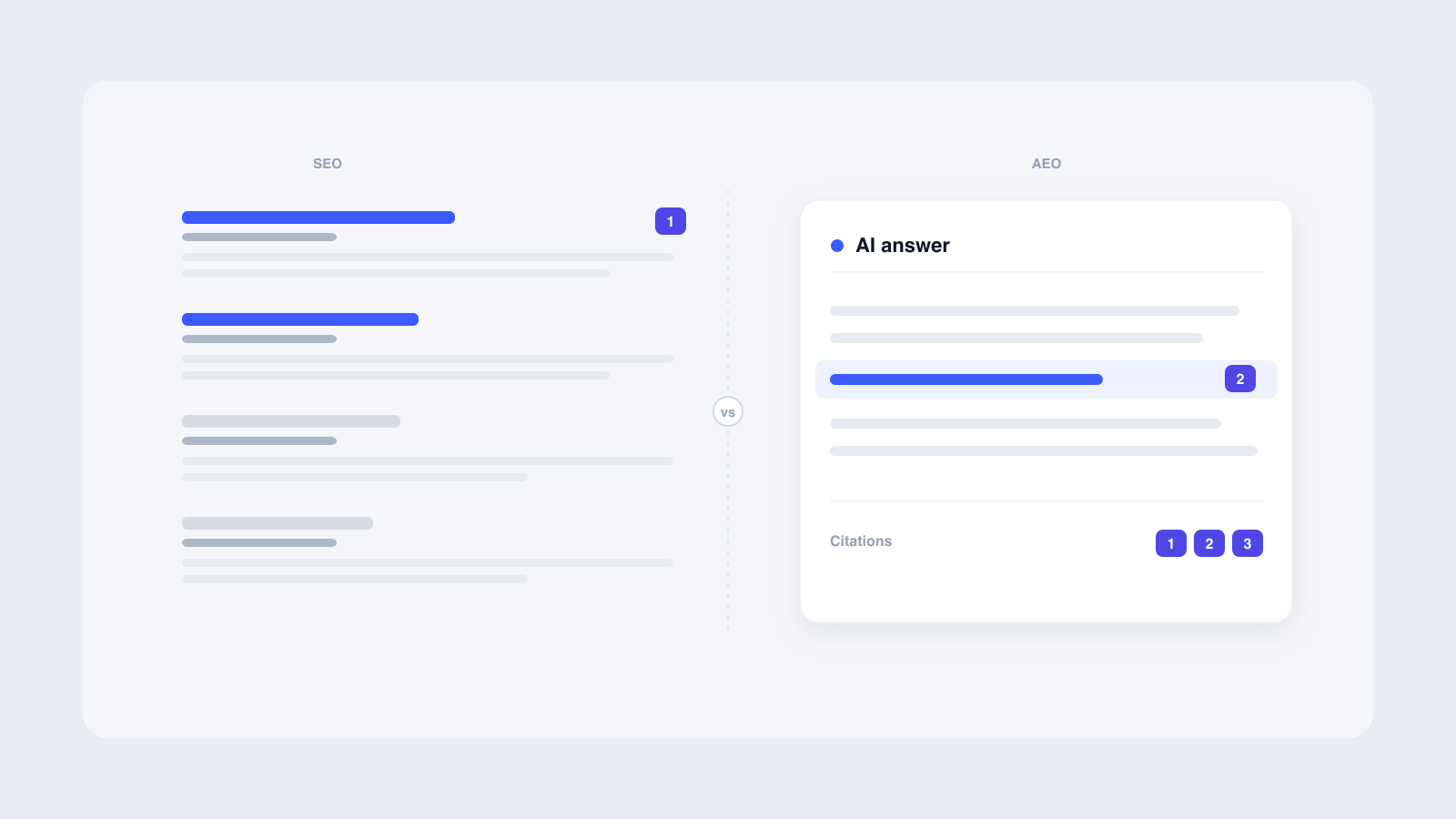
AEO and SEO share a foundation but optimize for different scoreboards. SEO earns rankings and clicks on search result pages, while Answer Engine Optimization earns citations, mentions, and recommendations inside AI-generated answers from ChatGPT, Perplexity, Gemini, and Claude. They overlap on crawlability, quality content, and links, but AEO adds answer-first formatting, brand authority, and citation tracking. Most B2B brands need both: SEO for traffic and the crawlable foundation, AEO for visibility in the answers buyers now read first.
Answer Engine Optimization (AEO) and traditional Search Engine Optimization (SEO) share a foundation but compete on different scoreboards. One measures rankings and traffic; the other measures citations and brand mentions. AEO gets your content quoted inside AI-generated answers, while SEO earns clicks from search result pages. The two disciplines overlap, but they reward different optimization choices.
The search landscape has shifted fundamentally. Buyers now ask ChatGPT, Perplexity, and Gemini for tool recommendations instead of Googling and clicking through to vendor sites. According to SparkToro data, 68% of Google searches ended without a click in early 2026. Position-one CTR for keywords with AI Overviews dropped from 7.3% to 1.6% (Ahrefs, comparing Dec 2023 vs Dec 2025). For comparison, informational keywords without an AI Overview saw CTR decline from 7.6% to 3.9% over the same period.
The traditional SEO playbook of ranking high and earning clicks is no longer the only path buyers take to discover and evaluate B2B tools. This guide answers a practical question: How is Answer Engine Optimization (AEO) different from traditional SEO? We break down the goals, metrics, content formats, and timelines that separate the two, and explain why most B2B brands need both.
What is Traditional SEO?
Traditional Search Engine Optimization (SEO) is the practice of improving your website's visibility in organic search results on engines like Google and Bing. The primary goal is to rank high for target keywords so users click through to your pages.
Core components include on-page SEO (keyword optimization, title tags, meta descriptions), off-page SEO (backlinks, brand mentions, PR), and technical SEO (site speed, crawlability, Core Web Vitals). Success is measured through rankings, organic traffic, click-through rates, and conversions attributed to search.
SEO works on a straightforward principle. Search engines crawl and index pages, then rank them based on relevance and authority signals. You optimize for keywords, build backlinks, and earn your way up the results page so users click your link.
What is Answer Engine Optimization (AEO)?
Answer Engine Optimization (AEO) is a strategy that enhances brand visibility by optimizing content for AI-generated answers across platforms like ChatGPT, Perplexity, Gemini, and Claude. Instead of earning a click, AEO aims to get your brand named, cited, and recommended inside synthesized AI responses.
A closely related discipline, Generative Engine Optimization (GEO), focuses specifically on how generative models assemble and present answers. For a deeper dive on AEO fundamentals, see our complete AEO guide.
When a user types a query into an AI answer engine, behavior varies by platform and mode. In retrieval-enabled modes, such as Perplexity's default search or ChatGPT with web browsing enabled, the model retrieves information from multiple web pages, synthesizes a single response, and provides citations to sources. In base-model mode, without web access, the model draws from training data and may not cite sources at all. Citation behavior also differs across ChatGPT, Perplexity, Gemini, and Claude, with each platform presenting sources in different formats and with varying frequency. Large Language Models use Retrieval-Augmented Generation (RAG) to crawl the web in real-time and answer questions directly when retrieval is enabled.
As Similarweb notes, a page can rank first on Google and still never appear in an AI-generated response, and the reverse happens too. This means optimizing for answer density, entity relationships, and citation-worthiness. AEO rewards content that AI models can easily understand, recombine, and present as a direct answer rather than content built purely for keyword relevance.
Key Differences: AEO vs. Traditional SEO
The core difference comes down to what you optimize for. SEO earns clicks from a list of links, while AEO earns citations inside synthesized AI answers. Here is how they compare across six dimensions.
| Dimension | Traditional SEO | Answer Engine Optimization (AEO) |
|---|---|---|
| Goal | Rank pages to earn traffic and clicks | Get content cited and recommended inside AI-generated answers |
| Where Results Appear | Search engine results pages (SERPs) | AI-generated responses (AI Overviews, ChatGPT, Perplexity, Gemini, Claude) |
| Success Metric | Rankings, organic traffic, click-through rate | Citation rate, brand mention rate, share of voice |
| Content Format | Keyword-optimized long-form pages | Answer-first content with structured data, FAQ blocks, comparison tables |
| How to Measure | Search Console, rank trackers, analytics | Run prompts across AI models, log brand mentions and citations |
| Timeline | 3-12 months for meaningful ranking movement | 2-4 weeks (Perplexity), 4-8 weeks (Gemini), 6-12 months (ChatGPT base model update cycle) |
Consider a concrete example. A buyer asks ChatGPT, "What's the best CRM for a B2B SaaS company under $50K MRR?" Traditional SEO would try to rank a blog post for that keyword. AEO works to increase the probability that ChatGPT names and recommends your brand in its response, measured by brand mention rate across a defined set of buyer prompts, even if the user never visits your website.
The Interplay: How SEO and AEO Work Together
AEO does not replace SEO. It builds on top of it. However, the commonly cited "80% overlap" figure is a single-source claim contradicted by more rigorous research. Ethan Smith, CEO of Graphite, estimates roughly 60-70% of tactics overlap between the two disciplines, while Josh Blyskal's 1,311-page study found that traditional SEO metrics explain only 4-7% of citation variance in AI answers. Most answer engines retrieve from search indexes, so your pages need to be crawlable and indexed before they can appear in AI-generated answers.
Both require keywords, relevance, backlinks, and good content practices. AEO adds brand authority, citation quality, sentiment, and PR from authoritative sources, factors that AI engines like ChatGPT weight more heavily when assembling answers.
Further research reinforces the gap. Blyskal's data showed that 79.2% of Claude citations came from Brave's top 10 results, confirming that SEO and AEO overlap but are far from identical. Separately, Ahrefs Brand Radar found only 8% overlap between ChatGPT citations and Google top-10 results, further evidence that ranking well on Google does not translate to AI citations.
In order to be able to rank in those answer engines, we need to also consider brand strength and authority, citations, quality of content, sentiment. PR from authoritative sources is really going to become more important.
Strong technical SEO foundations support AEO success. If your site is slow, uncrawlable, or poorly structured, AI models struggle to extract and cite your content. Learn more about technical SEO for AI search visibility to strengthen your technical foundation and reduce crawlability and extraction barriers.
Essential Concepts for AEO Success
Four concepts drive AEO performance. Each one makes your content easier for AI models to find, understand, and cite.
Structured data (Schema.org): AI platforms favor structured data because it is already organized and machine-readable. Use JSON-LD FAQ and HowTo schema, semantic HTML headings, and consistent entity markup for your brand, products, and locations.
E-E-A-T (Experience, Expertise, Authoritativeness, Trustworthiness): Traditional SEO uses author bios and external validation. AEO requires expertise embedded in the material itself, so write like someone who has done the work, not summarized it. Make specific, data-backed claims AI can reference with confidence.
Entity authority and topical authority: Define terms, show relationships between concepts, and build deep coverage of your topic area. Building topical authority for AI search helps models connect your brand to the right concepts.
Answer-first content format: Lead with a direct 1-2 sentence answer, then expand with detail. Use FAQ blocks, comparison tables, and concise factual paragraphs. For specific tactics, see how to get your website cited by ChatGPT and other AI search engines.
Does AEO Replace Traditional SEO?
No. AEO and SEO are complementary disciplines that serve different parts of the buyer journey. SEO remains vital for brand visibility, long-form content, and specific user journeys where buyers want to browse and compare on their own. For more on this, read about GEO vs SEO differences and whether you need both.
AEO captures the growing share of buyers who skip the results page entirely and go straight to AI for recommendations. The two work best as a unified strategy: SEO makes your pages findable and crawlable, while AEO increases the rate at which AI models name and cite your brand when synthesizing answers.
For B2B SaaS companies, treating them as separate, siloed efforts creates gaps. Your SEO team may be ranking well but missing AI citations entirely. Your AEO efforts need the crawlability and authority that SEO builds, so the two disciplines reinforce each other.
Implementing a Unified Hybrid Search Strategy
A practical hybrid strategy integrates AEO principles into existing SEO efforts without duplicating work. Here is how to approach it in four steps.
Audit your current state. Check where your brand appears and does not appear in AI-generated answers across ChatGPT, Perplexity, Gemini, and Claude. Run real prompts your buyers would use and log the results as your baseline. The right AI search tracking tools can help systematize this process.
Reformat high-priority content. Take your best-ranking pages and add answer-first structure with FAQ blocks, comparison tables, and JSON-LD schema. Make claims specific and verifiable so AI models cite your content with confidence.
Track both scoreboards. Continue monitoring rankings, traffic, and CTR through traditional SEO tools. Add AEO measurement by running prompts across AI models and logging citation rate, brand mention rate, and share of voice versus competitors. Learn more about measuring brand visibility in AI search.
Set a refresh cycle. AI models update their training and retrieval continuously, so what gets cited today may not get cited next month. Build a testing loop that re-runs prompts and refines content based on what changes.
The Evolution of Search: From Keywords to Answers
To understand why both disciplines matter, it helps to look at how search itself has evolved. Search has moved through three distinct phases. First, keyword matching: early search engines matched query strings to page content. Second, intent understanding: Google's algorithm evolved to interpret search intent, context, and entity relationships. Third, answer synthesis: AI models now retrieve, combine, and generate direct answers from multiple sources.
This shift changes what visibility means. For 15 years, visibility meant ranking in the top 10 results. Today, visibility also means being named when a buyer asks ChatGPT or Perplexity for a recommendation. A page can rank first on Google and still never appear in an AI-generated response, and the reverse also happens.
For B2B SaaS companies, the stakes are concrete. Ahrefs found that only 0.5% of their website traffic came from AI search, but it resulted in over 12% of signups at a conversion rate 23 times higher than their normal average. AI search leads are highly qualified. If your brand is not named when buyers ask AI for recommendations, you are losing deals you may not even know about.
Conclusion
The search landscape has split. Traditional SEO still drives traffic and builds the foundation AI models rely on, while AEO captures the growing share of buyers who go straight to AI for recommendations and never click a single link. For B2B SaaS companies between $10K and $200K MRR, the question is not whether to choose one over the other. The question is whether you can afford to ignore AI visibility while competitors get cited in the answers your buyers see. If you want to understand why ChatGPT recommends competitors, the answer often comes down to who optimized for AI citations first.
At VisibleAuthority, we specialize in Answer Engine Optimization for B2B SaaS companies and AI tool startups. Our AI Visibility Mapping analyzes buyer queries across ChatGPT, Perplexity, Gemini, and Claude to identify where your brand is missing in AI-generated answers. We build AI-Optimized Content Systems that create comparison, recommendation, and answer-first content AI models use to cite and recommend your brand.
Our AI Visibility Testing Loop continuously tests prompts across models and refines content to improve recommendations. And our 30-Day Visibility Sprint delivers measurable improvements in AI mention rates within 30 days through mapping, content deployment, and optimization. Ready to improve your brand visibility on ChatGPT, Gemini, and Perplexity?
Book Your Free AI Visibility Audit
Book your free AI visibility audit today. We will run your brand through real buyer prompts across ChatGPT, Perplexity, Gemini, and Claude, then show you exactly where you are missing and what it will take to get cited.
About the author: The VisibleAuthority team helps B2B SaaS companies and AI tool startups win visibility inside AI-generated answers from ChatGPT, Perplexity, Gemini, and Claude. We focus on measurable AI-driven outcomes, not vanity metrics.
- AEO and SEO share a foundation but optimize for different outcomes: clicks versus citations
- 68% of Google searches end without a click; position-one CTR for keywords with AI Overviews dropped from 7.3% to 1.6% (Ahrefs, Dec 2023 vs Dec 2025)
- Ethan Smith estimates ~60-70% tactic overlap between SEO and AEO, while Blyskal's 1,311-page study found traditional SEO metrics explain only 4-7% of citation variance
- Perplexity citations typically appear in 2-4 weeks, Gemini in 4-8 weeks; traditional SEO takes 3-12 months for meaningful ranking movement
- B2B SaaS brands need both: SEO for crawlability and traffic, AEO for AI citations and recommendations
FAQ: AEO vs SEO
Does AEO replace SEO?
How long does it take to see AEO results compared to SEO?
How do I measure AEO success?
What content format works best for AEO?
Should AEO have its own budget separate from SEO?
We'll run your category through the major models and map exactly where you appear, where competitors win, and what it takes to become the recommendation.