
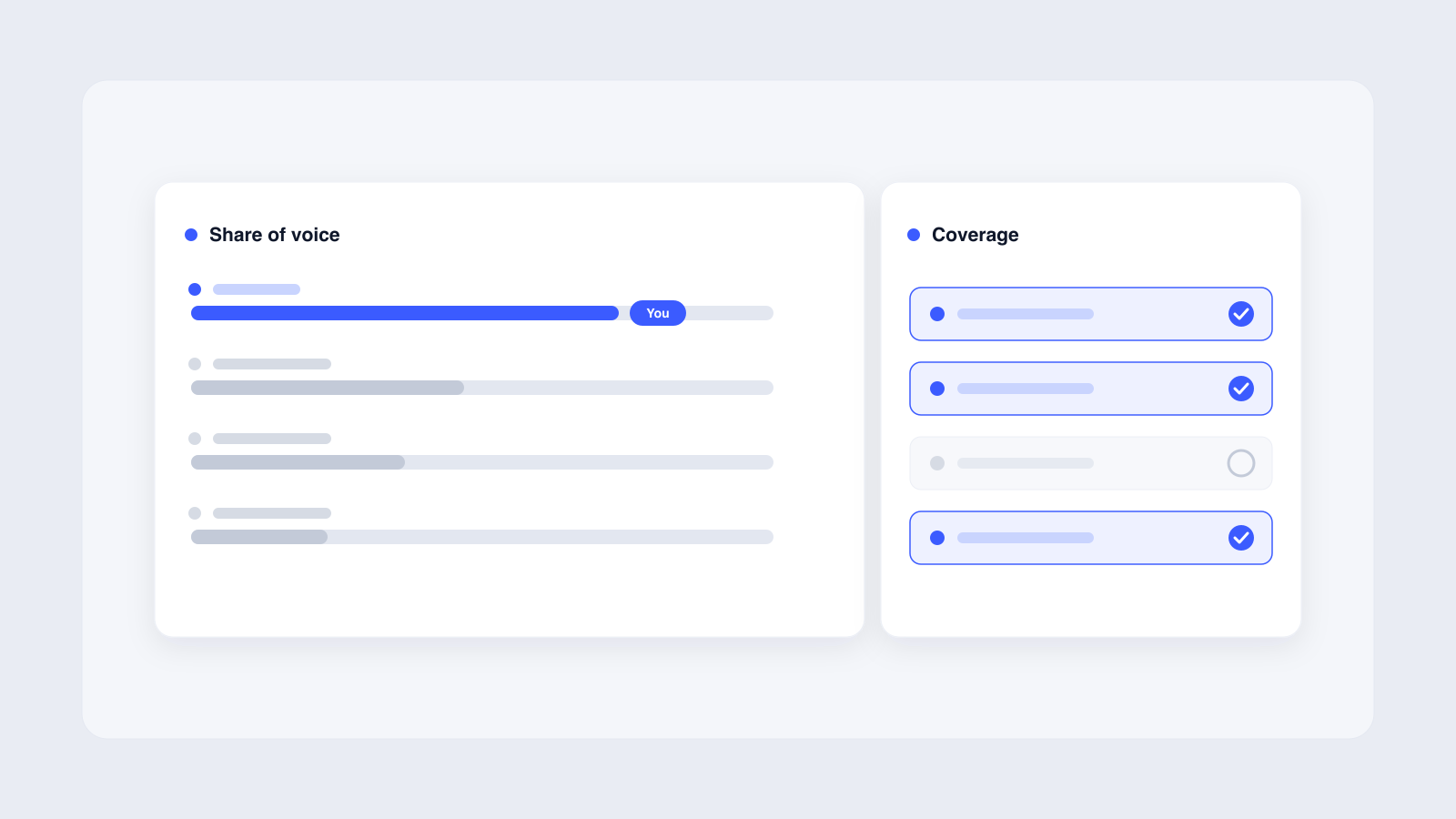
AI brand visibility tracking measures how often, how prominently, and how favorably AI engines like ChatGPT, Perplexity, Gemini, and Claude mention or cite your brand. The metrics that matter are share of voice, citation rate, ghost citation rate, sentiment, and platform coverage. No two tools measure the same way, so the same brand can score 3 percent in one and 18 percent in another. Remember that tracking only diagnoses the gap. To actually earn AI recommendations you also need to optimize the content the models pull from.
Your buyers are asking ChatGPT and Perplexity for category recommendations right now. If your brand doesn't appear, you've lost the deal before a prospect ever lands on your site. AI brand visibility tracking tells you where you stand, but here's the catch most vendors won't mention: tracking is diagnosis, not treatment.
This guide breaks down what to measure, which tools fit your budget, and how to close the gap between knowing you're invisible and actually earning AI recommendations.
What Are AI Brand Visibility Trackers?
AI brand visibility trackers monitor how often, how prominently, and how favorably AI engines mention or cite your brand across platforms like ChatGPT, Perplexity, Gemini, and Claude. Unlike traditional SEO, where you fight for position on a results page, AI visibility is binary. Your brand either appears in the answer or it doesn't. There is no position seven.
The most critical distinction is between a mention and a citation. A mention means your brand name appears in the response. A citation means the AI links to your content as a source. Mentions are frequent but hard to control. Citations are rarer, more volatile, and more directly tied to your content.
There's a third category: ghost citations. These are links to your site that never name your brand. Your content feeds the AI's answer, but the user sees a link, not your brand. According to Superlines' 2026 study, 73% of AI brand mentions are ghost citations.
You'll encounter overlapping terms: AI visibility tool, AI brand monitoring, LLM monitoring, and Answer Engine Optimization (AEO). The 2026 2X AI Visibility Index analyzed 70 B2B companies and found 96% invisible during early-stage AI-driven discovery, with only 4.3% maintaining a healthy funnel.
Why Traditional SEO Tools Fall Short in AI Search
Your rank tracker can't see inside a ChatGPT answer. A 2025 Moz analysis of 40,000 queries found 88% of Google AI Mode citations come from outside the organic top 10. The correlation between domain authority and AI citations is weak at +0.18, while page-level structural factors correlate at +0.71, per Digital Applied's 2026 analysis of 500 SaaS sites.
AI answers shift with every query. SparkToro tested 2,961 runs with 600 people, finding fewer than 1 in 1,000 gave the same brand list. Any tool claiming AI rankings is selling fiction.
B2B SaaS prospects increasingly ask AI engines for vendor shortlists and comparisons. If your tracking stack can't see those conversations, you can't optimize for them. Google AI Overviews now appear in 25.11% of searches, per Conductor's analysis of 21.9 million queries, nearly double March 2025's 13.14%.
Key Metrics Every AI Visibility Tracker Should Measure
- Share of Voice: percentage of relevant AI queries where your brand appears compared to competitors.
- Citation Rate: how often your URLs appear in AI source lists versus competitors. Rarer and more valuable than mentions.
- Ghost Citation Rate: links to your content that never name your brand. At 73% of AI brand mentions, this reveals whether your content feeds answers without building recognition.
- Sentiment: whether AI engines describe your brand favorably or negatively. Critical in contested B2B SaaS markets.
- Platform Coverage: which AI engines mention you. Rates and sentiment vary dramatically between ChatGPT, Gemini, Perplexity, and Claude.
A tool that reports only visibility frequency, without breaking down mentions versus citations versus ghost citations, gives you an incomplete picture. Only 28% of brands get both name mentions and content cited. If your tracker catches only name mentions, you're missing most of your AI brand presence.
Comparing the Top AI Brand Visibility Trackers in 2026
No two tools measure the same thing. Query universe construction, surface coverage, and mention-versus-citation definitions all differ, so the same brand can score 3% in one tool and 18% in another. Pricing is as of March 2026.
- Profound: Enterprise tracking, raised $20M seed. Starts at $399/month. Best for B2B SaaS needing competitive benchmarking.
- Otterly.ai: 5,000+ users, covers ChatGPT, Perplexity, Google AI Overviews. 50-prompt free trial, ~$89/month. Best for SMB SaaS and agencies.
- Peec AI: EUR 5.2M seed, tips to improve scores. ~$79/month. Best for self-serve mid-market.
- Searchable: Tracks visibility, citations, sentiment across ChatGPT, Perplexity, AI Overviews, Gemini. Pro $125, Scale $400, Enterprise $999/month.
- Ahrefs Brand Radar: Best for teams in the Ahrefs ecosystem.
- Free: Google Search Console and Microsoft Clarity for baselines.
Average cost across dedicated tools is about $337/month. Vendors still differentiate rapidly.
ChatGPT Brand Visibility Services
ChatGPT brand visibility services monitor how ChatGPT references your brand in response to buyer queries, tracking mention frequency, citation presence, and sentiment across category, comparison, and problem-solving prompts. The methodology: sample relevant queries, run them through ChatGPT, and parse responses for brand mentions, competitor mentions, and URL citations.
ChatGPT deserves special attention. Superlines' 2026 study found it cites sources only 0.59% of the time, versus Grok at 27%, making mention tracking critical. SOCi's 2026 study of 350,000+ spots across 2,751 brands found ChatGPT picks just 1.2%, versus 35.9% in Google's local 3-Pack.
Generic monitoring tools may blur mention-versus-citation distinctions, leading to misleading scores. VisibleAuthority's AI Visibility Mapping service analyzes buyer queries across major AI models, including ChatGPT, to identify where your brand is missing from AI-generated answers. The mapping covers category exploration, comparison, and problem-solving prompts your buyers actually use.
How to Choose the Right AI Visibility Tool
- Define your query universe: Identify category, comparison, and problem-solving prompts your buyers ask AI engines.
- Evaluate surface coverage: For B2B SaaS, ChatGPT and Perplexity are essential. Google AI Overviews matter for broader visibility. Claude and Gemini round out coverage.
- Clarify mention versus citation tracking: Ask vendors whether they track brand name mentions, URL citations, or both. Citations are more actionable for content optimization.
- Consider sampling frequency: Daily sampling catches volatility but costs more. Weekly may suffice for directional tracking.
- Factor in pricing: Free tools for baselines, $29 to $125/month for entry-level, $125 to $495/month for mid-market, $399 to $999+/month for enterprise.
- Assess API access: If you integrate visibility data into dashboards or client reports, API access becomes a deciding factor.
The AI brand visibility trackers landscape changes fast. Start with a mid-market tool, validate against manual sampling for two months, then either upgrade for scale or stay put.
From Tracking to Optimization
Here's the gap nobody talks about. A tracker tells you your brand is invisible in 96% of early-stage AI discovery queries. Then what? Most tools stop at the dashboard.
For B2B SaaS companies with $10K to $200K MRR, that gap is where pipeline lives or dies. Even a small increase in AI recommendation frequency can translate to significant pipeline impact when buyers ask AI engines for vendor shortlists.
This is where VisibleAuthority bridges tracking and optimization. Our AI-Optimized Content System creates comparison, recommendation, and answer-first content that AI models use to cite and recommend your brand. We don't just report visibility gaps; we build the content that closes them.
The AI Visibility Testing Loop continuously tests prompts across models, tracks brand mentions, and refines content to improve recommendations. The 30-Day Visibility Sprint delivers measurable improvements in AI mention rates within 30 days through mapping, content deployment, and optimization. Tracking is diagnosis. Optimization is treatment. You need both.
FAQ: AI Brand Visibility Tracking
What are AI brand visibility trackers and how do they work?
Why can't I use my regular SEO tool to track AI search visibility?
What do ChatGPT brand visibility services include?
How much do AI visibility tracking tools cost?
How common is brand invisibility in AI search results?
- AI visibility is binary: your brand appears or it doesn't. Traditional rank tracking cannot capture this.
- Five metrics matter: share of voice, citation rate, ghost citation rate, sentiment, and platform coverage.
- No two tools measure the same thing. The same brand can score 3% in one tool and 18% in another.
- Tracking is diagnosis. VisibleAuthority bridges the gap with content optimization and a 30-Day Visibility Sprint.
Conclusion: Take Control of Your AI Visibility
AI brand visibility tracking is no longer optional for B2B SaaS companies. With 96% of B2B brands invisible in early-stage AI discovery, the question isn't whether to track, but whether you'll act on what you find. VisibleAuthority bridges tracking and optimization, from identifying gaps to deploying content that earns AI recommendations. Book a 30-Day Visibility Sprint to get measurable before-and-after results in AI mention rates across ChatGPT, Perplexity, Gemini, and Claude.
We'll run your category through the major models and map exactly where you appear, where competitors win, and what it takes to become the recommendation.