
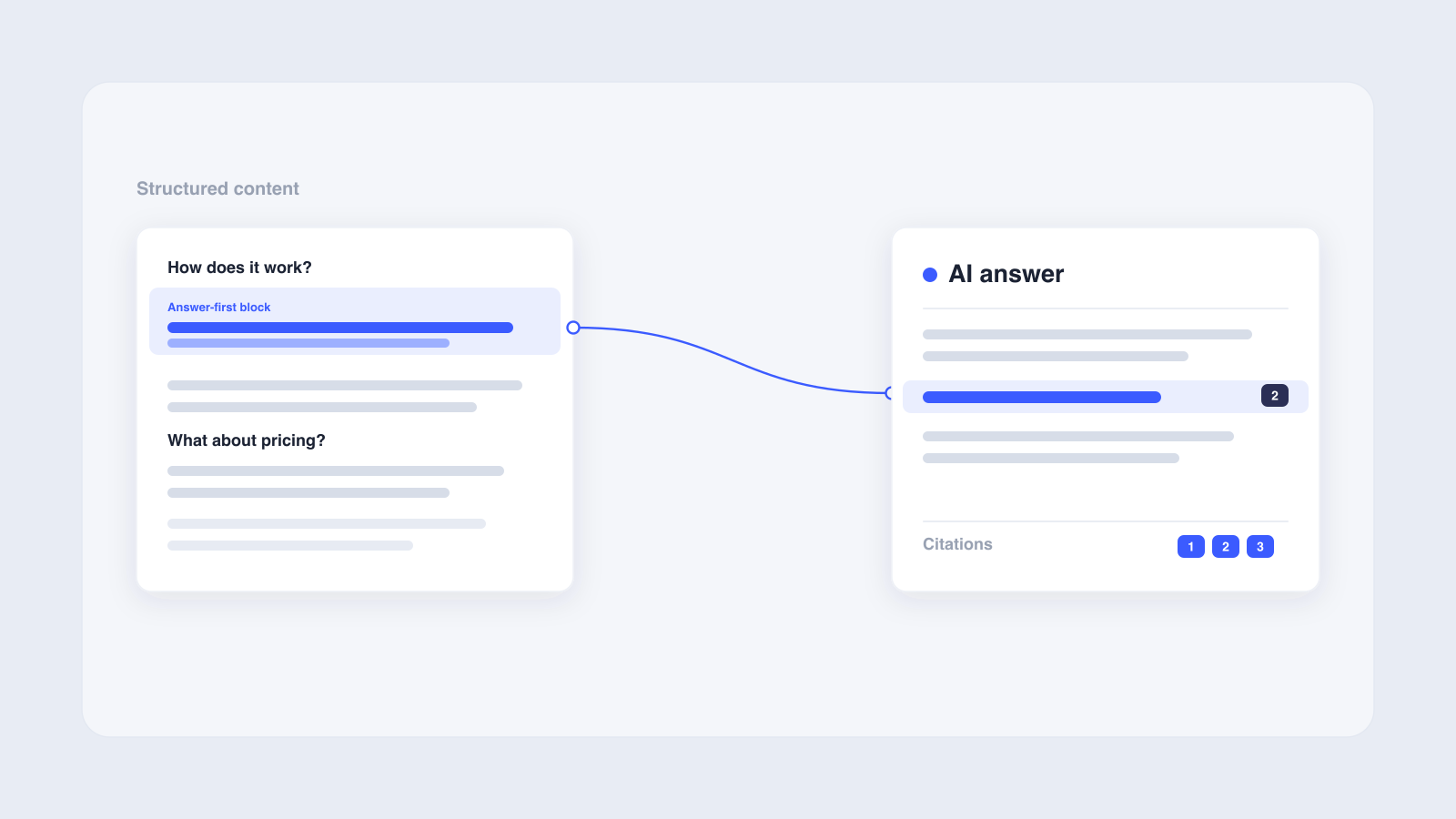
How should B2B SaaS companies structure content so AI assistants quote it? B2B SaaS companies should structure content as self-contained, answer-first blocks of 40 to 60 words each, paired with question-based H2 and H3 headings, machine-readable schema markup (FAQPage, Article, HowTo), comparison tables and numbered lists for extractability, and E-E-A-T trust signals including named authors, G2 and Gartner corroboration, and original data. This structure lets AI models like ChatGPT, Perplexity, Google AI Overviews, Claude, and Gemini lift clean passages and cite them verbatim.
51% of B2B software buyers now start research with an AI chatbot more often than with Google, up from 29% in 2025 (G2 Answer Economy survey, March 2026). 73% use AI tools somewhere in their purchase research, according to AEO research on SaaS buyer behavior. Your buyer's first impression of your product increasingly comes from a synthesized AI paragraph, not your homepage. This guide covers seven implementation-ready tactics: answer-first blocks, question-based headings, schema markup, E-E-A-T authority signals, extractable content formats, GEO and AEO differentiation, and continuous AI visibility monitoring.
The seven steps below walk through each structural tactic in order, with concrete examples and benchmark data you can apply immediately.
Structure Your Content to Get Quoted by AI Assistants
The core principle is simple: make every section a self-contained answer. AI engines chunk content into segments and pull the cleanest one that answers each sub-question. If a model can lift one passage from your page and use it as a complete, accurate response to a buyer question, you have built for AI citation. If it needs surrounding context to make sense, you have not.
For B2B SaaS companies, this means rethinking comparison pages, documentation, and FAQ sections as collections of standalone citation blocks rather than narrative essays. A page that reads beautifully end to end may still produce zero AI citations if no single passage answers a buyer question on its own.
Each step below provides a direct answer block, supporting evidence, and an implementation example you can adapt to your own pages.
Step 1: How do you write answer-first content blocks that AI can extract?
Start every major section with a direct, standalone answer to the section's implied question, followed by supporting evidence. This creates citation blocks: self-contained text AI can extract verbatim without needing surrounding context. Each block should be 40 to 60 words, answer one question completely, and read as a finished thought if pulled from the page.
The Bottom Line Up Front (BLUF) principle flips traditional content structure. SEO content builds toward an answer over several paragraphs. AEO content cannot. If your answer is buried, the model may never reach it. Building an AI-optimized content system that produces these citation-ready blocks consistently is what separates brands that get quoted from brands that get skipped.
BrightEdge reports that content with clear formatting is 30 to 40% more likely to be cited than unstructured content. Separately, the Princeton GEO study found a 28 to 43% citation lift specifically from adding quotations to content, not from formatting alone. The most directly relevant controlled figure for structure alone is a 17.3% citation lift from the GEO-SFE study (Yu et al., arXiv:2603.29979, March 2026). Pages that bury the answer under a long introduction rarely get cited. Put a direct, two to four sentence answer in the opening paragraph or callout box immediately after the intro.
- Weak: "Our platform offers many features designed to help teams collaborate more effectively across departments and workflows."
- Citation-ready: "VisibleAuthority's AI Visibility Mapping identifies exactly where a B2B SaaS brand is missing from AI-generated answers across ChatGPT, Perplexity, Gemini, and Claude, then prioritizes the highest-impact content gaps to close."
Step 2: How do question-based headings and FAQ sections increase AI citations?
Structure H2 and H3 headings as the exact questions buyers ask AI assistants. Pair these with dedicated FAQ sections using FAQPage schema to address common queries with concise, direct answers. This alignment lets AI models map your content directly to user prompts, increasing citation likelihood.
Question-based headings mirror how users interact with AI assistants. Buyers type full questions, not keyword fragments. If someone asks "how does X work," the H2 must say "How does X work" verbatim, not "Understanding X." The heading is the retrieval key the AI uses to match a section to the query.
- Weak: "Platform Evaluation Criteria" -> Better: "What criteria should I use to evaluate marketing automation platforms?"
- Weak: "Competitor Comparison" -> Better: "How does [Your Product] compare to [Competitor]?"
- Weak: "Understanding AEO" -> Better: "What is Answer Engine Optimization?"
FAQ schema implementation can increase AI search visibility by up to 40%. Every one of 29 cited articles analyzed by Setproduct had FAQ schema. FAQ schema gives AI Overviews a pre-structured question-answer pair it can extract without parsing prose. Answers should be concise, 40 to 80 words, and self-contained.
Glossary-style content with clear definitional structure often wins "What is [concept]?" citations even against much larger competitors. A well-structured definition page with FAQPage schema can outperform a 3,000-word pillar from a bigger brand if the definition is cleaner and more extractable.
Step 3: What structured data and schema markup do AI models need?
Add JSON-LD structured data to every key page using Article, FAQPage, HowTo, Organization, and SoftwareApplication schemas. Configure llms.txt to guide AI crawlers to your most authoritative content, and ensure robots.txt allows AI bot access. These technical foundations make your content machine-readable and explicitly signal content types and entities to AI models.
- Article: Declare who wrote the piece, when, and what it covers. Critical for blog posts and guides.
- FAQPage: Pre-structure question-answer pairs for direct extraction. Deploy on every FAQ section.
- HowTo: Signal step-by-step process content. Use for playbooks and tutorials.
- Organization with sameAs: Link your brand entity to LinkedIn, Crunchbase, G2, and Wikipedia profiles so AI systems can corroborate identity.
- SoftwareApplication: Declare product features, pricing, and categories on your product and pricing pages.
B2B sites with comprehensive structured data see 34% higher citation rates than equivalent sites without it, per KEO Marketing research. Raw schema quantity alone does not drive citations. Schema quality, including clean entity graphs and sameAs properties linking to authoritative profiles, is what improves mention rates and citation share.
A minimal FAQPage JSON-LD block looks like this: {"@context":"https://schema.org","@type":"FAQPage","mainEntity":[{"@type":"Question","name":"Your question here","acceptedAnswer":{"@type":"Answer","text":"Your concise answer here"}}]}. Each FAQ item should match exactly what appears on the visible page.
An llms.txt file is a curated list pointing AI crawlers to your most authoritative content. It is not yet universally supported across all AI engines, but it is a low-cost, high-upside investment. Think of it as a robots.txt specifically designed for AI model ingestion.
Ensure AI crawlers are not blocked in your robots.txt. GPTBot, PerplexityBot, ClaudeBot, and Google-Extended must all be allowed to access your content. Clean technical implementation is the price of entry for AI citation. For a deeper audit of your technical foundations, see our guide on technical SEO for AI search visibility. Our AI Visibility Mapping identifies exactly where your brand is missing across AI models.
Keep product facts identical everywhere the model might read them. Pricing tiers, integrations, security certifications, and feature lists should match across your site, G2 profile, and documentation. Contradictory facts across your own pages are one of the fastest ways to lose a recommendation.
Step 4: What authority and trust signals make AI models cite your content?
Establish E-E-A-T signals (Experience, Expertise, Authoritativeness, Trustworthiness) that correlate with higher AI citation rates. Support every claim with evidence, cite reputable sources, earn third-party corroboration on G2, Gartner, and industry publications, and maintain consistent brand entity representation across all platforms.
E-E-A-T-aligned signals appear to correlate with higher AI citation rates, likely because AI systems retrieve from search indexes that already weight these factors. However, no model provider has confirmed E-E-A-T as a direct citation-selection mechanism, and Google has stated that E-E-A-T is not a single signal or score. Still, pages with named authors, credible sources, and strong third-party corroboration tend to perform better in AI answers, suggesting alignment rather than direct causation.
- Current date stamps and regular content updates
- Clear attribution for all statistics and claims
- Transparent methodology for original research
- Named authors with real credentials and bios
- HTTPS and clean technical implementation
A SaaS company with a thin or outdated G2 profile is leaving one of the highest-impact AEO assets in its category completely unused.
AI engines cross-reference sources to build entity confidence. Mentions on G2, Capterra, Gartner, Wikipedia, Reddit, and industry publications increase the likelihood of being cited. For B2B SaaS, G2 and Capterra listings function as independent corroboration that AI systems weigh heavily for software category and comparison queries. Learn more about why ChatGPT recommends competitors and how third-party sources drive AI recommendations.
The Princeton GEO study (Aggarwal et al.) found that on Perplexity.ai, Quotation Addition improved Position-Adjusted Word Count by 22% and Statistics Addition improved Subjective Impression by 37%. No source reports a 30.1% aggregate visibility improvement on Perplexity. The study tested adding statistics generally, not only original statistics, and was primarily conducted on a Bing Chat-like system, with Perplexity used only for secondary validation. If you have proprietary data from customer surveys, usage analytics, or benchmark tests, publish it with clear methodology. Well-documented proprietary data gives AI models a distinctive source they cannot obtain elsewhere, which increases citation likelihood.
Run an entity-consistency audit across your homepage, G2 profile, Crunchbase listing, LinkedIn company page, and product documentation. Your company name, category description, and key messaging must be identical everywhere. If your G2 profile says "AI-powered analytics" but your homepage says "data intelligence platform," the model sees two different entities and loses confidence in both.
Step 5: Which content formats and B2B SaaS content types earn the most AI citations?
Build content in formats AI models favor for extraction: comparison tables, feature matrices, numbered lists, bullet points, data tables, and clear entity definitions. For B2B SaaS specifically, prioritize comparison pages, "best for" guides, alternatives-to pages, use-case pages, glossaries, and technical documentation. These directly address buyer evaluation queries and are prime candidates for AI summarization and citation.
A 12-month analysis of 22,295 AI answers across 460 B2B prompts reveals which content formats earn citations. Comparison and alternatives content accounted for 32.5% of all tracked citations, more than any other format. How-to guides followed at 21%, then product documentation at 18%, original research at 15.5%, and community content at 13%.
- Vendor comparison (vs.) pages
- "Best for" guides and category lists
- Alternatives-to pages
- Use-case pages tied to specific buyer scenarios
- Glossaries and definitional content
- Technical documentation and API references
- Pricing pages with clear tier breakdowns
- Security and compliance pages
Structure comparison content for extraction with clear evaluation criteria, weighted importance, specific use-case recommendations, transparent methodology, and tables for quick feature comparison. Include verdict summaries that work as standalone claims. A model should be able to pull your comparison table and verdict sentence without reading the surrounding prose.
A comparison page that only flatters your own product gets skipped by AI models because it does not answer the buyer's actual question. Honesty about trade-offs is a structural requirement. If your product is weaker in one category, say so and explain where it wins instead. Models reward pages that help the buyer decide, not pages that try to sell.
Step 6: What is the difference between GEO, AEO, and traditional SEO?
Traditional SEO optimizes for search rankings and click-through rates. Generative Engine Optimization (GEO) and Answer Engine Optimization (AEO) shift the focus to recommendation ingestion: getting AI models to extract, quote, and recommend your brand inside synthesized answers. For B2B SaaS, this means optimizing for visibility inside ChatGPT, Perplexity, Google AI Overviews, Claude, and Gemini rather than solely chasing blue-link positions.
- SEO: Rank pages for keyword queries and earn clicks. Success metric is organic traffic and rankings.
- AEO: Structure content so AI answer engines extract and cite it. Success metric is citation frequency and brand mention rate.
- GEO: Broader optimization for generative engine visibility across all AI-powered search surfaces. Encompasses AEO plus entity building, corroboration, and multi-platform presence.
Google AI Mode cites a source in 97.4% of B2B answers. Perplexity cites in 93.2%. ChatGPT cites in 68.3%, per the State of AI Search in B2B 2026 analysis. These rates show where citation opportunities are highest and confirm that every major AI engine is increasingly sourcing live content rather than relying solely on training data.
ChatGPT still answers from parametric training data approximately 32% of the time rather than citing a live source. That means some recommendations depend on what the model learned during training, not what your site says today. This is why building entity authority through third-party corroboration matters: the model needs to recall you even when it is not actively browsing.
69% of B2B buyers chose a different vendor than planned based on chatbot guidance, and one in three bought from a vendor they had never heard of before, per the G2 Answer Economy survey. If AI assistants do not recommend you, buyers pick someone else. For foundational context on this shift, read our complete guide to Answer Engine Optimization.
Step 7: How do you measure and monitor AI visibility and citation rates?
Track four key metrics to measure AI content performance: citation frequency, citation share, AI visibility, and AI Overviews trigger rate. Run consistent prompt tests across ChatGPT, Perplexity, Google AI Mode, Claude, and Gemini. Log brand mentions, identify which content formats earn the most citations, and refine your strategy based on real data.
- Citation frequency: Raw count of brand mentions across tracked prompts per AI model.
- Citation share: Your mentions divided by total mentions for all brands in the category.
- AI visibility: Percentage of relevant buyer prompts where your brand appears in the answer.
- AI Overviews trigger rate: How often your content triggers a Google AI Overview citation.
On matched-day prompts, Perplexity has the highest brand mention rate at 41.7%, followed by Google AI Mode at 33.7% and ChatGPT at 32.3%. Perplexity produces the shortest answers but the most citations per answer at 6.71, compared to ChatGPT's 3.60. Citation rate on one platform does not predict citation rate on another, so each engine must be tracked separately.
To audit your current AI citations, run a set of 20 to 50 buyer-relevant prompts across all major AI models. Log whether your brand is mentioned, which content is cited, and which competitors appear instead. Track citation position too: AI platforms typically cite three to five sources per answer, and being cited first or second receives disproportionately more attention than fourth or fifth.
Run this audit monthly. Each cycle reveals which content gaps cost you citations, which competitor pages are winning them, and which content updates produced measurable lift. Our AI Visibility Testing Loop operationalizes this process, running live prompt tests across multiple AI models and refining content based on which formats earn the most citations.
For a deeper dive into measurement frameworks, see our 2026 guide on measuring brand visibility in AI search. It covers prompt design, competitive benchmarking, and the tracking tools that make continuous monitoring practical for B2B SaaS teams.
The FAQ section below is structured for direct extraction by AI models. Implement FAQPage JSON-LD schema in your page's structured-data layer, mirroring each question and answer pair exactly as they appear on the visible page, to give AI engines a pre-structured extraction path.
Frequently Asked Questions
What word count works best for AI-extractable content blocks?
How often should B2B SaaS companies update content to maintain AI citations?
What is the fastest way to test whether AI assistants cite your content?
How long does it take to see measurable AI visibility improvements?
- Each section should open with a 40 to 60 word answer-first block AI can extract verbatim.
- Question-based H2 and H3 headings, paired with FAQPage schema, can increase AI visibility by up to 40%.
- Deploy Article, FAQPage, HowTo, Organization, and SoftwareApplication schema on every key page.
- Comparison and alternatives content earns 32.5% of all AI citations in B2B SaaS, more than any other format.
- Track citation frequency, citation share, AI visibility, and AI Overviews trigger rate monthly across all major AI models.
VisibleAuthority specializes in Answer Engine Optimization for B2B SaaS companies and AI tool startups, using live AI prompt testing across ChatGPT, Perplexity, Gemini, and Claude to validate and refine visibility strategies. If you want to know exactly where your brand is missing from AI-generated answers, our AI Visibility Mapping identifies the gaps. Our 30-Day Visibility Sprint delivers measurable before-and-after improvements in AI mention rates through mapping, content deployment, and optimization. Schedule a visibility audit to see where you stand and which content changes will improve your AI mention rate and citation share fastest.
We'll run your category through the major models and map exactly where you appear, where competitors win, and what it takes to become the recommendation.