
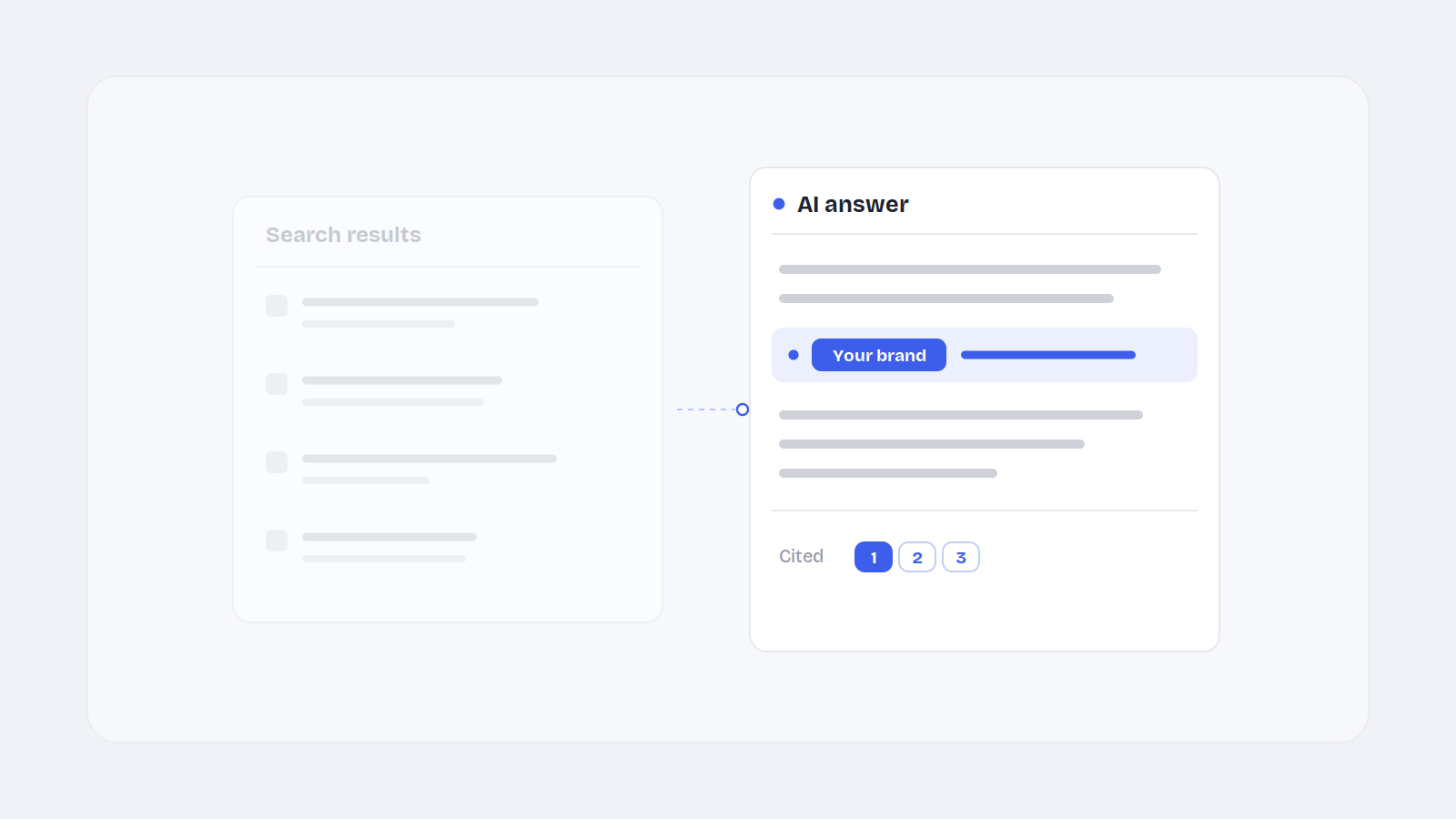
Answer Engine Optimization (AEO) is the practice of shaping your content to be the answer that AI tools and answer boxes hand back. It leans on clear, self-contained answers, structured data, and real authority, so that ChatGPT, Perplexity, Gemini, and Google's AI Overviews pull you into the response instead of a competitor.
If a buyer asks ChatGPT, Perplexity, or Google Gemini for the best tool in your category, will your brand appear in the answer? That question sits at the center of What is Answer Engine Optimization (AEO) and how does it work? AEO is the discipline of making your brand the most reliable, easy-to-quote source for the questions customers ask across AI-powered systems so your brand is named and cited as the answer, not just ranked near it. For B2B SaaS companies and AI tool startups, the stakes are direct: if you are not in the synthesized answer, you lose the deal before the buyer ever visits your site.
What Is Answer Engine Optimization (AEO)?
AEO is the practice of structuring content so AI answer engines cite your brand when they synthesize responses to buyer questions. The goal is citation inside generated answers, not blue-link rank on a SERP. The discipline is roughly two years old, and terminology is not yet standardized; AEO and GEO are often used interchangeably despite distinct focuses. AEO evolved from featured snippet optimization and semantic SEO, extending to cover the full ecosystem of AI answer surfaces including Google AI Overviews, ChatGPT, Perplexity, Claude, and voice assistants.
AEO is not a replacement for SEO. Your content still needs to be indexed, crawlable, and authoritative enough for AI systems to trust it. SEO is the prerequisite. AEO is the optimization layer that determines what happens once you are eligible to be selected as the answer.
- AEO produces three sequential outcomes: (1) being retrieved when an AI system searches for source material, (2) being trusted enough to be selected as a primary source, and (3) being cited with your brand name in the final synthesized answer.
Why AEO Matters in the Current Digital Landscape
The shift from clicking blue links to reading AI summaries is accelerating. According to Similarweb, the zero-click rate for the exact keyword "answer engine optimization" on Google reached 78% based on keyword data from December 2025 through February 2026. Individual AEO-related queries range from 0% to 84.5% zero-click. A separate Pew Research Center study of 900 U.S. adults found that users clicked a traditional search result just 8% of the time when an AI summary appeared, compared to 15% without one. When buyers get their answer without visiting your site, ranking alone no longer guarantees visibility.
Gartner predicted in February 2024 that traditional search engine volume would drop 25% by 2026 due to AI chatbots and virtual agents, not that organic search traffic would shift to AI chatbots. As of 2026, this has only partly materialized; Google retains 90%+ market share and AI referral traffic is approximately 1% of website visits. Current 2026 estimates for Google AI Overviews prevalence range from approximately 20% (SparkToro/Similarweb) to approximately 70% (AdvancedWebRanking); Google self-reports approximately 50%. For question-based searches, Pew Research Center found AI summaries appear 60% of the time. ChatGPT commands 87.4% of all AI referral traffic (Conductor, 2026), making it the dominant AI surface for referral traffic.
- For B2B SaaS brands, the implication is measurable: BrightEdge found that brands optimized for AI visibility appear in 18% of relevant answers versus 3% for non-optimized brands (January 2026).
That 15-point gap in mention rates maps directly to lost referral traffic and pipeline. For a B2B SaaS company at $50K MRR, losing 15 points of AI mention share means buyers form their shortlist without your name on it. The cost is not lower rankings; it is lost qualified referrals at the exact moment buyers define their consideration set.
How Answer Engines Work: The Technical Mechanism
Answer engines select content through a three-stage pipeline: retrieval, synthesis, and citation. In retrieval, the model issues live web searches or uses a curated index to pull candidate sources. In synthesis, it reads those sources and generates a single answer, paraphrasing across them. In citation, some sources surface as links or footnotes. Not all retrieved sources get cited.
This process is powered by Retrieval-Augmented Generation (RAG). The AI interprets the query, retrieves candidate content, breaks pages into extractable chunks, scores those chunks for relevance, clarity, and trust, and synthesizes a response. Your content competes at the chunk level, not the page level. A single H2 section is the unit of competition, not the article as a whole.
- The system also uses query fan-out: it decomposes a query into sub-queries, each targeting a different aspect of the original question. Your content needs to answer each sub-query independently.
Chunks are scored on three qualities. Relevance: does the chunk address the specific sub-query? Semantic proximity matters more than keyword frequency. Clarity: is the answer directly stated, or buried in context? AI systems reward content that leads with the answer. Trust: does the content contain authority signals? Named authors, consistent brand entity signals, statistics attributed to verifiable sources, and structured data all help.
Google AI Overviews operates differently from RAG chatbots. Rather than retrieving documents at query time through vector search, AI Overviews draws from Google's existing search index, which means organic ranking is the gateway. BrightEdge's 16-month study found that AI Overview citation overlap with organic rankings grew from 32% to 54% between May 2024 and September 2025, with YMYL verticals like healthcare reaching 68 to 75% overlap. Separately, Princeton GEO-Bench research confirmed that keyword stuffing performs below the unoptimized baseline in LLM engines, while adding quantified statistics improved citation rates by up to 41%.
AEO vs. SEO vs. GEO: Key Differences and Overlaps
These three disciplines are related but distinct. SEO ensures pages are indexed, crawlable, and authoritative enough for search engines to trust them. AEO structures content so AI systems extract and attribute it as answers. GEO extends further to maximize share of voice and brand influence across the full generative AI landscape, including off-page signals and brand mentions.
- SEO targets ranked links on SERPs. AEO targets brand mentions inside AI answer boxes. GEO targets citations within longform generative responses.
- All three require authoritative content, entity consistency, and trust signals. AEO and GEO build on SEO foundations. AEO is more focused on answer extraction and citation; GEO encompasses broader brand influence.
AEO and GEO are often used interchangeably, though AEO is more on-page (structure, extractability, answer blocks) while GEO includes off-page signals like brand mentions, entity consistency, and review platforms. Think of AEO as the content layer within the broader GEO strategy.
Core Strategies for AEO Optimization
Effective AEO requires specific, repeatable content engineering. These six strategies are the foundation for making brands citable across AI answer engines.
- Answer-first content (BLUF): state the answer in a self-contained sentence near the top of the section. AI rewards content that leads with the answer, follows with evidence, and does not require reading surrounding sections.
- Chunk-level optimization: optimize each H2 section as an independently extractable, citable unit with a clear topic sentence, supporting evidence, and a concise summary.
- Entity consistency and structured data: maintain consistent brand entity signals across all web properties. Use Schema Markup to help AI systems understand relationships between entities.
- Quantified statistics and citable evidence: Princeton GEO-Bench found adding quantified statistics improved citation rates by up to 41%. Attribute all statistics to verifiable sources.
- Off-page brand mentions: mentions across Reddit, forums, news, and comparison posts push your name into the LLM's working representation of the topic, even when those pages do not link to you.
- Avoid keyword stuffing: Princeton research confirmed keyword stuffing performs below the unoptimized baseline in LLM engines. Focus on semantic relevance and natural language.
These strategies are what we deploy through our AI-Optimized Content System, which creates comparison, recommendation, and answer-first content that AI models use to cite and recommend brands. The system is built for chunk-level extractability, not just page-level relevance.
For your content to be citation-eligible, each chunk must be independently answerable: someone reading only that section should get a complete, useful response.
Measuring AEO Performance and Key Platforms
AEO performance is measured differently from traditional SEO. The core KPIs are AI citation frequency, brand mention rate, share of voice across AI engines, fan-out coverage score, and zero-click rate trend. These differ fundamentally from rank-and-click metrics.
There is no Search Console for AI engines. AEO is measurement-led but relies on third-party auditing and manual prompt testing across models. A mention means your brand name appears in the answer. A citation means your brand is linked or footnoted as a source. Different engines define cited differently, so tracking both matters.
- Google AI Overviews: rooted in core Search ranking; no special markup required but organic ranking is the gateway.
- ChatGPT: training data plus live browsing; highest AI referral traffic at 87.4%.
- Perplexity: retrieval-first and citation-heavy with a research audience.
- Bing Copilot: critical for ChatGPT visibility since ChatGPT uses Bing for retrieval.
- Claude: growing in enterprise contexts.
- Gemini: bundled with the Google ecosystem.
Google still holds approximately 89 to 91% of the global search market in 2026, making AI Overviews the most critical surface for US queries. But a multi-engine approach is necessary because buyers use different tools at different stages of research.
VisibleAuthority's AI Visibility Testing Loop tracks changes in mention rate, citation rate, and share of voice across models, refining content based on what the data shows rather than assumptions. Ongoing testing is the only reliable way to measure whether your AEO strategy is working.
Frequently Asked Questions About AEO
What is the difference between AEO and SEO?
How do answer engines choose which content to cite?
Which AI answer engines should my brand optimize for?
How long does it take to see results from AEO?
Can AEO work alongside my existing SEO strategy?
Conclusion: Building Your AEO Foundation
AEO is the optimization layer that determines whether your brand appears in AI-generated answers when buyers ask relevant questions. With a 78% zero-click rate for the exact keyword "answer engine optimization" on Google (Similarweb, Dec 2025 to Feb 2026) and Gartner's prediction that traditional search engine volume will drop 25% by 2026, brands that ignore AEO risk invisibility at the moment of decision.
From AI Visibility Mapping to the 30-Day Visibility Sprint, VisibleAuthority provides the diagnostic, content, and testing infrastructure to make brands visible inside AI answers. We specialize in contested B2B SaaS and AI tool markets where AI recommendations directly influence buyer decisions.
Start with an AI Visibility Mapping engagement to identify where your brand is missing in AI-generated answers across major models. If you are ready to move, our 30-Day Visibility Sprint delivers measurable before-and-after results in AI mention rates within 30 days. Learn how AEO tactics drive citation lift and then contact us to build your AEO foundation.
We'll run your category through the major models and map exactly where you appear, where competitors win, and what it takes to become the recommendation.