
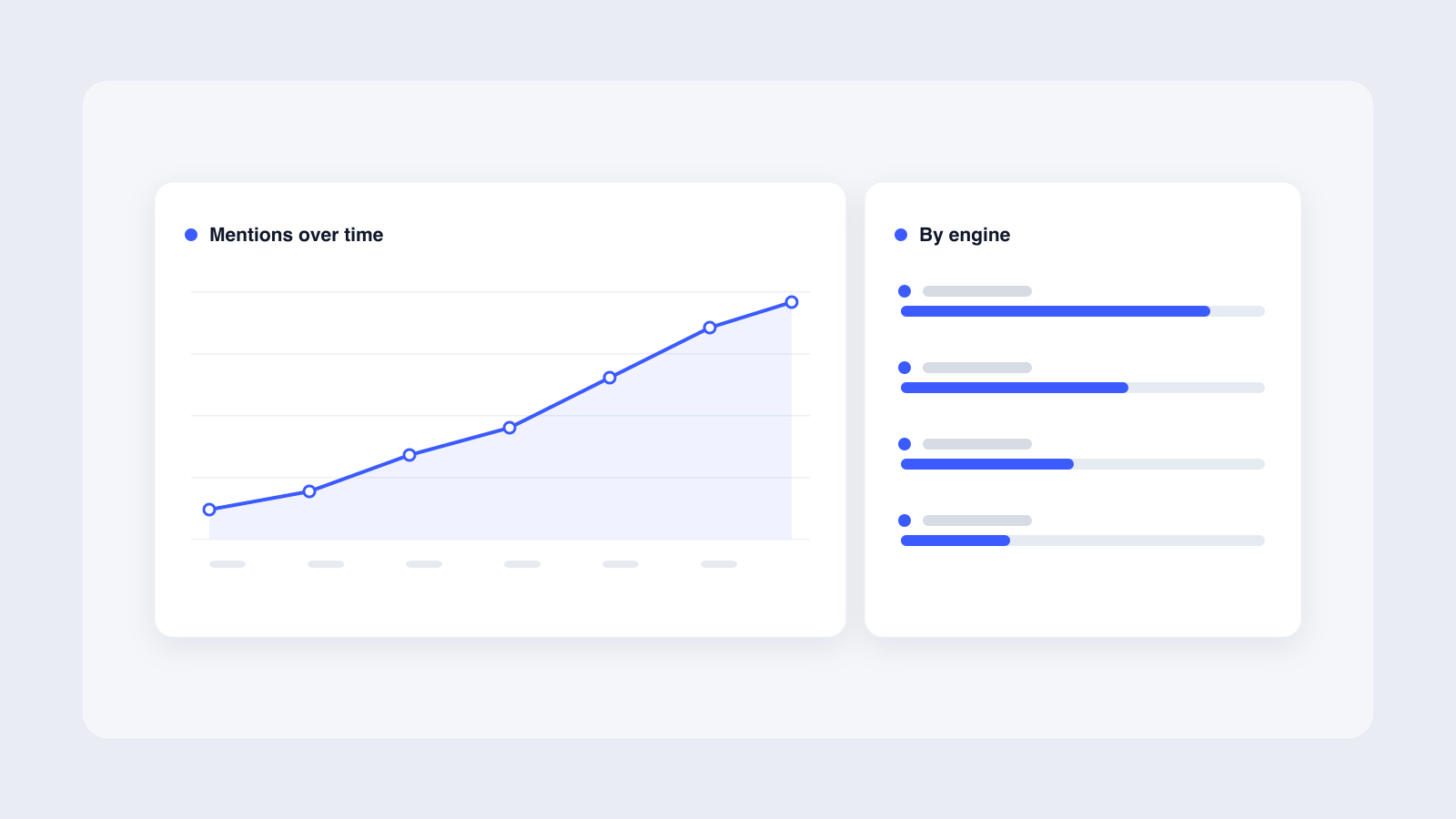
To track AI mentions and citations, build a prompt library of 30 to 100 real buyer questions, run them across ChatGPT, Perplexity, and Gemini on a set cadence, and log whether your brand is named, whether your domain is cited and on which page, which competitors appear, and where you sit in the answer. Track mention rate and citation rate separately, watch your share of voice and blindspot count, and start with a free manual baseline before paying for tools.
If you are a B2B SaaS founder asking, "How do I track AI mentions and citations for my brand?", you are already ahead of most companies. Buyers no longer just Google your product name and click the top result. They ask ChatGPT for recommendations, pull comparison lists from Perplexity, and read Google AI Overviews before they ever visit your site.
Understanding AI Mentions and Citations for Your Brand
When an AI model generates an answer about your category, two things can happen. An AI mention means your brand name appears in the response text, with or without a link to your site. An AI citation means the model links to your domain as an explicit source for its answer. Both matter, but they serve different strategic purposes: mentions build awareness, while citations drive traffic and signal that the AI trusts your content enough to reference it.
Traditional SEO tracks keyword rankings on a deterministic results page. AI visibility is fundamentally different. It is prompt-driven and non-deterministic, meaning the same question can produce different answers on different days, across different models, and even within the same session. This makes systematic tracking essential, not optional, for any brand competing in markets where AI recommendations influence buyer decisions.
Why Tracking AI Mentions and Citations Is Essential for Your Brand
AI search is reshaping how B2B buyers discover and evaluate software. When a buyer asks an AI model for the best tool in your category, the brands named in that response win attention before the buyer ever runs a Google search. Tracking your AI mentions and citations tells you whether your brand shows up in those moments at all.
The data underscores how much ground traditional tracking misses. Only 5.9% of citations in a 1,000-query Perplexity study went to vendor sites, meaning most AI citations point to third-party content rather than your own pages. Meanwhile, only 11% of cited domains overlap between ChatGPT and Perplexity, according to a 2026 analysis of 680 million citations. Strategies optimized for one engine may not transfer to another, which makes multi-engine tracking critical.
Beyond brand visibility, tracking gives you competitive intelligence, reputation management, and a feedback loop for content strategy. You learn which competitors appear in answers where you are absent, whether the AI describes your product accurately, and which content earns citations versus which gets mentioned without a link.
Key Metrics to Track for AI Brand Visibility
Tracking AI visibility requires a metrics framework that goes beyond counting how often your brand appears. Each metric below answers a different strategic question about your AI presence.
- Mention rate: percentage of tracked prompts where your brand name appears at all. This is your baseline awareness signal.
- Citation rate: share of prompts where the AI links to your domain. This requires active retrieval and signals deeper trust.
- Trust mention rate: prompts where both a mention and citation occur together. This is the most reliable performance signal because it shows the AI both recognizes and trusts your brand.
- Share of voice: your mentions or citations as a percentage of all brands appearing in your prompt set. Under 15% signals a citation gap; 25 to 40% is competitive.
- Blindspot count: prompts where competitors appear and you are absent. This is the most actionable metric because every blindspot is a fixable gap.
- Citation position: where in the answer your brand appears (lead source, mid-paragraph, or footnote). Earlier positions carry more visibility weight.
- Citation accuracy: whether the AI correctly describes your product, pricing, or capabilities when it names you.
Track mention rate and citation rate separately. A brand can be mentioned in 73% of runs but cited with a link in only 12%. That gap tells you whether your content is structured for extraction or merely recognized as relevant.
Step-by-Step Guide to Tracking AI Mentions and Citations
- Define your target query set. Build a prompt library of 30 to 100 realistic buyer questions covering brand terms, product names, industry topics, executive names, and common misspellings.
- Select AI models to monitor. At minimum, track ChatGPT, Perplexity, and Gemini, which powers Google AI Overviews. Add Claude as a fourth platform for manual baseline testing.
- Establish a monitoring cadence. Daily is the minimum useful frequency for automated tools. Weekly works for manual tracking. Monthly is essentially anecdotal and misses meaningful movement.
- Collect data methodically. Run each prompt multiple times per engine to account for non-determinism. Log whether your brand was named, whether your domain was cited (and which page), which competitors appeared, and your position in the answer.
- Analyze for insights. Review blindspot counts, share of voice trends, and citation accuracy. Turn findings into content and PR actions.
Running this process manually is a strong starting point, but scaling it across multiple engines, prompt sets, and competitor matrices is where most teams hit a wall. Our 30-Day Visibility Sprint delivers measurable before-and-after results in AI mention rates through mapping, content deployment, and optimization, all within 30 days.
Building an Effective Prompt Library and Query Matrix
Your prompt library is the foundation of every tracking effort. Develop 30 to 100 realistic buyer questions spanning awareness, comparison, and decision stages. Categorize them as high-intent (what is the best CRM for SaaS startups), comparative (Brand X vs. Brand Y), informational (how does AI citation tracking work), and best-of prompts that mirror real buyer behavior.
Include brand name variations, product names, executive names, and common misspellings. The goal is comprehensive coverage that reflects how actual buyers phrase questions, not how you want them to. Tracking must happen at the prompt level, not the brand search level. Typing your company name into ChatGPT is a trivial retrieval task that tells you nothing about whether AI recommends you when buyers do not name you first.
Tools and Software for AI Mention and Citation Tracking
Dedicated AI visibility platforms have matured rapidly. Peec AI tracks visibility, ranking, sentiment, and source depth for each answer. Ahrefs Brand Radar covers 260 million real prompts with a free tier starting at $129 per month. Profound offers deep citation analytics for enterprise teams. Semrush provides an AI Visibility Toolkit as an add-on at roughly $99 per month, and Otterly is a lower-cost option at $29 per month across four engines.
Judge any tool on four criteria: per-platform breakdown, entity-level share of voice, competitive gap view, and source-level citation data. Avoid tools that blend everything into a single score. Most tool pricing is gated or unpublished, making direct cost comparison difficult. Start with a manual baseline before investing in paid tools.
Platform-Specific Tracking Considerations
ChatGPT has the largest consumer user base and tends to be mention-led, relying on internet consensus rather than explicit source citations. According to HubSpot's AI citation tracking guide, mentions are conversational visibility while citations are sourced authority. Profound's research found that Turn 1 of a ChatGPT conversation is 2.5x more likely to be cited than subsequent turns, so the first response in a conversation carries the most visibility weight.
Perplexity is source-rich and provides explicit citations, making it the most informative platform for understanding which pages earn links. A 1,000-query Perplexity study measured an average of 7.6 citations per response drawn from 739 unique domains. Use Perplexity to see exactly which content the AI trusts enough to link to.
Google AI Overviews integrate with traditional search and lean on brand-owned websites for citations. Recent changes to Gemini affect citation behavior, so update your tracking approach when Google ships model changes. Claude is recommended as a fourth platform for manual baseline testing, particularly for buyers who use Anthropic's models for research and analysis.
Engine sourcing divergence is significant. Only 11% of domains cited by ChatGPT overlap with Perplexity, according to a 2026 analysis of 680 million citations. This means a strategy that wins visibility on one engine may produce zero results on another. Tailor your tracking and optimization per platform rather than treating AI as a single channel.
Analyzing Data and Optimizing Your AI Visibility Strategy
Once you have collected data across engines and prompt sets, the analysis phase turns raw logs into decisions. Identify trends in mention rate over time. Map competitive gaps using your blindspot count, where rivals appear and you do not. Track which content earns citations versus which gets mentioned without a link.
Use insights to refine your content strategy. If the AI names you but never cites your domain, your content may be recognized as relevant but not structured for extraction. If the AI describes your product inaccurately, update your content to make correct information more prominent. Errors often stem from outdated training data, conflicting sources, or competitor framing.
Build dashboards that track per-prompt history, per-engine breakdowns, and a competitor matrix. Our AI Visibility Testing Loop continuously tests AI prompts across models, tracks brand mentions, and refines content to improve AI recommendations over time. This turns tracking from a one-time audit into an ongoing optimization discipline.
Integrating AI Tracking with Existing Analytics (GA4, GSC)
Google Analytics 4 and Google Search Console complement your prompt-level tracking by confirming that AI citations actually generate clicks. In GA4, navigate to Reports, then Acquisition, then Traffic Acquisition, and filter by session source or referral domain. ChatGPT links frequently include identifiable referral parameters, and Google AI Overviews traffic often includes a #text= fragment indicating which cited passage the user clicked.
Create a custom channel in GA4 where Medium equals referral and Source matches an AI regex pattern (chatgpt.com, perplexity.ai, gemini.google.com, claude.ai, copilot.microsoft.com). Place this rule above the standard Referral channel. Refresh the regex pattern quarterly as new engines appear.
Treat GA4 AI traffic as a floor, not a ceiling. AI apps and in-answer browsers often strip the referrer, so GA4 files that traffic as direct. Watch for unexplained direct traffic rises to AI-relevant pages, and reconcile those against your citation log. Referral visits confirm citation-generated clicks but do not reveal how often AI cited your content.
Conclusion
Tracking AI mentions and citations is a continuous discipline that requires a prompt library, multi-engine testing, consistent cadence, and a metrics framework tied to revenue impact. The brands that build this discipline now will own AI visibility in their categories before competitors realize the ground has shifted. At VisibleAuthority, we focus on optimizing for AI recommendations inside synthesized answers rather than traditional search rankings, and we specialize in contested B2B SaaS and AI tool markets where AI recommendations directly influence buyer decisions.
FAQ: Tracking AI mentions and citations
Do I need expensive software to start tracking AI citations?
Which AI engines should I track for brand visibility?
Can I track AI-driven traffic in Google Analytics?
How often should I check my AI mentions and citations?
What is the difference between an AI mention and an AI citation?
We'll run your category through the major models and map exactly where you appear, where competitors win, and what it takes to become the recommendation.