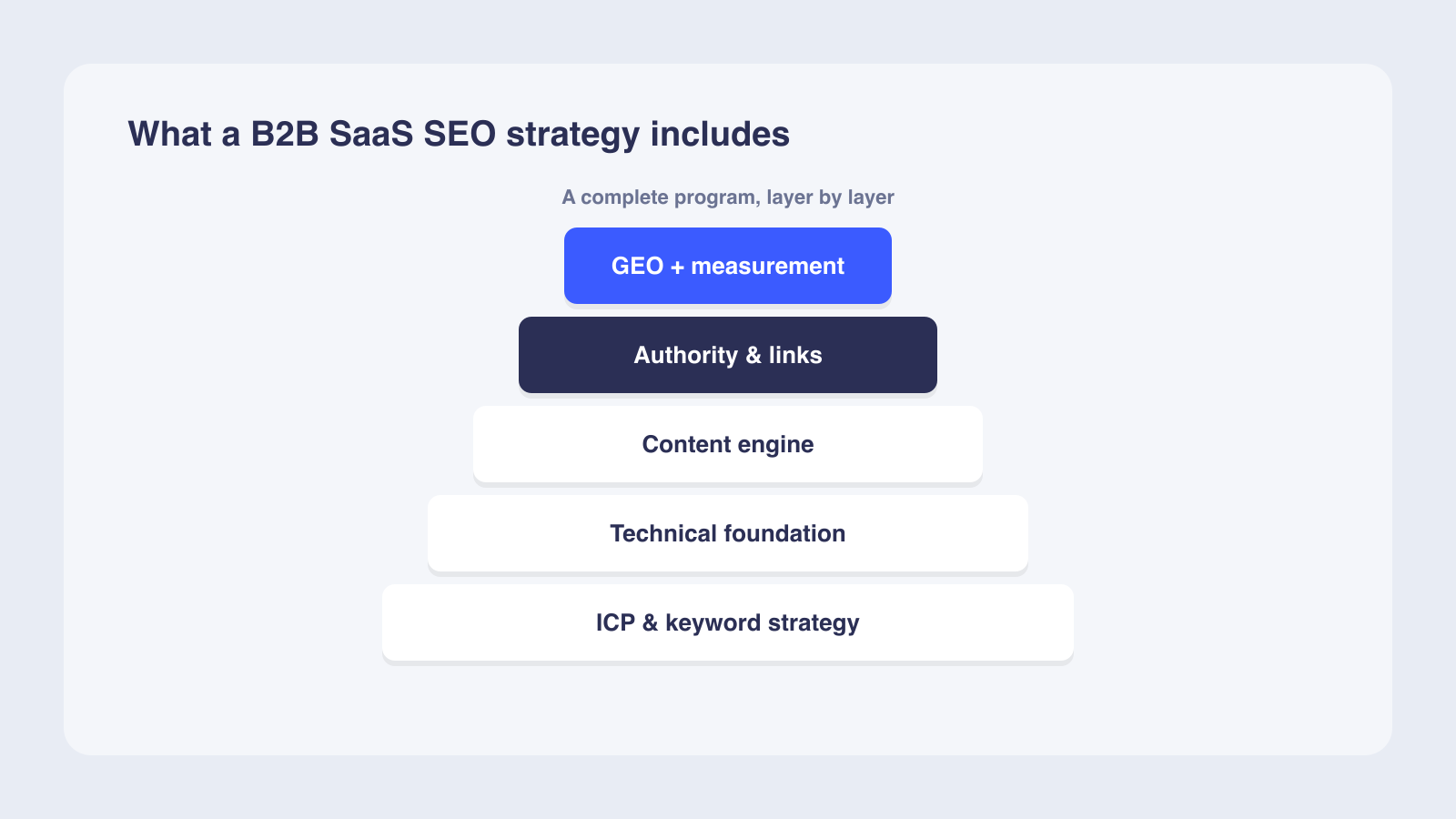
A B2B SaaS SEO strategy should start from your ideal customer profile and revenue goals, not keyword volume, then build out seven components: ICP-driven keyword mapping to the buying committee, a content architecture of pillar pages and clusters plus comparison and alternative pages, technical SEO foundations (crawlability, Core Web Vitals, schema, and rendering for JavaScript sites), on-page optimization written answer-first for both Google and AI engines, earned links and third-party authority on review sites and in the press, generative engine optimization so you get named in AI answers, and pipeline-focused KPIs tied to MRR and CAC rather than rankings alone. Sequence it: fix technical issues first, then publish revenue-driving content, then measure pipeline and AI share of voice. A simple 90-day plan is audit and map, build and publish, then measure and scale.
A B2B SaaS SEO strategy should include ICP-driven keyword mapping, a content architecture built for topical authority, technical SEO foundations, on-page optimization, link earning, generative engine optimization, and pipeline-focused KPIs tied to MRR growth and CAC reduction. This guide covers each component in practical order. It moves from keyword research through AI search visibility, ending with a 90-day execution plan you can hand to your marketing lead.
How to anchor your B2B SaaS SEO strategy in ICP and business goals
Start with business targets, not keyword volume. A B2B SaaS SEO program exists to grow MRR and reduce CAC through organic discovery, not to rank for vanity terms. Set your revenue targets first, then reverse-engineer the SEO activities that support those numbers.
Define your buying committee
B2B SaaS purchases involve multiple stakeholders with different search behaviors at each stage. A typical buying group includes a champion, an economic buyer, a technical evaluator, and a security reviewer. Each role types different queries into Google and asks AI assistants different questions. Map the committee before mapping keywords.
Set business targets first
If you need a specific share of new pipeline from organic search within 12 months, calculate the traffic, conversion rate, and content volume required to hit that number. Working backward from the revenue goal keeps the program honest and prevents it from drifting toward high-volume, low-intent terms.
Baseline your AI visibility
Analyze where your brand already appears, and where it is missing, in AI-generated answers across major models before you build content. The strategy should account for both traditional search and AI-driven discovery from the outset. Traditional search still handles the majority of B2B research traffic, so the strategy must cover both channels. This baseline tells you which buyer questions your content already answers and which gaps cost you pipeline.
What content architecture builds topical authority for SaaS companies
Build topic clusters around revenue-driving themes. A content architecture that covers the full funnel and concentrates authority on revenue-driving topics outperforms scattered blogging.
Pillar pages and cluster posts
Use one pillar page of 2,500 to 4,000 words with 8 to 15 supporting cluster posts of 800 to 1,500 words. All cluster posts link back to the pillar to concentrate authority and create clear crawl paths. Each cluster targets a specific buyer question, so the pillar becomes the canonical source for that topic.
Product-led, comparison, and alternative pages
Create a page-type portfolio mapped to buyer jobs: problem articles for awareness, use-case pages for solution exploration, product tutorials for evaluation, comparison pages for vendor selection, and integration pages for stack design. Comparison and alternative pages capture buyers already evaluating vendors, which makes them a core revenue-driving page type in the B2B SaaS funnel.
Programmatic SEO pages
Use programmatic SEO for high-volume page patterns like integrations, comparisons, and templates, but only when each page carries unique data, real search demand exists for the variations, and the volume justifies the build. Ship in pilot batches of a few dozen pages and monitor Google Search Console before scaling. If two pages differ only by a swapped noun, you have a template problem, not a data problem.
Which technical SEO foundations B2B SaaS sites need in 2026
If a crawler cannot read the page, nothing else in the strategy matters. SaaS sites built on JavaScript frameworks often ship empty HTML to bots that do not run scripts, and most AI crawlers do not execute JavaScript.
Crawlability and indexation
Ensure crawlability and indexation: fix orphan pages, configure robots.txt correctly, submit XML sitemaps through Google Search Console, and keep SSL certificates active. Run a full crawl and check GSC Crawl Stats for coverage gaps. Keep important pages close to the homepage and flatten directory structures, so /topic/page-name is better than /folder/subfolder/year/page.
Core Web Vitals
Optimize for Google's Core Web Vitals thresholds: LCP under 2.5 seconds, INP under 200 milliseconds, and CLS under 0.1. These metrics are especially critical for JavaScript-heavy single-page applications that may not render content for crawlers without server-side rendering or pre-rendering. Replace raster images with WebP or AVIF, lazy-load below-fold images, and move non-critical JavaScript out of the critical path.
Schema markup and SPA rendering
Implement schema markup (Organization, SoftwareApplication, FAQPage, Article, and BreadcrumbList) for entity clarity and, where eligible, rich results. FAQPage no longer earns a rich result in Google Search, but it still helps AI engines parse your Q&A. Address SPA-specific challenges with server-side rendering or pre-rendering, clean URL structures, and proper canonical tags so JavaScript-rendered content is fully indexed. Major AI crawlers like GPTBot, PerplexityBot, and ClaudeBot do not execute JavaScript, making client-side rendering a visibility risk for AI search.
Pages that fail Core Web Vitals or block AI crawlers lose visibility in both traditional search and AI-generated answers. Fix technical SEO before investing in content.
How to optimize on-page elements for search and AI engines
AI engines lift passages, not pages. A section that opens with a direct, self-contained answer is easier to quote and attribute than one that warms up for three paragraphs.
Title tags and meta descriptions
Write title tags of 50 to 60 characters and meta descriptions of 150 to 155 characters that include target keywords and compel clicks. Test titles and snippets for any page group whose click-through rate lags what its average position would predict, since pages ranking further down naturally earn lower rates. Name your brand in the passage, not only the word we, because a passage that never names you cannot be attributed to you.
Heading structure and internal linking
Structure headings logically with one H1, H2s for main sections, and H3s for subsections. Use descriptive anchor text for internal links that matches user intent rather than raw keywords. Every bottom-of-funnel page should be two clicks from the homepage and linked from related posts. Breadcrumb navigation and semantic HTML help both Google and AI engines understand page relationships and create clear crawl paths.
Semantic HTML and keyword integration
Use semantic HTML: tables, lists, and clear hierarchy. The GEO-16 study of AI answer-engine citations reports that well-structured, answer-first content, with semantic HTML, metadata, and structured data, is among the signals most strongly associated with being cited in AI answers. Naturally incorporate target keywords and semantic variations throughout the page content, image alt text, and URL structures to improve relevance for both traditional search and AI-generated answers.
How to earn links and third-party authority signals
Your own site tells AI what you are; other sites tell it whether to recommend you. Earning coverage on authoritative third-party domains is what gets you cited in synthesized answers.
Digital PR and earned media
Pursue digital PR and earned media on authoritative third-party domains, because AI engines weight earned media heavily and often lean on third-party sources over brand-owned content in their synthesized answers. Focus on relevance and domain authority over volume. Vary anchor text naturally to avoid pattern detection. Real news coverage and integration partner directories are pages AI tends to trust.
Review platforms and analyst directories
Build presence on review platforms like G2, Capterra, and TrustRadius and analyst directories like Gartner and Forrester, because AI engines cite these sources when recommending products. Keep profiles current with accurate pricing, categories, and descriptions so AI engines can match you to the right buyer queries.
Community and user-generated content
Build presence on Reddit, Quora, and Stack Overflow where buyers ask real questions, because these platforms surface in both traditional search and AI-generated answers. Use guest posting, broken link building, and industry partnerships strategically. When buyers ask AI for a shortlist, the answer often draws from these third-party sources, not your blog.
How to optimize for AI-generated answers and generative engine visibility
GEO is not a separate project from SEO. It is SEO aimed at the questions buyers ask AI, plus crawler access and mentions on other sites. B2B software buyers increasingly use AI chatbots for research and shortlisting, so visibility in AI answers directly affects revenue.
Adopt GEO principles
Adopt GEO principles: answer-first summaries, structured data with valid JSON-LD, provenance citations to primary sources, freshness signals with human-visible timestamps, and semantic HTML. The GEO-16 study of AI answer-engine citations finds that pages scoring high on these GEO factors, with a normalized GEO score at or above 0.70, align with substantially higher citation rates across AI engines than pages that ignore them.
Create content types AI engines prefer
Create content types AI engines prefer: in-depth solution pages answering niche buyer questions, industry-specific landing pages for segmented ICPs, comparison pages structured around real-world decision criteria, and pricing or total-cost-of-ownership explainers. Content should be self-contained and answer-first so a model can extract it in one window. State facts plainly: vague copy like the platform that powers modern teams gives AI nothing to quote.
Pursue a dual strategy
Pursue a dual strategy: on-page excellence plus coverage on authoritative third-party domains, because generative engines heavily weight earned media and often favor third-party sources over brand-owned blog content even when it is high quality. Mapping where your brand is missing from AI-generated answers across ChatGPT, Perplexity, Gemini, and Claude gives you a baseline to measure improvements against before investing in content changes.
Which KPIs reveal whether your SaaS SEO strategy is working
Track pipeline metrics beyond rankings. Report SEO in the same units as the rest of go-to-market: demos, pipeline, and revenue, not keyword positions.
| Page group | Primary KPI | Leading indicator | Decision trigger |
|---|---|---|---|
| Use-case pages | Demo starts | CTR | If CTR below 2%, test titles and snippets |
| Comparison pages | High-intent conversions | SERP coverage | If SERP coverage is thin, add buyer criteria tables |
| Integration pages | Activation completes | Partner-sourced deals | If activations stall, audit integration docs |
| Problem articles | Newsletter sign-ups | Returning readers | If returning readers decline, refresh content |
| Pricing pages | PQLs from pricing | Scroll depth | If PQLs below baseline, test pricing transparency |
Track pipeline alongside rankings
Track organic pipeline share, organic CAC, MRR influenced by organic, and PQLs from organic, rather than rankings or traffic alone. Use first-touch attribution for organic, because organic typically initiates awareness and last-touch models undercount SEO's contribution.
Set decision triggers per page group
Set decision triggers for each page group. If CTR is below 2%, test titles and snippets. If INP is slow, prune scripts. If comparison pages lack SERP coverage, add buyer criteria tables and request partner or analyst links. Track AI share of voice alongside traditional rankings, because AI-referred sessions are a growing channel that standard analytics miss.
Set ROI expectations
Set expectations with leadership accordingly, and track leading indicators monthly while waiting for pipeline outcomes. Early signals like impressions and ranking movement show the program is working before revenue catches up.
Your 90-day B2B SaaS SEO action plan
A simple three-phase plan keeps the first quarter focused. Audit and map, then build and publish, then measure and scale.
| Phase | Focus | Key actions |
|---|---|---|
| Days 1 to 30 | Audit and map | Define ICP and buying committee, run a technical audit in Search Console, map keywords to funnel stages, baseline KPIs and AI visibility |
| Days 31 to 60 | Build and publish | Ship the first pillar plus 8 to 15 clusters, launch comparison and integration pages, implement schema, fix technical issues |
| Days 61 to 90 | Measure and scale | Track pipeline share, CAC, and PQLs against baseline; test AI visibility across models; double down on what converts |
Days 1 to 30: Audit and map
Define your ICP and buying committee. Run a full technical SEO audit with Google Search Console. Map keywords to funnel stages, identify content gaps, and establish baseline KPIs for organic pipeline share and CAC.
Days 31 to 60: Build and publish
Create your first pillar page with 8 to 15 supporting cluster posts. Launch comparison and integration pages for high-intent MOFU and BOFU keywords. Implement schema markup across all page types, and fix the technical issues identified in the audit.
Days 61 to 90: Measure and scale
Measure organic pipeline share, CAC, and PQLs against your baseline, and test your AI visibility across ChatGPT, Perplexity, Gemini, and Claude. Double down on the page groups that are converting, refresh the ones that are underperforming, and scale the content patterns that earned early traction.
Frequently asked questions
How long does B2B SaaS SEO take to show results?
What keywords should a B2B SaaS company target first?
How does programmatic SEO work for SaaS companies?
What technical SEO issues affect SaaS websites most?
How do AI search engines change B2B SaaS SEO?
What metrics prove SEO is driving pipeline for SaaS?
- Prioritize MOFU and BOFU keywords for fastest pipeline impact.
- Build topic clusters with pillar pages and supporting posts.
- Fix technical SEO before investing in content.
- Optimize for AI-generated answers alongside traditional search.
- Track pipeline KPIs alongside rankings.
Next steps
The fastest start is to run a technical SEO audit and baseline your AI visibility this week. Request a visibility audit to see where your brand stands across ChatGPT, Perplexity, Gemini, and Claude, and which gaps are costing you pipeline.
We'll run your category through the major models and map exactly where you appear, where competitors win, and what it takes to become the recommendation.