
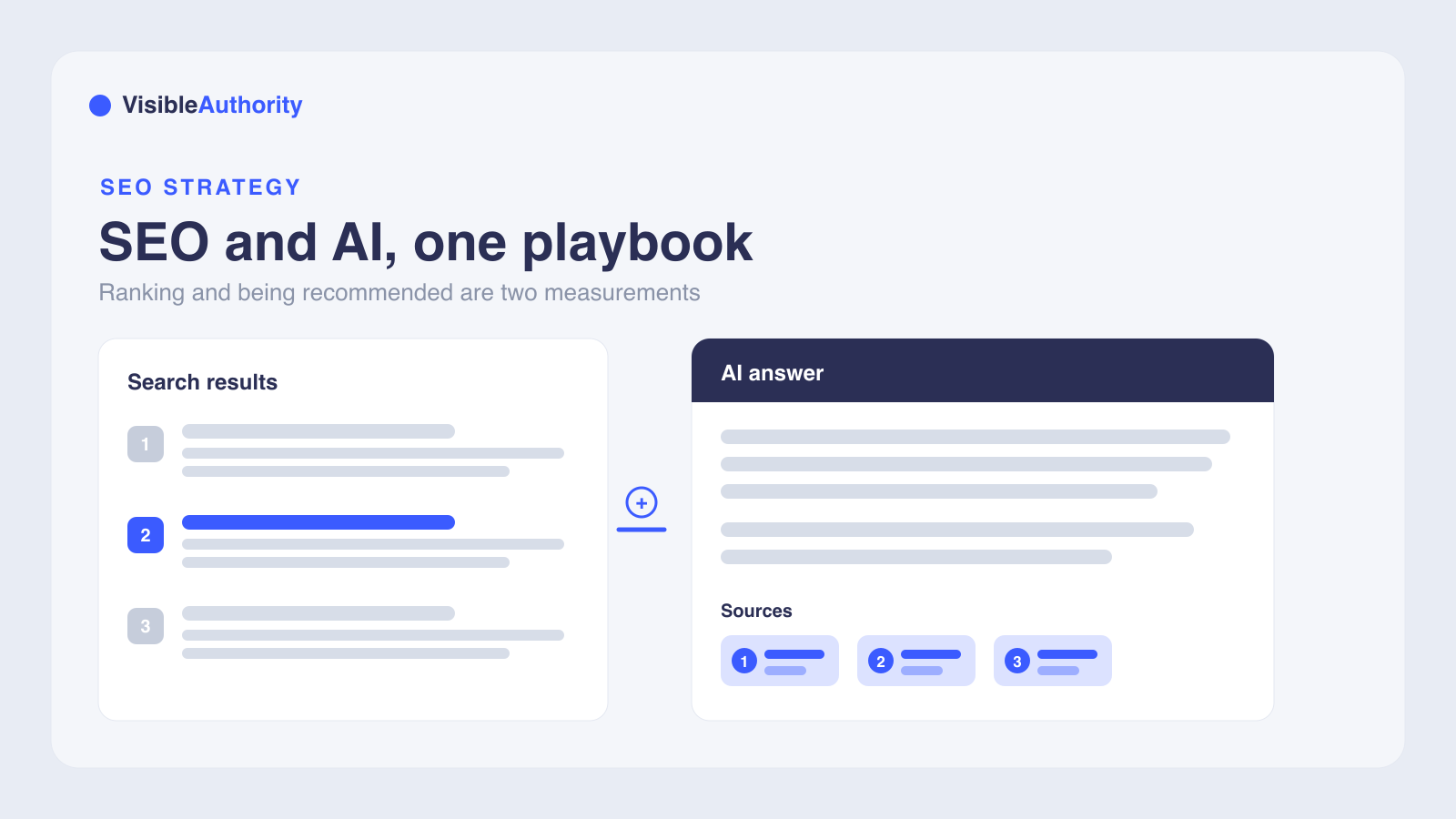
Yes, traditional SEO is still worth investing in, but the strategy has to evolve. Google still processes about 14 billion searches a day and all AI search platforms combined drive under 3% of the traffic Google delivers, so your technical SEO foundation stays essential. What changed is that the pages ranking in Google's top 10 no longer match the sources AI models cite, so ranking and being recommended are now two separate measurements. Keep your SEO fundamentals intact and layer answer engine optimization on top: track your AI mention rate across ChatGPT, Perplexity, Gemini, and Claude, and shift incremental budget toward closing the gap between ranking and being recommended.
B2B software buyers now ask ChatGPT, Perplexity, or Gemini for vendor recommendations before they type a query into Google. That shift raises a real question for marketing leaders: is traditional SEO still worth investing in now that buyers use AI search? The short answer is yes. But the strategy behind that investment has to evolve.
We help B2B SaaS companies with $10K to $200K MRR and AI tool startups optimize their visibility inside AI-generated answers. The question we hear most often from founders and marketing leaders is whether they should keep spending on traditional SEO or shift everything to AI visibility. The answer is to maintain your SEO foundation while testing whether your brand is actually named when buyers prompt ChatGPT, Perplexity, Gemini, and Claude for recommendations.
Executive summary: is traditional SEO still worth investing in?
Google still processes 14 billion searches per day. AI search platforms combined drive less than 1% of web traffic as of mid-2025. By volume alone, traditional search remains the dominant discovery channel for B2B buyers.
But AI Overviews now appear on roughly 48% of tracked queries, and when they appear, 80 to 83% of searches end without a click. The buyer who once scrolled through blue links now reads a synthesized answer and may never visit your site.
The verdict: maintain your SEO investment and layer answer engine optimization on top. The distinction that matters now is between ranking in Google and being named when a buyer asks ChatGPT or Perplexity for a recommendation. The brands that close that gap will be the ones running live prompt tests across multiple AI models, tracking their AI mention rates, and refining content until those rates move. Ranking and being recommended are two separate measurements, and both need budget.
Why traditional SEO fundamentals still matter in the AI era
Technical SEO, crawlability, and page experience remain the foundation of online visibility. AI models like ChatGPT, Perplexity, Gemini, and Claude still crawl and index well-structured web content to generate their answers. Your site needs technical SEO fundamentals for both Google and AI models to parse and surface it.
High-quality content that demonstrates E-E-A-T (Experience, Expertise, Authoritativeness, Trustworthiness) is what AI models surface in synthesized responses. Author bios, primary research citations, and demonstrable expertise give AI engines the signals they need to trust and recommend your brand.
Link building and domain authority still influence whether AI engines consider a brand credible enough to cite. AI models weight brand authority signals alongside on-page content when deciding which sources to include in generated answers.
SEO also compounds in ways that paid campaigns do not. Organic traffic continues to deliver after investment pauses. Google reports that total organic click volume has been relatively stable year over year, with average click quality increasing. All LLM platforms combined still account for only 2 to 3% of the organic traffic Google delivers, per Search Engine Land analysis.
How AI search changes buyer research and search behavior
AI Overviews and generative search tools have introduced zero-click searches at scale. Pew Research Center analyzed web browsing data from 900 U.S. adults in March 2025. Users who encountered an AI summary ended their browsing session 26% of the time. Pages without a summary saw a 16% session-end rate.
The click-through impact is measurable. Seer Interactive analyzed 3,119 search terms across 42 organizations and 25.1 million organic impressions. Organic CTR for queries with AI Overviews fell 61%, from 1.76% in June 2024 to 0.61% by September 2025. Even queries without AI Overviews saw organic CTR decline 41% over the same period.
B2B buyers increasingly ask AI models for vendor comparisons and recommendations, bypassing the traditional SERP entirely. When a brand is cited in an AI Overview, it receives 35% more organic clicks. It also receives 91% more paid clicks than when it is not cited, per the same Seer Interactive analysis.
AI-referred traffic is growing fast from a small base. The Previsible AI Traffic Report, cited on Semrush's blog, found that AI-referred traffic rose 527% when comparing January through May 2025 against the same months in 2024. The conversion picture is less clear. Adobe's Brand Visibility page, citing Semrush (an Adobe company), states that AI-referred visitors convert at 4.4x the rate of organic search visitors. Semrush's companion page labels the same 4.4x figure as CTR rather than conversion rate, so the precise metric remains unresolved. Gartner's February 2024 prediction was also widely misread. The forecast said traditional search engine query volume would drop 25% by 2026 as AI chatbots absorb queries previously run on traditional search engines. It did not say brands would lose 25% of their web traffic.
How AI search works: foundational concepts for content creators
Large Language Models (LLMs) like GPT-4, Gemini, and Claude process and synthesize information from web content to generate answers. AI engines determine which fragments of information are credible enough to include in a generated answer. Structured data and schema markup help models understand and cite your content accurately.
AI Overviews no longer pull citations exclusively from the top-ranked pages. The share of citations from top-10 pages dropped from 76% in July 2025 to 38% in March 2026, per Ahrefs analysis. Semrush, in partnership with Datos, analyzed over 10 million keywords. AI Overview prevalence was volatile throughout 2025: 6.49% of keywords in January, peaking at nearly 25% in July, then declining to 15.69% by November.
The mix of query types triggering AI Overviews has also shifted. In January 2025, 91.3% of queries triggering AI Overviews were informational. By October, that share fell to 57.1%, with commercial and transactional queries rising. Navigational queries triggering AI Overviews grew from 0.74% to 10.33% over the same period.
AI models weight E-E-A-T signals and brand mentions across the web, including off-page sources, when deciding which brands to recommend. Building entity-level brand presence across multiple sources matters more than keyword density alone.
Traditional SEO vs. answer engine optimization and generative engine optimization
Traditional SEO focuses on ranking in search engine results pages (SERPs) to earn clicks. Answer Engine Optimization (AEO) focuses on being named and cited inside AI-generated answers from models like ChatGPT, Perplexity, Gemini, and Claude. Generative Engine Optimization (GEO) focuses on optimizing content for inclusion in generative AI responses and AI Overviews.
The metrics differ because the goals differ. SEO measures rankings and clicks; AEO and GEO measure citations, brand mentions, and share of AI voice. John Dawson, VP of strategy at Jellyfish, recommends unifying SEO and GEO as one approach rather than treating them as separate disciplines.
The overlap between top-10 rankings and AI answer citations has collapsed from 75% in mid-2025 to 17 to 38% by early 2026. Winning traditional SEO no longer guarantees visibility in AI-generated answers. A brand can rank in the top 10 for a competitive B2B SaaS query and still never appear when a buyer asks ChatGPT for a recommendation.
A unified playbook for SEO, GEO, and AEO
Maintain technical SEO fundamentals first. Site speed, crawlability, mobile optimization, and clean site architecture remain prerequisites for both traditional and AI search visibility. Without this foundation, neither Google nor AI models can effectively parse and surface your content.
Several practices work across all three disciplines:
The same structured data that helps Google parse your pages also helps ChatGPT and Perplexity cite them. A single comparison page can rank in Google, appear in an AI Overview, and get recommended by Claude if it is built for both human and machine reading.
That shared infrastructure is why treating SEO, GEO, and AEO as separate budgets wastes resources. The technical foundation in the previous section supports all three; the content and brand strategies below do the same.
Testing across models is what separates a guess from a strategy. Running live prompts against ChatGPT, Perplexity, Gemini, and Claude shows exactly where your brand appears and where competitors are named instead.
The following actions apply across SEO, GEO, and AEO:
- Implement structured data and schema markup to help AI models understand and cite your content accurately
- Strengthen E-E-A-T signals with author bios, primary research, and demonstrable expertise that AI models can verify
- Create answer-first content: comparison pages, recommendation lists, and direct answers to buyer questions that AI models can synthesize and cite
- Build brand mentions and entity validation across the web; AI models weight brand presence across multiple sources when deciding which brands to recommend
- Test AI prompts across models to identify where your brand is missing in AI-generated answers and refine content accordingly
Focus on content that serves both human readers and LLMs. Helpful, reliable, people-first content that uses clear structure is what AI models can parse and what human buyers want to read. The two audiences are not in conflict.
Metrics and measurement in the AI search era
Traditional SEO metrics still matter. Organic traffic, keyword rankings, and conversion rates from Google Search Console and GA4 remain foundational. But the framework for measuring brand visibility in AI search needs to expand beyond rankings and clicks.
Google launched the Generative AI performance report in Search Console in June 2026, showing impressions in AI Overviews and AI Mode by page, country, and device. Traffic from AI Overviews and AI Mode is attributed to Organic Search in GA4, not AI Assistant, which means your existing dashboards may already capture some of this traffic.
New AI-era metrics to track include share of AI voice (how frequently AI tools cite your brand), prompt visibility (which user questions trigger your brand in AI responses), and SERP saturation. Being cited in AI Overviews drives 35% more organic clicks, making citation tracking a high-value metric for any B2B team. AI-referred visitors also browse 12% more pages per visit and show a 23% lower bounce rate than traditional organic visitors.
What to stop over-investing in (and what to re-evaluate)
Reduce investment in aggressive keyword stuffing and thin content. AI models penalize low-quality content, and Google's core updates can penalize sites producing content purely for visibility. The risk of losing ranking traction through quality shortcuts outweighs any short-term gain.
Re-evaluate a sole focus on traditional SERP rankings. If you rank in the top 10 but never appear in AI Overviews or AI-generated answers, your visibility is narrowing as more buyers rely on synthesized responses. Shift budget from ranking-only tracking to citation and AI visibility tracking.
Glenn Gabe warns that neglecting core search quality can lead to declines from Google's broad core updates. Do not over-invest in AI strategies at the expense of SEO fundamentals. Scale back outdated link-building tactics: AI models weight brand mentions and entity validation more than raw link counts.
Reallocate resources toward content that earns citations in AI answers, including clicks from blue links. Track organic traffic and keyword rankings alongside AI mention rates, prompt visibility, and citation frequency to see the full picture.
Frequently asked questions
Is SEO dead because of AI search?
Does AI search drive real traffic to websites?
Should I stop investing in traditional SEO and focus only on AEO?
How do I measure SEO success when AI Overviews reduce clicks?
Will AI search replace Google entirely?
Next steps for your AI-era visibility strategy
Audit your current visibility across both traditional search and AI-generated answers to identify where you are missing. You may be ranking well in Google while remaining invisible to buyers who ask AI models for recommendations.
Start with a structured sprint. We map your AI visibility across major models, deploy answer-first content, and measure before-and-after mention rates to deliver measurable improvements within 30 days. You get a baseline assessment, a content deployment plan, and clear before-and-after results.
Contact VisibleAuthority to assess where your brand stands in AI-generated answers from ChatGPT, Perplexity, Gemini, and Claude. We will map your current AI visibility, identify the gaps, and build a roadmap that unifies SEO and AEO investment for the months ahead.
We'll run your category through the major models and map exactly where you appear, where competitors win, and what it takes to become the recommendation.