
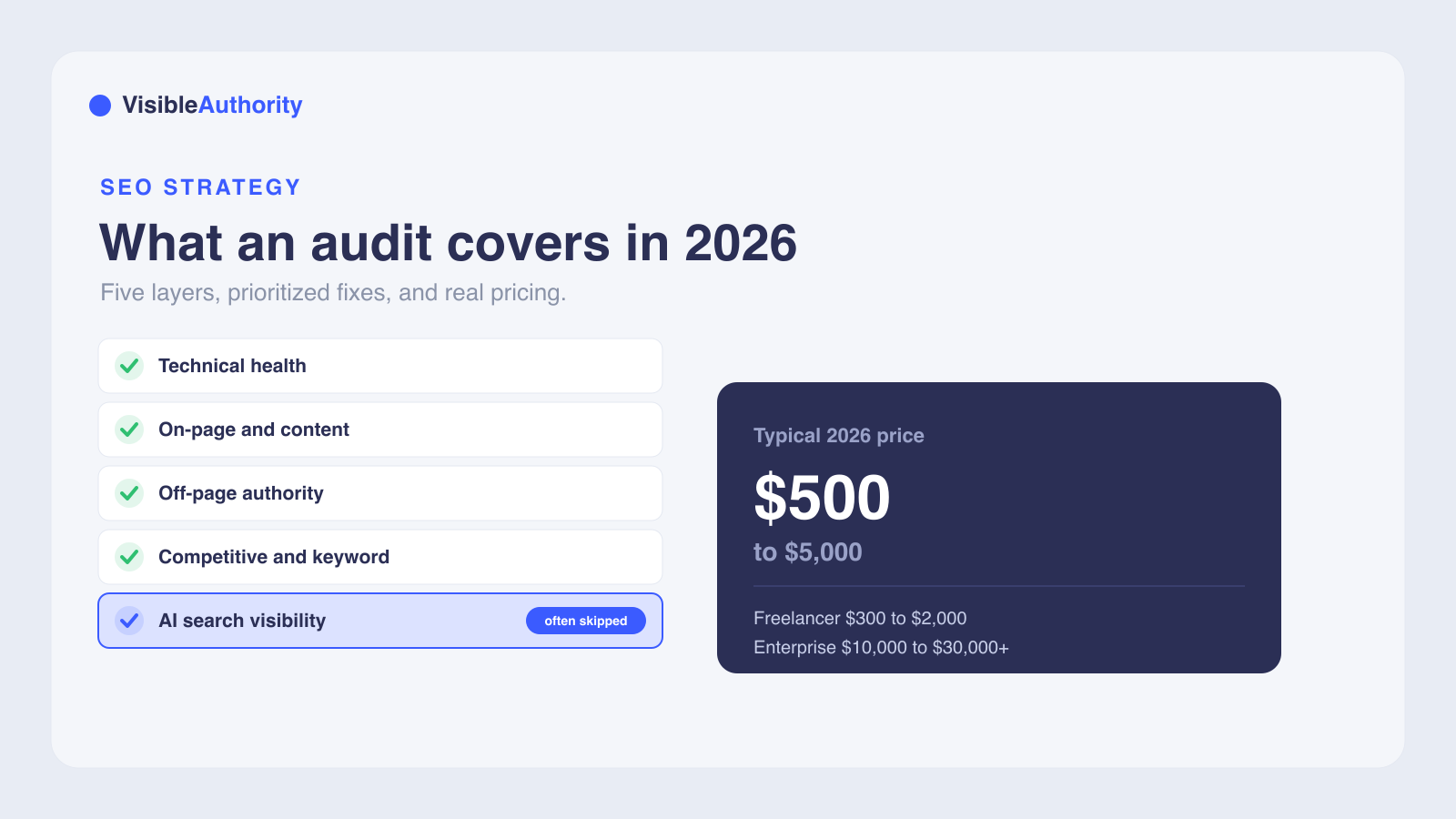
A professional SEO audit is a manual, expert-led review of how well your site can be found, understood, and recommended, across five layers: technical health, on-page and content, off-page authority, competitive and keyword analysis, and, in 2026, AI search visibility. What you are really paying for is prioritization, the three to eight fixes that drive most of the revenue, not a 200-item data dump. Most professional audits cost 500 to 5,000 dollars, with freelancers around 300 to 2,000 dollars, boutique agencies 2,000 to 10,000 dollars, and enterprise 10,000 to 30,000 dollars or more, scaled by site size, manual depth, and auditor seniority. Insist on deliverables with a prioritized roadmap, named owners, and evidence, and remember the ROI comes from implementing the fixes, not from the document itself.
What does a professional SEO audit include and how much does it cost? If you are a B2B SaaS founder or marketing lead evaluating whether to commission an audit, you need a straight answer to both parts. This guide covers every component a credible audit includes, what deliverables to expect, and real 2026 pricing by provider type and site size.
What is a professional SEO audit?
A professional SEO audit includes a manual, expert-led analysis of how well your site can be found, understood, and recommended by search engines. It is not an automated tool report. The purpose is plain: find what is suppressing rankings and traffic now, what opportunities exist, and what to fix first for revenue impact.
SEO audits tend to pay for themselves: in a WebFX survey, the large majority of businesses reported that audits improved rankings, traffic, and revenue. In 2026, an audit should cover two surfaces: traditional search results and AI-generated answers from ChatGPT, Perplexity, Gemini, and Claude. If your audit only checks Google rankings, it misses where buying decisions happen.
The core components every audit should cover
The core SEO audit components fall into five layers: technical health, on-page and content, off-page authority, competitive and keyword analysis, and AI search visibility. A good auditor separates critical issues, usually three to eight items that account for most of the ranking opportunity, from housekeeping. A report listing 200 issues in alphabetical order is a data dump, not an audit. Prioritization is what you are paying for. Standard tools include Google Search Console, Screaming Frog, Ahrefs, Semrush, and Moz.
Technical SEO audit: crawlability, indexation, and site health
The technical layer checks whether search engines can access and understand your site. That means verifying crawlability, indexation, Core Web Vitals, site architecture, redirects, JavaScript rendering, and structured data.
- Crawlability and indexation: robots.txt rules blocking too much, misapplied noindex tags, crawl traps, XML sitemaps with 404s
- Core Web Vitals: LCP, CLS, and INP reflect real user experience; auditors check field data from Search Console and lab data from PageSpeed Insights
- Site architecture: core pages reachable within three clicks, orphaned pages, internal anchor text alignment
- Duplicate content and canonicalization: faceted navigation, parameter handling, www vs non-www, trailing slashes splitting ranking signals
- Redirects: chains of three can erode link equity; 404s with inbound links are high-ROI fixes
- JavaScript rendering: client-side content can delay indexation; auditors check for static HTML fallbacks
- Structured data: schema validation errors and coverage gaps on core page types
On-page and content audit: relevance, quality, and gaps
The on-page SEO audit checks whether each page communicates its topic clearly and matches what searchers want. Title tags, meta descriptions, heading structure, and image alt text are reviewed for whether search engines understand each page. The content audit covers depth, uniqueness, and freshness, flagging thin or duplicate pages. Content gap analysis identifies topics competitors rank for that your site does not cover. For B2B SaaS, the audit should weight comparison and alternative queries heavily because those queries map to late-funnel buying intent and competitor displacement opportunities.
Off-page and backlink audit: authority and risk
The off-page SEO layer evaluates links pointing to your site. Backlink profile analysis looks at referring domain quantity, quality, and diversity. Anchor text distribution is checked for over-optimization, a penalty signal. Toxic backlink identification flags spammy links for disavow. Competitor backlink comparison reveals link gaps that represent the fastest authority wins. If traffic dropped, penalty recovery analysis checks for manual actions or algorithmic suppression.
Competitive analysis and keyword research
An auditor maps competitors' technical and content strengths against your site. Keyword gap analysis identifies queries where competitors rank and you do not, prioritized by commercial value. For B2B SaaS, comparison and alternative queries are where buying decisions happen. These findings should turn into a prioritized roadmap, not a list of observations.
Local SEO audit: visibility in your service area
For location-based businesses, a local SEO audit checks Google Business Profile optimization, NAP consistency across directories, local citations, and customer review signals. If you sell globally as a B2B SaaS company, skip this section. It matters most for agencies, consultancies, and service businesses tied to a geography.
AI search visibility: the audit layer most providers still skip
AI search visibility is the audit layer most providers still skip, and it is where buying decisions increasingly happen. GEO citation checks identify which third-party pages AI models pull from.
This is where our AI Visibility Mapping fits. It analyzes buyer queries across major AI models to find where a brand is missing from AI-generated answers. Ask any prospective auditor: does your audit include AI visibility, or only Google rankings?
What deliverables should you receive?
The SEO audit deliverables you receive should include:
- A prioritized findings report, critical issues separated from housekeeping, ranked by traffic and revenue impact
- An action plan with specific fixes, owners, and effort estimates
- A walkthrough call so your team can ask questions and sequence the work
- Evidence behind each finding: data, screenshots, or exports
A tool-generated PDF with no human interpretation is a report, not an audit. A good test: if a proposal lacks a named owner per finding and a stated implementation plan, you are buying a document, not an audit.
How much does a professional SEO audit cost?
SEO audit pricing in 2026 ranges from $500 to $5,000 for most professional work, with enterprise reaching $10,000 to $30,000 or more. In the same WebFX survey, a large share of businesses paid under $750, with smaller sites skewing to the low end, while professional, strategy-led audits land higher in the $500 to $5,000 range and the distribution thins out sharply above $2,500.
By provider type: solo freelancers charge $300 to $1,500. Senior independent consultants and small boutiques charge $1,500 to $6,000. Boutique agencies charge $2,000 to $10,000. Large agencies and enterprise firms charge $10,000 to $30,000 or more.
By site size: 1 to 20 URLs cost $300 to $800. Sites with 20 to 80 URLs cost $800 to $2,000. Sites with 80 to 500 URLs cost $2,000 to $5,000. Sites with 500 to 10,000 URLs cost $5,000 to $10,000.
By audit type: automated or AI-light $50 to $250; basic manual $300 to $800; standard professional $800 to $3,000; advanced strategic (B2B SaaS territory) $3,000 to $10,000; enterprise $10,000 to $30,000 or more. DIY tools like Semrush, Ahrefs, and Screaming Frog run $10 to $139 per month, but they surface data, not strategy.
What drives the price up or down
Several SEO audit cost factors move the price:
- Site size: a 50-URL audit takes hours; a 50,000-URL audit takes weeks of senior time
- Manual depth: tool-only audits skip the interpretation layer, where the real work happens
- Auditor experience: senior auditors bill several times junior rates (roughly $150 to $350/hour versus $40 to $80/hour)
- Scope: technical-only costs less than a full-stack audit
- Turnaround: rush timelines carry premium pricing
- Industry: YMYL sectors require extra E-E-A-T evaluation and cost more
Pricing red flags: $49 instant audits are lead magnets. Guaranteed rankings bundled with an audit is an ethics violation. Long-term contracts required just to get the audit should make you question the provider.
How to choose the right audit provider
- Automated tools: cheap and fast, good for monitoring, but no strategy
- Freelance consultants: $300 to $2,000, best for specific problems and small sites
- Boutique agencies: $2,000 to $10,000, deeper specialist coverage, the sweet spot for growing B2B SaaS
- Enterprise firms: $10,000 or more, justified for multi-market or M and A due-diligence scenarios
When you choose an SEO audit provider, demand: sample deliverables, clear prioritization, transparent scope, no ranking guarantees, and AI visibility coverage. We run audits with live AI prompt testing across models, so findings cover both search rankings and AI recommendations.
After the audit: implementation is where the ROI lives
An audit without implementation is a diagnostic, not a treatment. SEO audit implementation starts with sequencing: critical technical fixes first, because they unblock everything else, then content and authority building. Options include in-house work, project-based help, or a retainer. A common SEO retainer range is $2,500 to $5,000 per month.
Re-audit quarterly for competitive markets, annually for stable ones. For B2B SaaS in contested categories, a structured engagement like a 30-day sprint can turn audit findings into measurable before-and-after results quickly.
FAQ: SEO audit scope and pricing
How much does an SEO audit cost in 2026?
How long does a professional SEO audit take?
Are free SEO audits worth it?
Can I run an SEO audit myself with free tools?
Should an SEO audit include AI search visibility?
- A professional SEO audit is manual and expert-led; prioritization is what you are paying for
- Most audits cost $500 to $5,000 in 2026, with enterprise reaching $30,000 or more
- A 2026-grade audit must cover both search results and AI-generated answers
- Demand deliverables with a prioritized roadmap, named owners, and evidence
- Implementation is where the ROI lives; an audit without action is just a diagnostic
Get an audit that covers AI answers, not just rankings
Know exactly where you stand in Google results and in AI-generated answers from ChatGPT, Perplexity, Gemini, and Claude. Request an audit that covers both traditional SEO health and AI visibility mapping. You can see what is suppressing rankings now and what is keeping your brand out of AI recommendations.
We'll run your category through the major models and map exactly where you appear, where competitors win, and what it takes to become the recommendation.