
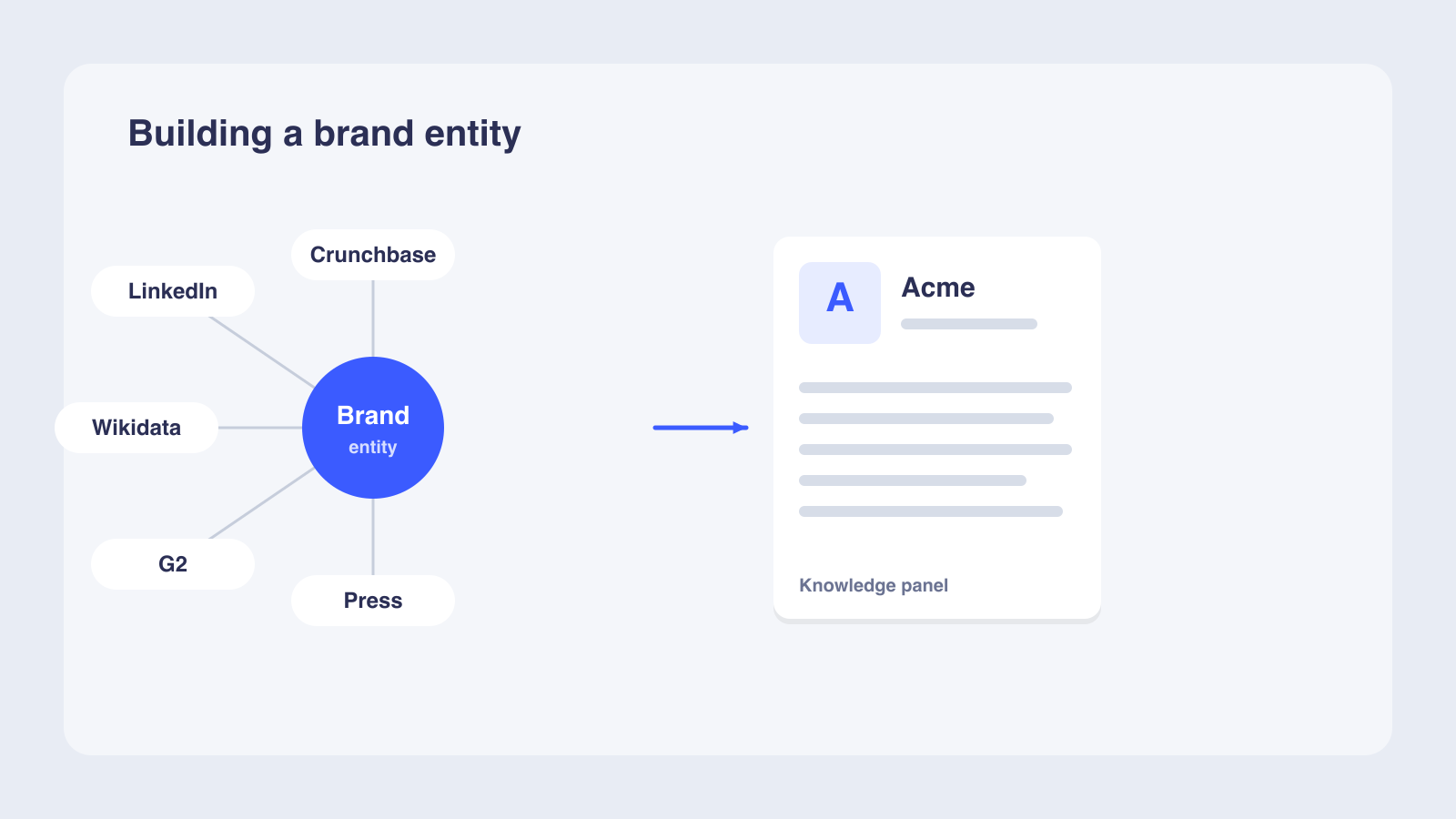
To establish your brand as an entity in Google's Knowledge Graph, you need a single canonical identity that is corroborated across your website, structured data, external profiles, and independent press. In practice that means using one exact brand name everywhere, adding Organization JSON-LD (name, url, a logo at 112 by 112 pixels or larger, and sameAs links to every official profile) on one page, aligning every profile you control so names, descriptions, URLs, and logos match, adding sourced Wikidata statements, and earning accurate press coverage. Google only shows a Knowledge Panel once it has enough independent corroboration, so schema alone is not enough. You can check progress for free with the Knowledge Graph Search API, which returns an entity id when Google recognizes you and nothing when it does not.
Establishing your brand as an entity in Google's Knowledge Graph requires consistent work across your website, structured data, external profiles, and earned press. You need a canonical brand identity, Organization schema markup with sameAs links, aligned profiles, and independent corroboration before Google's entity resolution algorithm recognizes you. The process is measurable: the Knowledge Graph Search API returns a concrete @id when Google has an entity for you, and zero results when it does not. The tools are free, but the process requires sustained effort and monthly monitoring.
What you need before establishing a brand entity
Google's Knowledge Graph aggregates data from Wikipedia, Wikidata, structured data on the web, licensed databases, and its own crawling. Google does not publicly specify a fixed number of independent sources required for its entity resolution algorithm to gain confidence that its understanding of your brand is accurate. A Knowledge Panel is the visible expression of that understanding. A brand can exist in the graph without a visible panel, and panels vary by query, country, and device.
Audit your current entity presence
- Search your exact brand name on Google and note whether a panel appears on the right side of the results.
- Check for name variants and possible namesakes that could cause disambiguation problems.
- Save a dated baseline screenshot of your branded search results for later comparison.
Gather your canonical facts
- Legal name, founding year, founder names, and headquarters location.
- What you sell and who your customers are, stated in one sentence.
- Official website URL and logo file at a minimum of 112 by 112 pixels.
- Complete list of every official profile you control (LinkedIn, X, YouTube, Crunchbase, GitHub).
Quick test: query the Knowledge Graph Search API at kgsearch.googleapis.com/v1/entities:search?query=YOUR+BRAND+NAME&key=API_KEY&limit=5 to check in under one minute whether Google already has an entity for your brand.
How to establish your brand entity, step by step
Four implementation steps move your brand from an unverified name to a disambiguated entity Google can validate. Each step adds a corroborating signal, from your website's structured data to independent press, that the Knowledge Graph API can measure.
Canonical identity and schema
Make your website the canonical source. Use one exact brand name across title tags, logo alt text, footer, and legal pages. Add Organization JSON-LD to your home page or About page only, with name, url, logo (at least 112 by 112 pixels per Google's Organization schema documentation), and sameAs linking to every official profile. Google recommends placing Organization structured data on a single page that describes your organization. A minimal Organization schema looks like this:
{
  "@context": "https://schema.org",
  "@type": "Organization",
  "name": "Your Company",
  "url": "https://yourcompany.com",
  "logo": "https://yourcompany.com/logo.png",
  "sameAs": [
    "https://linkedin.com/company/yourcompany",
    "https://twitter.com/yourcompany",
    "https://youtube.com/@yourcompany",
    "https://github.com/yourcompany",
    "https://crunchbase.com/organization/yourcompany"
  ]
}
Profile alignment and two-way links
Audit every profile you control for exact name (including spacing and capitals), matching one-line description, website URL pointing to your canonical home page, the same logo file, and correct founding year. Make links two-way so your site's sameAs and the profile's link back reconcile into one entity. A single mismatch across profiles weakens entity resolution confidence.
Wikidata and independent press
Build Wikidata presence with sourced property statements: instance of, founded by, inception, headquarters, industry, and external identifiers like LinkedIn ID and Crunchbase ID. Wikidata requires verifiable existence backed by serious, publicly available references. Its notability bar is lower than Wikipedia's. Any organization with a verifiable external record can meet it.
Earn independent press coverage in trade publications or news sites that name and describe your brand accurately. One accurate description in a respected outlet outweighs many directory listings. Do not write your own Wikipedia article.
Wikipedia requires significant coverage in independent, reliable sources, and self-created articles are likely to be deleted. If your brand meets that standard, an independent editor will usually create the article. Focus on earning coverage first.
Worked example: a SaaS company with zero entity presence implements Organization schema with a 112 by 112 pixel logo, aligns its profiles with two-way links, and earns press mentions. Those steps supply the corroborating signals that establish the brand as a Knowledge Graph entity.
Mistakes that block Knowledge Panel recognition
Schema placement and data conflicts
- Placing Organization schema on every page dilutes the signal. Place it on one page that describes your organization, as Google's documentation recommends.
- Conflicting data across sources is worse. When your schema, website, and external profiles disagree on name, address, or description, Google's entity resolution loses confidence in your identity. Fix the underlying source first, or the wrong fact may return after you correct the panel.
Self-promotion and over-reliance on markup
- Creating self-promotional Wikidata or Wikipedia entries violates both platforms' policies. Both discourage writing about yourself, and entries are likely to be deleted. Add neutral, sourced statements to Wikidata instead. If your brand meets Wikipedia's notability standard, an independent editor will usually create the article.
- Expecting Organization markup alone to trigger a panel is the most common mistake. JSON-LD declares your identity to Google, but Google requires independent corroboration from multiple sources before displaying a panel. For more on what schema does and does not do, see VisibleAuthority's analysis of whether schema markup helps AI citations. Markup is a signal, not a trigger.
A 30-day entity establishment worked example
The following is an illustrative plan, not a guaranteed timeline, since earning press is the variable that most often stretches it.
Starting point: zero entity presence
A B2B SaaS company starts with no Knowledge Panel and no entity returned by the Knowledge Graph Search API.
- API query with limit=5: zero results.
- Days 1 to 5: audit entity presence, inventory name variants, choose the canonical facts for Organization schema.
- Dated baseline screenshot of branded search results saved for later comparison.
What changed by day 30
- Days 6 to 10: complete the About page with a one-sentence definition, deploy Organization JSON-LD with sameAs to every official profile.
- Days 11 to 18: correct all profiles for name, description, website link, and logo consistency, and add sourced Wikidata claims.
- Days 19 to 30: publish original research that earns three trade-press mentions.
The full 30-day cycle breaks down into five phases: 5 days audit, 5 days website updates, 8 days external consistency, 7 days evidence, and 5 days validation. The two-way links between the profiles and the site were an implementation step; the three press mentions from original research provided the independent sources Google needed to display a panel.
How entity establishment changes for local and online brands
The signals you need depend on whether you serve customers at a physical location, online only, or both. Match your business type to one of three scenarios to see which signals and panel format apply.
Local business signals
Local businesses with physical locations get panels from Google Business Profile. Set it up, verify it, and keep name, address, phone, and hours identical to your website. Google Business Profile panels appear for location-based queries and include reviews, hours, and maps. Keep NAP (name, address, phone) consistent across every directory and profile.
Online brand signals
Online businesses, SaaS companies, and agencies aim for a standard Knowledge Panel built from Organization schema, Wikidata, and independent press. Some businesses need both: a Google Business Profile for each location plus a brand-level Knowledge Panel for the parent company. The brand-level panel draws on schema, sameAs, and press coverage.
| Signal type | Physical-location business | Online-only brand | Hybrid (both) |
|---|---|---|---|
| Primary panel source | Google Business Profile | Organization schema plus press | Business Profile plus Knowledge Panel |
| Key signals | NAP, reviews, hours | sameAs, Wikidata, press | All of the above |
| Panel format | Local with map and reviews | Standard with description and links | Local for locations, brand for parent |
Horizontal knowledge panel cards, showing 4 to 6 photos alongside the homepage and dynamic content, have become triggerable for corporations since early 2025, according to Search Engine Land. These cards appear at the top of the brand SERP and take significant space.
How long entity establishment takes and when to call a professional
Timeline breakdown
The audit and disambiguation phase runs about 5 days, and the external consistency phase another 5 days. Earning independent press coverage, the longest part, often extends the timeline to weeks or months.
Direct tool costs are minimal. Organization schema is free to implement. Wikidata is free to edit. The Knowledge Graph Search API is free to query; the examples here pass limit=5, though the API's own default is 20 results per query (up to a maximum of 500).
Entity records can also change or disappear over time, particularly newer ones with /g/ machine identifiers, so ongoing monitoring is worthwhile. Budget time each month to recheck your entity status and branded queries.
When to seek professional help
If your team lacks the time or expertise to manage schema, profiles, Wikidata, and press outreach simultaneously, VisibleAuthority can compress the timeline and avoid costly missteps. Managing all four workstreams in parallel requires sustained attention that most marketing teams cannot spare from their day-to-day work.
How to check whether Google recognizes your brand
API and panel checks
- Search for your exact brand name. If a panel appears, claim it by clicking Claim this knowledge panel and verifying through Search Console.
- Not every panel is claimable yet, so check periodically for the claim button to appear.
- Query the Knowledge Graph Search API with your brand name and API key (
limit=5). A result with an@idlikekg:/g/11abc123means Google recognizes you even without a visible panel. - No results from the API means Google does not recognize you yet. Continue building corroboration signals.
Connecting entity clarity to AI visibility
AI models draw on many of the same structured sources Google's Knowledge Graph uses to decide which brands to name in answers. The connection between entity clarity and answer engine optimization is direct.
Entity confusion directly hurts AI visibility. When Google's Knowledge Graph describes a brand incorrectly, AI models can repeat that wrong description in their answers. Search Engine Land documented a U.K. activewear brand, TALA, that the Knowledge Graph labeled a financial services company because a larger same-named fintech owned the entity; TALA then appeared in none of the athleisure recommendations the tested AI models produced. A clear, corroborated entity identity lets AI models disambiguate and cite your brand with confidence.
If entity gaps are blocking your visibility in AI answers, VisibleAuthority maps where your brand is missing across major AI models and deploys content that improves AI mention rates.
Frequently asked questions
How long does it take to get a Knowledge Panel for my brand?
Can I create a Wikipedia page for my own company?
Does adding Organization schema automatically trigger a Knowledge Panel?
What is the difference between a Google Business Profile and a Knowledge Panel?
How do I check if Google recognizes my brand as an entity?
Why does entity clarity matter for AI search and answer engines?
Next steps
Once your entity is established, verify it monthly using the Knowledge Graph Search API and branded search. Recheck your sameAs links for broken URLs and confirm that your panel still displays accurate information. Google can change panel content based on what it finds on the web, so your work does not end at recognition.
If entity gaps are blocking your AI search visibility, request a 30-Day Visibility Sprint. The sprint maps where your brand is missing across major AI models and deploys content that closes those gaps.
A monthly check of branded search results, your Knowledge Graph Search API record, and your panel content catches these changes early. Without it, AI models pick up the wrong description and repeat it in their answers.
We'll run your category through the major models and map exactly where you appear, where competitors win, and what it takes to become the recommendation.