
Yes, Bing SEO matters for ChatGPT visibility, but less than older advice claims. Getting indexed by Bing is close to non-negotiable, because Bing is one of the search providers ChatGPT pulls its initial results from. But ranking in Bing is neither necessary nor sufficient for a citation: ChatGPT also draws on Google results and its own crawler, then reranks everything with its own model. The 2025 citation data has shifted toward Google overlap, and many of ChatGPT's most-cited pages do not rank at all. So treat Bing indexation as table stakes, keep your Google hygiene strong, and win citations with extractable, well-structured content that any model can quote.
Yes, Bing SEO matters for ChatGPT search visibility, but less than most 2024-era advice claims. Bing indexing is a prerequisite for ChatGPT to find and cite your pages. Yet ChatGPT also draws on Google results and its own crawler, then reranks everything with its own model.
Ranking in Bing is neither necessary nor sufficient for ChatGPT citations. Indexation in Bing is close to non-negotiable; Bing rankings are one input among several. Here is how the pipeline works, what the citation data shows, and what to do about it.
How ChatGPT search actually uses Bing: the two-stage pipeline
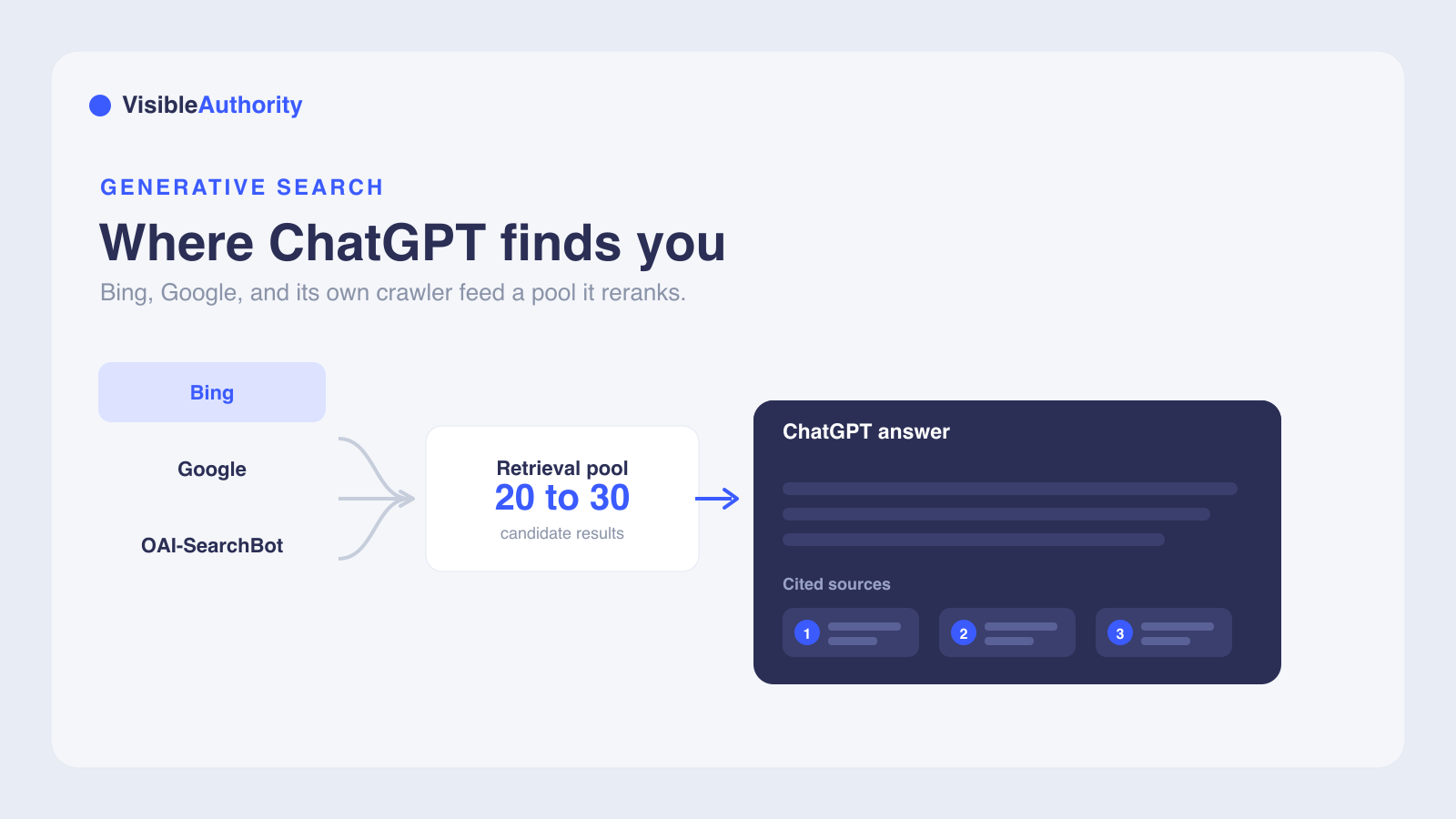
ChatGPT search works in two stages. First, a search provider retrieves an initial pool of web results, reportedly around 20 to 30. Bing is one of those providers, but not the only one. OpenAI's help documentation names Bing and Shopify as third-party search partners, and states that ChatGPT "sometimes partners with other search providers" beyond those two.
Second, ChatGPT's model selects, filters, and synthesizes from that pool. It shortlists promising sources, then cites the ones that are verifiable, linkable, and not paywalled. ChatGPT is not a repackaged Bing results page. It applies its own logic to decide what to read, quote, and cite.
One detail worth noting: ChatGPT appears not to use Bing's local profile data from Bing Places for Business, so optimizing Bing Places does not flow into ChatGPT local answers.
Bing indexation is the hard filter: no index, no citation
If Bingbot cannot crawl and index a page, ChatGPT cannot retrieve it through the Bing pipeline. Indexation is the non-negotiable first step for any ChatGPT visibility effort.
Many sites invest heavily in Google SEO and neglect Bing entirely. No Bing Webmaster Tools account, no sitemap submitted, no verification. They are invisible to half of the retrieval pipeline.
You can check indexation quickly. Search site:yourdomain.com on Bing to see indexed pages at a glance. Use URL inspection in Bing Webmaster Tools for specific pages. Compare your indexed page counts against Google Search Console to spot gaps.
OpenAI also runs its own crawlers: OAI-SearchBot for search and GPTBot for training. Your robots.txt should allow both Bingbot and OpenAI's crawlers unless you have a specific reason to block them. Treat Bing indexation as table stakes, not as a strategy on its own.
Technical SEO that makes your content reachable by Bing and ChatGPT
The technical foundation for ChatGPT visibility starts with making pages crawlable by Bing's indexer and OpenAI's own crawlers. Here is the checklist:
- Verify your site in Bing Webmaster Tools and submit an XML sitemap
- Adopt IndexNow, the instant-indexing protocol Microsoft co-created, so new and updated URLs reach Bing the moment they change
- Configure robots.txt to allow Bingbot and OpenAI's crawlers, and check that disallow rules are not blocking CSS, JS, or rendered content
- Serve clean server-rendered or static HTML, fix redirect chains, and 301 outdated URLs
- Keep URL structures stable and descriptive
The same crawlability and rendering hygiene that helps Bingbot also helps OAI-SearchBot and every other AI crawler. These basics serve double duty across models.
What the citation data shows: Bing rankings vs. ChatGPT citations
Early 2025 data favored Bing overlap, but later tests found stronger Google overlap and substantial non-ranking citations.
In February 2025, Seer Interactive matched 500-plus citations across about 100 questions. About 87% of ChatGPT search citations matched Bing's top 20 organic results, versus 56% for Google. Many matches sat in positions 11 through 20, meaning page two of Bing still counted.
By mid-2025, the picture shifted. Between April and July 2025, norg.ai found ChatGPT's alignment with Google's index rose from 12% to 33%, while Bing alignment fell from 26% to 8%. Langsync's 400-keyword study showed 75% keyword overlap between Google first-page results and ChatGPT citations, versus 55% for Bing, with 1.7 shared brands per query on Google versus 0.9 on Bing. These studies used different vendors, query sets, and methods, so treat the shift as directional rather than exact.
Citation-tracking analyses also find that ChatGPT cites ranking domains far more often than the exact ranking pages, roughly a three to one gap between domain-level and URL-level overlap, and that close to a third of its most-cited pages have little or no Google organic visibility at all.
Search rankings are a poor sole predictor of citation. The Bing-only strategy most 2024 articles recommended is now outdated. Heading into 2026, the balance has tilted toward Google and extractable content, not Bing rank alone.
Why ChatGPT also uses Google (and what OpenAI does not say)
In July 2025, Aleyda Solis published a test that demonstrated ChatGPT uses Google search snippets. She indexed a brand-new page through Google Search Console, and ChatGPT found and described it before Bing had indexed it. ChatGPT confirmed it used a "cached snippet via web search" from Google's publicly indexed version of the page.
Search Engine Land later reported that OpenAI quietly used a Google-search-scraping service, and SerpApi listed OpenAI as a customer. During antitrust proceedings, OpenAI's Nick Turley testified that Bing had "significant quality issues" and that Google's index would accelerate OpenAI's search ambitions.
There is a tier nuance too. Semrush found that the paid ChatGPT Plus tier surfaced Google-indexed content in tests, while the free tier did not. An August 2025 analysis by acme.bot confirmed that ChatGPT's paid-version results were most similar to Google and "actually quite dissimilar to Bing's search results."
OpenAI's public documentation still names only Bing and Shopify. Treat all provider claims as provisional and retest quarterly.
Optimizing for ChatGPT's reranker: where GEO goes beyond Bing SEO
Once a page is indexed and retrieved, a second competition begins. ChatGPT's model decides which of the retrieved pages to actually read, quote, and cite.
Extractability matters. Lead each section with a concise 40 to 60 word answer summary the model can lift directly. Use question-style H2s and H3s that mirror how buyers phrase queries. FAQ blocks, schema markup, definition-style sentences, tables, and short paragraphs all raise the odds a page is readable by an LLM and attributable as a citation.
Authority signals count too. Consistent brand naming, third-party mentions, review platforms, and comparison pages all help, because ChatGPT synthesizes across sources and favors brands it can verify in multiple places.
For B2B SaaS vendors, the queries that matter are "best [category] tool" and "[tool A] vs [tool B]." Those answers are where extractable, well-structured content wins citations. This is also where an AI Visibility Testing Loop pays off, since citation behavior must be measured across models rather than assumed.
A practical Bing-plus-Google checklist for ChatGPT visibility
Run this audit this week to cover both engines ChatGPT uses:
- Verify your site in Bing Webmaster Tools and submit your sitemap
- Enable IndexNow so new and updated URLs reach Bing instantly
- Audit robots.txt for Bingbot, OAI-SearchBot, and GPTBot
- Compare Bing versus Google indexed page counts to find gaps
- Fix crawl errors and redirect chains, and ensure rendered HTML is crawlable
- Add FAQ schema and 40 to 60 word answer summaries to pages that map to buyer questions
- Run the same audit for the queries your buyers ask AI assistants, and track whether your brand is named
One warning. Tactics Bing has historically tolerated better, like heavy keyword density and aggressive exact-match anchors, are exactly what Google's spam systems penalize. Google is now the stronger citation driver. Never sacrifice Google hygiene for Bing.
The only way to know what works is before-and-after mention tracking across ChatGPT, Perplexity, Gemini, and Claude. Measuring AI mention rates over time tells you whether your Bing and Google work is actually producing citations.
These are the questions buyers and marketers ask after learning ChatGPT uses more than Bing.
Frequently asked questions about Bing SEO and ChatGPT
Does ChatGPT use Bing or Google for its search results?
How do I check if Bing has indexed my website?
If my pages rank well on Google, will ChatGPT cite them?
Should I block or allow GPTBot and OAI-SearchBot in robots.txt?
Is optimizing for Bing bad for my Google rankings?
Find out where your brand stands in AI answers today
The fastest way to answer whether Bing SEO matters for your ChatGPT visibility is to test your own brand against the queries your buyers ask.
A visibility mapping exercise runs buyer queries across ChatGPT, Perplexity, Gemini, and Claude, then shows exactly where your brand is missing from AI-generated answers.
Request an AI visibility audit to see the mapping, content, and testing process end to end. A 30-Day Visibility Sprint can deliver measurable improvements in AI mention rates within 30 days, giving you before-and-after results you can act on.
We'll run your category through the major models and map exactly where you appear, where competitors win, and what it takes to become the recommendation.