
You can run automatic SEO optimization as a repeatable cycle that moves your AI mention rate in weeks, not quarters. Map buyer queries, test them across AI models, build answer-first content for the gaps, republish, and retest. The prerequisites are simple: CMS or publishing access, 50 to 150 target buyer queries classified by funnel stage, and live access to at least two AI models.
Sounds familiar? Pick what is true for you
- SaaS / AI startup founderWhy does AI recommend our competitors instead of us?
- Agency & software-house partnerWe spend more time explaining AI search than doing it. What helps?
- SaaS / AI startup founderHow do we measure sign-ups that come from AI?
- Agency & software-house partnerWe don't have AI search skills in house. Can we still sell it?
We answer it in a free audit of your own site, with the report in 24 hours.
What you need before you automate SEO content optimization
Three things stand between you and a working optimization cycle. Get them in place before you write a single prompt.
- CMS or publishing access to update and publish pages without a developer queue. AI models re-cite fresh content, so you will publish or revise pages throughout the cycle.
- 50 to 150 target buyer queries classified by funnel stage: awareness, comparison, and decision. This tells you which AI prompts to test and track.
- Live access to at least two AI models, such as ChatGPT and Gemini.
- A recorded baseline: run every target query through each model and note whether your brand appears. This is the number you measure every improvement against.
How to automate SEO content optimization, step by step
Visible Authority treats SEO content optimization as an AI-mention problem, not a ranking problem. Here is how that cycle runs, with the math to show the gain.
Map buyer queries and record your AI visibility baseline
Sales calls and support tickets give you the exact language buyers use when comparing options. Keyword research fills in volume, but the sales conversation gives you intent.
- Collect buyer queries from sales calls, support tickets, and keyword research, then classify each by funnel stage: awareness, comparison, or decision.
- Record whether your brand is named, mentioned, or absent. This is your AI visibility baseline, the number every improvement gets measured against.
Prioritize revenue gaps and build answer-first content
Revenue impact means asking which missing mention costs you the most pipeline. A query like "best CRM for SaaS startups" that surfaces three competitors but not your brand is worth more than a high-volume query you already win in search.
- Rank the gaps where your brand is missing from comparison and recommendation answers by estimated revenue impact, not search volume.
- Build answer-first content for those gaps: comparison pages, recommendation lists, and direct-answer paragraphs designed to be cited by AI models.
Republish, retest, and measure the mention-rate change
Mention rate is the percentage of your total test prompts where your brand appears in the AI answer. Keep it as your primary before-and-after measure, the one figure you report to leadership and watch move cycle over cycle.
Then run three supporting checks each cycle so a single number does not hide a visibility gap: whether the brand is named explicitly versus merely referenced, whether mentions appear across both models or only one, and whether the answer frames the brand positively or neutrally.
- Republish the updated pages, retest the same prompts through the same models, and record the new mention rate alongside your baseline.
- Log whether each new mention names the brand, which models produced it, and whether the surrounding context is positive or neutral.
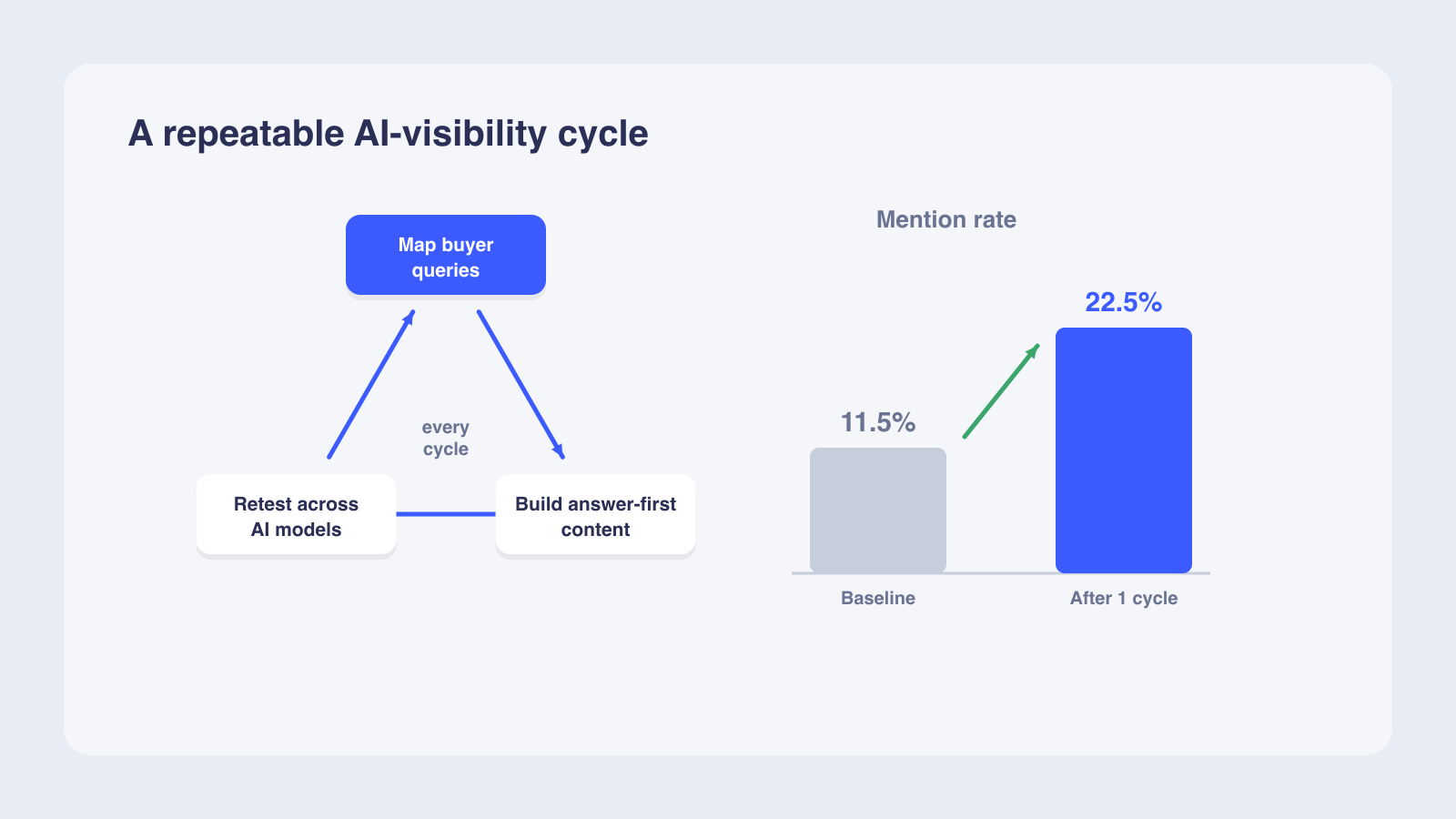
To see how the math works, consider a team that starts with 100 buyer queries and tests each through 2 AI models, for 200 total tests. If their brand appears in 23 answers, that is an 11.5% mention rate. They prioritize 40 high-revenue-gap queries, build answer-first content, republish, and retest all 200. If the brand then appears in 45 answers, that is a 22.5% mention rate, an 11 percentage-point gain from one cycle.
| Measure | Baseline | After one cycle |
|---|---|---|
| Total tests (100 queries x 2 models) | 200 | 200 |
| Answers naming the brand | 23 | 45 |
| Mention rate | 11.5% | 22.5% |
Mistakes to avoid when automating SEO content work
Four mistakes can derail an optimization program before it produces results. Each one is avoidable if you know what to watch for.
Review gaps and quality control
Publishing AI-generated content without human review is the most common failure point. In Keyword.com's 2026 report "State of AI and Automation in SEO," which collected 97 usable responses from SEO professionals, 70% named poor-quality output, hallucinations, or quality-control time as their biggest limitation, and in the same report roughly 44% said a human checks AI-generated work before it goes live. Skip the review step and you ship content that AI models may cite inaccurately, which undermines the trust signal you are trying to build.
Measurement and coverage blind spots
- Optimizing for traditional rankings alone. If AI models do not name your brand in comparison answers, a page-one ranking will not close the gap.
- Skipping the baseline. Without a before number, you cannot prove the content system moved the needle or justify the spend to leadership.
- Testing only one AI model. Answers vary significantly across ChatGPT, Perplexity, Gemini, and Claude, so single-model testing gives a false picture of your visibility.
How long does an SEO content optimization cycle take?
A first cycle runs end to end through three phases: mapping buyer queries, deploying answer-first content, and retesting across AI models. Run as a dedicated engagement, a complete cycle fits in roughly 30 days; in-house teams balancing other priorities should plan for longer.
In Keyword.com's 2026 survey of 97 SEO professionals, 87% used AI regularly or more, but only 1% called their work fully automated, so plan for human review time alongside any tool subscription. When in-house bandwidth runs thin, Visible Authority's 30-Day Visibility Sprint delivers the mapping, content, and testing loop as a single engagement rather than per-seat tool subscriptions.
How to check your SEO content optimization worked
Run the same queries through the same models and compare the mention rate before and after the cycle. A structured tracking framework helps you log which platforms mention your brand across your prompt set.
- Calculate the percentage-point change between baseline and post-cycle mention rates, so you have a defensible number to report to stakeholders.
- Check whether your brand appears in comparison and recommendation answers specifically, excluding tangential mentions.
- Compare referral traffic from AI platforms in your analytics over time. Treat any single third-party traffic-lift figure as directional only, since reported gains vary widely by source and methodology.
- Automatic SEO optimization for AI answers is a repeatable cycle: map buyer queries, record a baseline, build answer-first content for the gaps, republish, and retest.
- Mention rate, the percentage of test prompts where your brand appears in the AI answer, is the one before-and-after number to report to leadership.
- Prioritize the gaps by estimated revenue impact, not search volume: a missing mention in a high-intent comparison query is worth more than a high-volume one you already win.
- Keep a human in the loop. In Keyword.com's 2026 survey, 87% of SEO teams used AI regularly but only 1% called their work fully automated, and 70% named poor output or hallucinations as their biggest limit.
Your next step
After your first cycle, re-run the same queries through the same models to check whether mention rate improved. If it did, expand to more queries and models. If it did not, audit whether the content was truly answer-first or whether AI models need more external citations to trust the brand. Visible Authority's 30-Day Visibility Sprint delivers the mapping, content, and testing loop as a single engagement with measurable AI mention results in 30 days.
Frequently asked questions
What is the difference between SEO and AEO for content?
How long does SEO content optimization take to show results?
Can SEO content optimization be fully automated?
What does automated SEO content optimization cost?
How do I measure SEO content optimization success?
A free AI visibility audit of your own site across 5 engines: where you appear, who wins instead, and the first fixes. Report within 24 hours.