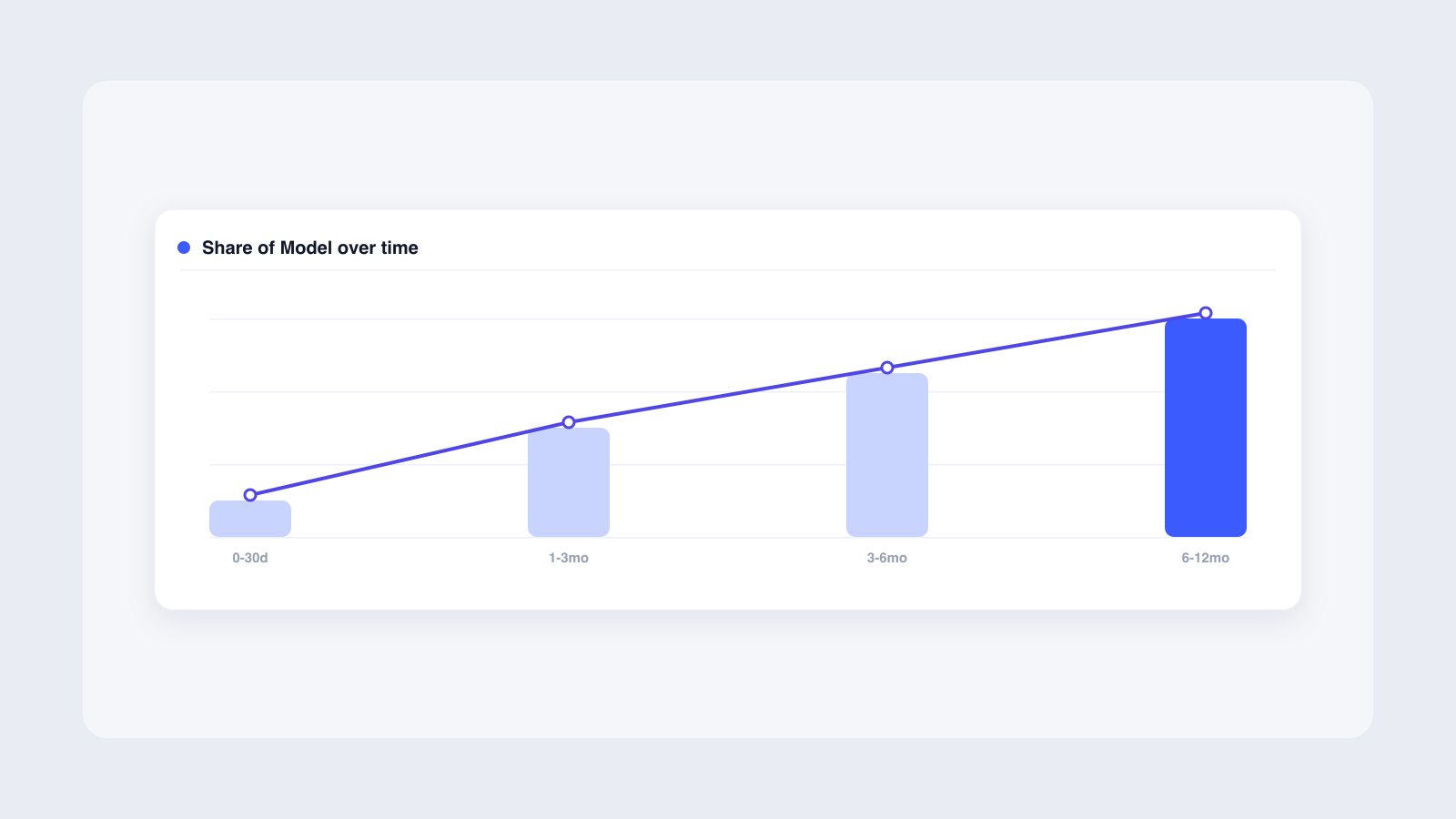
There is no single timeline. RAG-based engines like Perplexity and Google AI Overviews can cite you within 48 hours to 4 weeks if your content is crawlable and fresh. Base-model visibility in ChatGPT, Claude, and Gemini is slower, since new brands only enter model weights at the next major release, a 12 to 24 month wait driven by release cadence and data cutoffs. Expect initial signals in 2 to 4 weeks, measurable impact in 3 to 6 months, and compounding authority over 6 to 12+ months. Track reference rate, not clicks, and sample across many prompt runs.
If you are asking how long it takes to improve a brand's visibility in AI search results, the answer runs on two tracks. RAG-based engines like Perplexity and Google AI Overviews can show initial citations within 48 hours to 4 weeks. Base model visibility in ChatGPT, Claude, and Gemini operates on a different clock. Actual training compute runs for frontier models take approximately 1 to 3 months (GPT-4 reportedly trained in 90 to 100 days; Llama 3 405B in 54 days). The 12 to 24 months figure commonly cited in SEO content refers to the waiting period for a brand to appear in the next major model release. Release cadence typically runs 6 to 12 months between major versions. The gap between data cutoff and public release adds further delay.
There is no single fixed timeline. Results depend on the AI platform, your starting brand authority, and how aggressively competitors invest in Generative Engine Optimization (GEO). For B2B SaaS and AI tool companies in contested markets, the stakes are concrete. When a buyer asks ChatGPT or Perplexity to compare tools in your category, the models either name your brand or they do not. The framework below separates RAG-based visibility, measurable in weeks, from base-model training visibility, measurable in months to years. It tracks reference rate, not click-through rate, as the success metric.
The realistic timeline for AI search visibility
The realistic timeline breaks into three windows. Initial signals appear in 2 to 4 weeks for RAG-based engines, significant measurable impact takes 3 to 6 months, and compounding authority builds over 6 to 12+ months. The sections below add platform-specific detail and the factors that shift these ranges.
The two-lane model explains why. RAG-based engines (Perplexity, SearchGPT, Google AI Overviews) fetch data in real time, reading top web results and synthesizing answers on the fly. A brand can appear as a cited source within 48 hours if the right content exists and AI crawlers can reach it. Base model training (ChatGPT, Claude, Gemini) works differently. These models embed brands into their weights during training runs that take approximately 1 to 3 months of compute. The practical waiting period for a new brand to appear in a base model is 12 to 24 months, driven by release cadence and data cutoff gaps. If your product launches after a model's training data cutoff, it does not exist to the base model until the next major version.
For new brands, the average time to first AI mention is reportedly 126 days, or roughly 4.2 months, of consistent digital presence, according to Trakkr.ai. A more rigorous longitudinal study by Xale AI, which tracked 127 brands over 12 months, found a median time-to-first-citation of 47 days, with the 90th percentile at 103 days. Multiple sources converge on 4 to 8 weeks for initial AI visibility. Established brands with existing high-authority backlinks and domain age see faster results.
McKinsey projects that $750 billion in US revenue will funnel through AI-powered search by 2028. Brands that invest in AI visibility before that shift matures gain a competitive advantage.
What AI search visibility means for B2B brands
AI search visibility is the practice of optimizing for what an AI model references in its generated answers. Generative Engine Optimization (GEO) and Answer Engine Optimization (AEO) are the frameworks most commonly used for this work. You can learn more about what AEO entails in our complete guide.
The shift from traditional SEO is fundamental. SEO rewards precision and keyword repetition. Generative engines prioritize content that is well-organized, easy to parse, and dense with meaning. The focus moves from organic rankings to entity recognition, direct answers from large language models, citation acquisition, and topical authority.
Your own website comprises only 5 to 10% of the sources AI search references. The rest comes from publishers, user-generated content, and communities like Reddit and YouTube. For B2B SaaS brands, software review sites and comparison publishers carry significant weight in AI-generated answers. Ahrefs' research on Google AI Overviews found that the top pages mentioning a brand often do not include the brand's own domain at all.
a16z frames this shift clearly: visibility now means showing up in the answer itself, and the metric that matters is reference rate, not click-through rate. Only 16% of brands systematically track AI search performance today, which creates an arbitrage opportunity for early movers.
Factors that accelerate or delay AI visibility
The fastest changes come from factors that affect RAG visibility, such as unblocking AI crawlers and adding fresh content. Base-model visibility depends on training data cutoffs and release cadence, which operate on a longer timeline.
Current brand authority matters first. Established brands with high-authority backlinks and domain age see faster results than new entrants. New sites lacking domain authority may need 6 months to a year before stable citations appear.
Content quality and freshness directly affect citation speed. AI models favor recently updated, well-structured content with statistics, expert quotes, and citations. Princeton researchers built GEO-bench to test this and found that three methods (Cite Sources, Quotation Addition, and Statistics Addition) collectively improved Position-Adjusted Word Count by up to 41%. Quotation Addition had the highest absolute score. The metric measured was visibility, not citation likelihood.
Technical infrastructure is the fastest lever. Unblocking AI crawlers like GPTBot, adding schema markup, and implementing llms.txt can show results in 2 to 4 weeks. Brands that fix 404s, canonicals, and robots.txt issues in the first month build the foundation for everything that follows.
Citation velocity has a tipping point. Approximately 15 unique high-authority domain mentions across news, blogs, and forums create the threshold where AI models begin referencing your brand consistently.
The competitive field shapes timelines. In contested B2B software categories, multiple vendors target the same buyer queries. If competitors already invest in AI SEO, you need stronger citations and more off-site presence to displace them. Fast-moving sectors like technology may take longer because more brands compete for the same AI answers.
Target AI platforms matter because different models have varying indexing speeds and refresh cycles. A strategy that works for Perplexity may not move the needle for Claude's base model.
Phase-by-phase timeline: from initial signals to sustained authority
Phase 1 (0 to 30 days): Technical audit, unblock AI crawlers, add schema, submit sitemaps. The expected outcome is improved crawlability and early indexing. The 30-Day Visibility Sprint operates in this window. It maps buyer queries across AI models, deploys initial content, and produces measurable before-and-after results in AI mention rates.
Phase 2 (1 to 3 months): Deploy answer-first content, build off-site presence on Reddit and YouTube, earn mentions on high-authority domains. Expected outcome: early citations in Perplexity and Google AI Overviews, reaching 8 to 15% Share of Model. Share of Model is the percentage of tested prompts where a brand appears in the AI-generated answer.
Phase 3 (3 to 6 months): Content refinement, proactive citation acquisition, community engagement. Expected outcome: consistent visibility for USP-tied queries, 15 to 25% Share of Model, and compounding authority begins.
Phase 4 (6 to 12+ months): Quarterly content refreshes, expanded topical authority, sustained off-site presence. Expected outcome: 25 to 40% Share of Model. Early movers pull ahead as default answers. The gap compounds monthly.
These benchmarks come from Foundation's Athena data, which tracks Share of Model trajectories across AI platforms. The typical path runs from a 0 to 5% baseline to 8 to 15% at three months, 15 to 25% at six months, and 25 to 40% at twelve months. Top performers reaching 40 to 60% Share of Model share common traits. They maintain deep off-site presence across Reddit, YouTube, and review sites. They run quarterly content refresh cycles. They engage actively in community discussions.
Platform-specific timelines and considerations
Perplexity indexes in 24 to 72 hours because it fetches web results in real time. Google AI Overviews run on a 2 to 12 week cycle tied to traditional ranking signals. ChatGPT's base model requires 1 to 2 years because new brands only enter its weights during the next major training run.
Perplexity: 24 to 72 hours to visibility. Real-time RAG and fast indexing mean query relevance and traditional ranking signals drive results. A brand can launch a whitepaper on Tuesday and appear as the primary source by Thursday.
Google AI Overviews: 2 to 12 weeks. Visibility ties to traditional Google ranking signals and content structure. Ranking in the top 3 organic spots increases the likelihood of appearing in AI Overviews. AI Overviews now appear in 13.14% of search queries as of July 2025, double the rate from earlier in the year.
ChatGPT Search (SearchGPT): 1 to 3 weeks. Bing search index integration and OpenAI publisher partnerships drive visibility. Real-time news and direct answers perform best.
ChatGPT base model: 1 to 2 years. This waiting period is dictated by model release cadence and training data cutoffs, not the training run itself, which takes approximately 1 to 3 months of compute. New brands do not exist to the base model until a major update incorporates their data. The strategy here is brand ubiquity and category definition.
Gemini and Claude: partially RAG-enabled, with base model constraints underneath. Gemini integrates Google Search results, and Claude offers web search, so both can surface real-time citations faster than a pure base model. Reported timelines of 2 to 6 months likely reflect these RAG components. For base model weight inclusion, the same 12 to 24 month waiting period applies. Confidence signals like backlinks and structured data affect citation speed where RAG is active.
Your strategy must account for these differences. Improving brand visibility across ChatGPT, Gemini, and Perplexity requires platform-specific tactics. RAG-based engines reward fresh content and technical fixes. Base models require sustained off-site authority and entity building.
Strategies to accelerate AI search visibility
Technical optimization comes first. Implement structured data (Organization, Product, FAQ, Article schema), refine AI crawler permissions, and add llms.txt. These fixes can show results in 2 to 4 weeks for RAG-based engines.
Content strategy follows. Create 4 to 8 answer-first pages: comparisons, alternatives, and best-of lists. Optimize them with statistics, expert quotes, and citations. Implement FAQ schema on high-traffic pages. Princeton's GEO-bench research confirmed that content with citations, quotations, and statistics gets referenced more often by AI models.
Entity building and disambiguation ensure AI models recognize your brand correctly. Use consistent brand naming, descriptions, and attributes across all online properties. This prevents hallucination errors where AI models confuse your brand with competitors.
Proactive citation acquisition means identifying the top 50 cited URLs in your space and executing editorial outreach to publications AI already trusts. Profound's GEO guide recommends earning citations from at least 20 high-authority domains per quarter.
Third-party mentions carry outsized weight. Engage in 3 to 5 high-value Reddit threads, create 2 to 3 YouTube videos, and secure reviews on major platforms. AI can pick up unlinked brand references just as easily as linked ones, per Ahrefs' research on Google AI Overviews.
Brands reaching 15 to 25% Share of Model in under 6 months typically start with off-site presence before on-domain content. They optimize existing high-traffic pages before creating new ones and maintain aggressive refresh cadences: monthly for money pages, quarterly for blog content.
Measuring and tracking AI visibility progress
Move beyond traditional SEO metrics. The KPIs that matter for AI search are citation rate, share of voice in AI answers, entity recognition, and sentiment analysis.
Track your presence across 20 to 50 prompt runs, not single snapshots. AI search has 20 to 30% volatility as a baseline, so one-off checks are misleading. Only 30% of brands stay visible between consecutive answers. Dual-signal visibility, meaning both a mention and a citation, shows 40% higher recurrence likelihood.
Tools like Semrush AI Visibility Toolkit and Profound help monitor mentions and citations across AI platforms. Ahrefs Brand Radar tracks mentions, impressions weighted by search volume, and AI share of voice for specific topics.
The metric a16z emphasizes is reference rate: how often your brand is cited or used as a source in model-generated answers. This replaces click-through rate as the primary success measure. You can read more about measuring brand visibility in AI search in our 2026 guide.
Our AI Visibility Testing Loop continuously tests prompts across models, tracks brand mentions, and refines content to improve AI recommendations. This ongoing testing is essential because AI models rebalance constantly.
Common mistakes that slow down AI visibility
Focusing solely on traditional SEO is the most common mistake. GEO is not a replacement for SEO but an additional component. Neglecting entity optimization and AI-specific tactics limits visibility even when traditional rankings are strong.
Neglecting off-site presence misses most of the opportunity. Your brand's own site is a small fraction of what AI models reference. Ignoring Reddit, YouTube, review sites, and publisher content means AI models have little evidence to cite you.
Failing to track AI-specific metrics is another pitfall. Measuring only traditional rankings and traffic ignores citation rate and share of voice in AI answers. Brands that do not track these metrics cannot tell whether their GEO investment is working.
Expecting instant results leads to premature abandonment. Consistent visibility takes 12 to 16 weeks minimum. Anyone promising quick wins in GEO is either misinformed or dishonest.
A static strategy fails because GEO requires dynamic, month-to-month adjustments. AI models rebalance constantly. Brands that maintain visibility treat it as an ongoing operational discipline, not a one-time project.
These questions address the most common concerns about AI search timelines for B2B brands evaluating when to invest.
Frequently asked questions about AI search timelines
How fast can a brand appear in AI search results?
How long does it take for a new brand to get mentioned in AI?
Can I speed up my brand's visibility in AI search?
Does my industry affect how long AI visibility takes?
What metrics should I track for AI search visibility?
Start your AI visibility sprint today
Buyers are already asking AI models to compare tools in your category. Brands that start now build citation velocity and off-site authority before competitors saturate the sources models reference. Every month of delay compounds the gap.
Our AI Visibility Mapping analyzes buyer queries across major AI models to identify exactly where your brand is missing in AI-generated answers. Schedule a consultation or request an AI visibility audit to see your current position and build a plan to close the gap.
We'll run your category through the major models and map exactly where you appear, where competitors win, and what it takes to become the recommendation.