
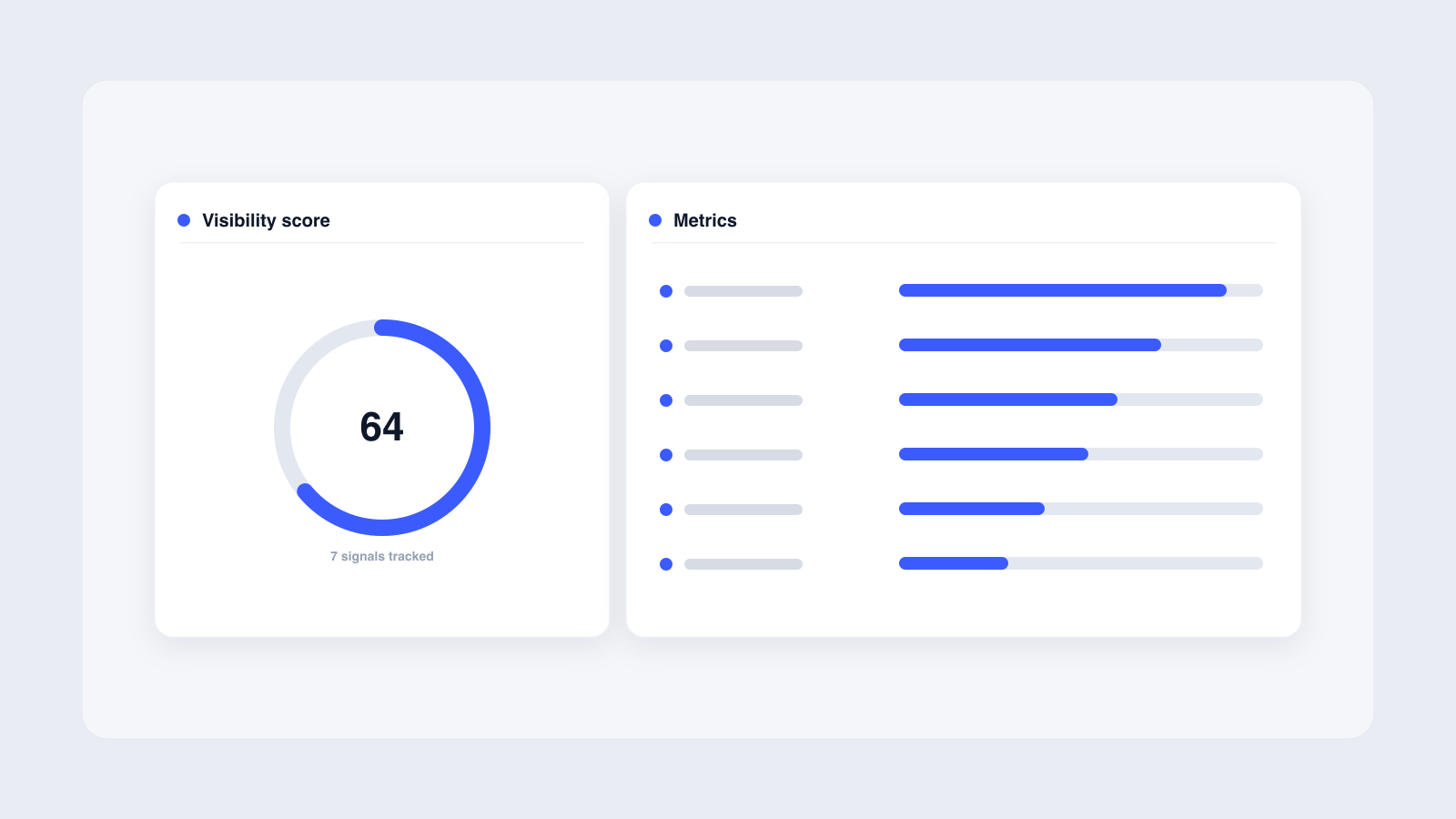
AI visibility is whether your brand gets named, cited, or recommended inside AI-generated answers. Measure it with seven signals: mention rate, citation share, AI share of voice, recommendation rank, average position, sentiment and accuracy, and prompt coverage. Build a locked prompt set of 25 to 200 buyer questions, run them across ChatGPT, Gemini, Perplexity, Claude, and Google AI Overviews repeatedly, and track trends rather than single runs. Scores are directional, not definitive, because models are probabilistic and there is no universal standard.
AI visibility tracks whether your brand gets named, cited, or recommended inside AI-generated responses. Understanding what AI visibility means and how to measure it comes down to tracking specific signals across the models your buyers use.
Traditional search rankings no longer capture the full picture. Buyers get synthesized answers from large language models instead of scrolling through links, and a brand absent from that answer is invisible. The metrics below turn that risk into numbers you can track.
What is AI visibility? A core definition
AI visibility is your brand's presence, prominence, and influence within generative AI outputs. It measures how often models like ChatGPT, Google AI Overviews, Gemini, Perplexity, and Claude name, cite, or recommend your brand when buyers ask questions in your category. Instead of ranking in a list of links, your brand needs to appear inside a single synthesized answer.
There is no page two in an AI response. Marketers track three dimensions. Presence is whether the model names you. Framing is how it describes you: first or last, recommended or hedged. Evidence is which sources the model cited to build the answer.
Large language models generate answers through two paths. Learned knowledge comes from training data and is hard to influence directly. Grounded retrieval pulls from live web content through retrieval-augmented generation, and this is the path content optimization can consistently affect.
Seven metrics for tracking AI visibility
These metrics convert AI visibility into trackable numbers. A common approach combines them into a weighted composite. The formula is AI Visibility Index = (Citation Rate x weight) + (Mention Score x weight) + (Entity Frequency x weight). Weights reflect your priorities.
Mention rate
Mention rate is the percentage of tracked AI answers where your brand is named. Calculate it as: (prompts where your brand appears / total prompts tested) x 100. A brand is mentioned far more often than its URL is cited, and that gap is where competitive opportunity lives.
Citation share
Citation share is the percentage of tracked AI answers that include a link to your domain. Calculate it as: (prompts citing your domain / total prompts tested) x 100. Research suggests you may see as much as 100x more brand references in AI answers compared to registered clickthroughs. Citation share captures only part of your true visibility.
AI share of voice
AI share of voice compares your brand's mentions to competitors across the same prompts. Calculate it as: (your brand mentions / total brand mentions across all competitors) x 100. This shows whether you are the default recommendation or a secondary mention after a competitor. Mention-based and citation-based share of voice can disagree, so track both.
Recommendation rank
Recommendation rank is the position where your brand appears when an AI model lists options: first, second, third, and so on. Lower numbers mean stronger visibility, and being named first carries disproportionate influence on buyer decisions. Track across all prompts and calculate an average to compare against competitors over time.
Average position
Average position measures where in the AI response your brand first appears: top, middle, or bottom. Calculate it as the mean character or paragraph position of first brand mention across all tracked prompts. Brands appearing early receive more reader attention, even when multiple brands appear in the same answer.
Sentiment and accuracy
Sentiment and accuracy are separate checks. Sentiment scoring measures whether AI describes your brand positively, negatively, or neutrally, typically from -100 to +100. Factual-accuracy auditing checks whether the model hallucinates incorrect claims about your products, pricing, or features. Use these to correct inaccuracies rather than chase positions in a system without stable rankings.
Prompt coverage
Prompt coverage is the percentage of your tracked prompt set that returns your brand in any form: mention, citation, or recommendation. Calculate it as: (prompts returning your brand / total prompts in your set) x 100. Low coverage signals absence from entire categories of buyer questions, and it points to a ranking problem within them.
How AI visibility measurement differs from traditional SEO and AEO
Traditional SEO ranks pages in a list of results. AI visibility measures whether and how your brand is named inside a single synthesized answer. SEO tracks rankings, click-through rate, and organic traffic. AI visibility tracks mentions, citations, share of voice, and sentiment.
Research suggests you may see as much as 100x more brand references in AI answers compared to registered clickthroughs, meaning referral traffic captures only a fraction of true visibility.
Answer Engine Optimization (AEO) and Generative Engine Optimization (GEO) are the practices of measuring and improving this presence. They overlap with SEO because AI engines run web searches and cite what they find, but success is measured by brand mentions, not page position.
The academic foundation for GEO comes from research published at KDD 2024. That research showed that adding citations and statistics can boost visibility by up to 40% in generative engine responses.
A page that ranks well in Google may never appear in an AI answer. For a deeper comparison, see our GEO vs SEO guide.
What AI visibility tracking tools actually measure
The tooling market ranges from free open-source platforms to enterprise solutions, with pricing from $27 per month to over $499 per month. More than 20 companies now sell AI visibility measurement tools, and the IAB's 2026 framework was created to bring shared standards to a fragmented market.
Several tools serve different needs. Brand Radar and Mercury Orbit focus on brand mention tracking and share of voice across AI platforms. Zumi and GeoScout specialize in citation analysis and prompt-level visibility scoring. Semrush offers AI visibility tracking alongside its SEO toolkit, and Ahrefs has added similar features.
otterly.ai tracks share of voice and visibility trends. peec.ai monitors mentions and sentiment. Its costs scale as you add queries. airops.com offers AI operations tooling that overlaps with visibility tracking. Most platforms also track Microsoft Copilot alongside ChatGPT, Gemini, Perplexity, and Claude.
One limitation: most tools query models via API rather than simulating the consumer web interface. These are not equivalent. Web interfaces use hidden system prompts, dynamic temperature, and browsing tools that APIs do not replicate, so API-based scores may not match what your buyers see.
Five steps to build an AI visibility measurement strategy
Building a measurement strategy takes five steps:
- Define objectives. Decide whether you are benchmarking current visibility, tracking competitor share of voice, or monitoring for factual accuracy across AI answers.
- Build a representative prompt set. Gather 25 to 200 high-intent questions buyers actually ask AI, grouped by funnel stage: awareness, consideration, and decision. Lock this set for at least a month.
- Run prompts across ChatGPT, Google AI Overviews, Gemini, Perplexity, Claude, and Microsoft Copilot. Capture full text responses and note which domains the models cite.
- Score each response for mention, citation, position, sentiment, and share of voice. Normalize scores to a 0 to 100 scale using weighted averages that reflect your priorities.
- Establish a reporting cadence. Sample repeatedly and report trends, not single results, because the same prompt can yield different answers on different runs.
Our AI Visibility Mapping service follows this methodology to identify where your brand is missing from AI-generated answers across major models.
Why AI visibility scores are directional, not definitive
Large language models are probabilistic generators, not ranked indices. There is no stable AI ranking system, and the same prompt can produce different results on different runs. A single run is statistically meaningless; you need repeated sampling to calculate reliable rates.
No universal scoring standard exists. Different tools weight metrics differently, and a score from one platform is not comparable to one from another. The IAB framework distinguishes directional measurement, useful for spotting patterns, from decision-grade measurement, the rigor needed before budget decisions.
Attribution is also uncertain. When an LLM cites a source, verifying that the citation actually influenced the response is technically difficult. Google does not fully separate AI Overviews sessions from regular organic traffic, which makes it hard to trace buyers through analytics.
Prompt set bias is another risk. A score from a poorly curated prompt list measures performance against that test set, not market reality. Entity-level monitoring at low frequency is more defensible than high-volume tracking with a weak prompt list.
Our AI Visibility Testing Loop addresses this by continuously testing prompts across models, tracking mentions over time, and refining content based on observed trends rather than single data points.
Frequently asked questions about AI visibility
How is AI visibility different from traditional SEO?
What metrics should I track for AI visibility?
How accurate are AI visibility scores?
Can I measure AI visibility without a paid tool?
Which AI platforms should I monitor for brand visibility?
Start tracking your AI visibility with a 30-day benchmark
You can track mentions, citations, share of voice, and sentiment across the models your buyers use. Measurement requires repeated sampling, a curated prompt set, and an understanding of each model's quirks.
Our 30-Day Visibility Sprint delivers measurable before-and-after improvements in AI mention rates through mapping, content deployment, and optimization. Start your 30-day AI visibility sprint to see where your brand stands today and where it could be in 30 days.
We'll run your category through the major models and map exactly where you appear, where competitors win, and what it takes to become the recommendation.