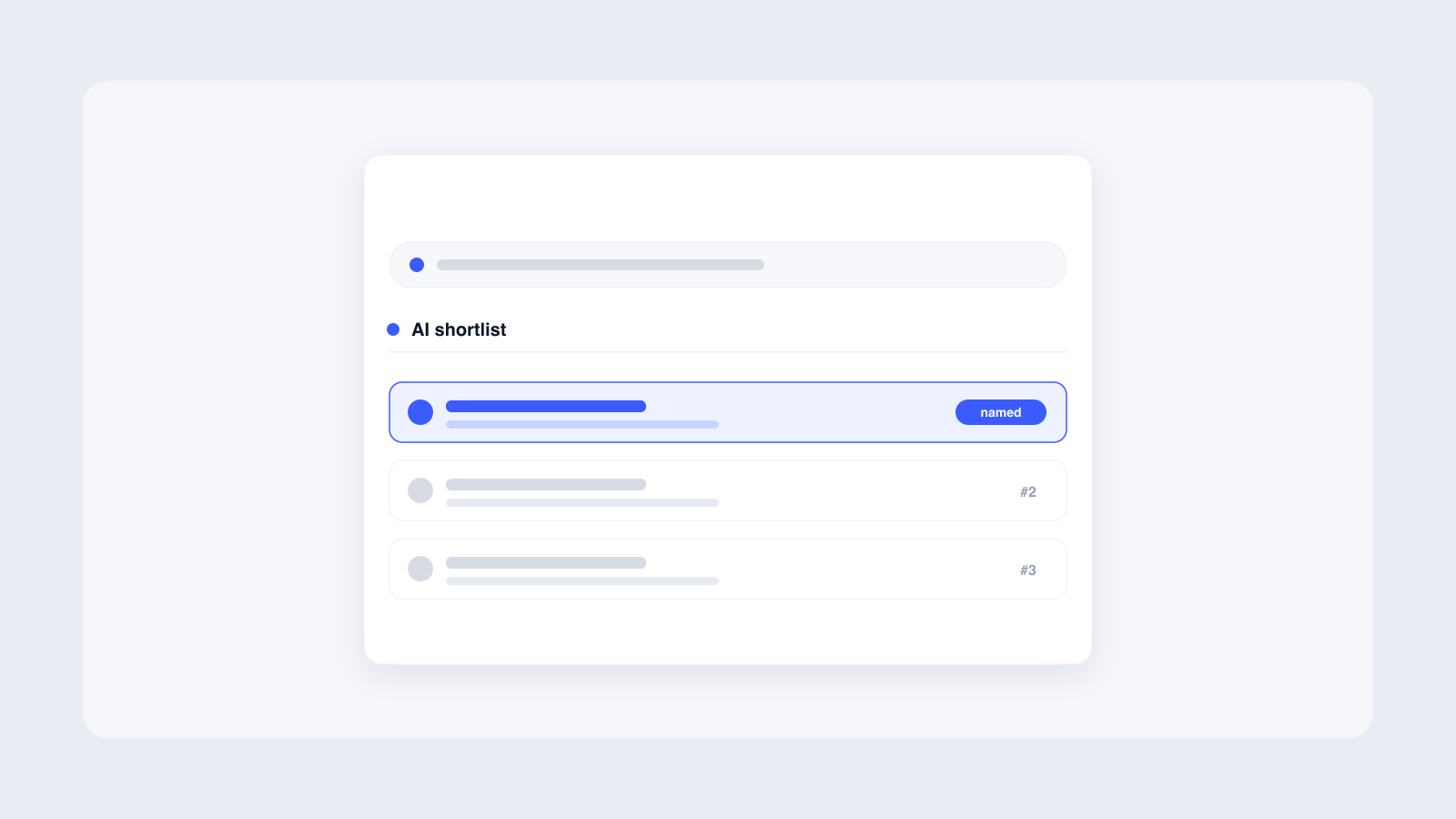
Most B2B software buyers now research in AI assistants first. G2 found 71% of buyers use AI chatbots somewhere in their process and 51% start research with an AI chatbot more often than Google, while 6sense found 94% use LLMs during buying. Buyers use AI to explore solutions, compare vendors, and build shortlists, then verify on the vendor site and review platforms like G2. AI chatbots are now the number one source shaping shortlists, so vendors absent from AI answers lose deals before a conversation starts.
Half of B2B software buyers now start their research in an AI chatbot instead of Google Search. That shift has rewritten how vendors get discovered, shortlisted, and chosen. If you are wondering how buyers use ChatGPT and other AI assistants to research B2B software, the data tells a clear story: AI is no longer an experiment in the procurement process. It is the starting point.
G2's 2026 AI Search Insight Report found that 71% of B2B buyers rely on AI chatbots somewhere in their software research process, up from roughly 60% just seven months earlier. 6sense's 2025 Buyer Experience Report shows 94% of buyers use large language models during their buying process. This is the current state of B2B software procurement.
The shift to AI-powered B2B software research
The numbers have moved fast. In G2's April 2025 survey of 1,169 B2B decision-makers, 79% said AI search had changed how they conduct research. By the time G2 ran its 2026 AI Search Insight Report, 93% of buyers said AI chatbots had fundamentally changed their research process. The shift from traditional search to AI-synthesized answers is what G2 calls the Answer Economy, where buyers expect instant, conversational answers rather than a list of blue links to click through.
This is not a marginal change in behavior. G2's 2026 report found that 51% of buyers now start their research with an AI chatbot more often than Google. G2's August 2025 survey had already documented a 71% jump in this behavior over just four months. 6sense's study of nearly 4,000 B2B buyers found that 94% use LLMs like ChatGPT and Claude during their buying process. AI research is now a near-universal behavior in B2B software procurement.
The stakes are measurable. G2's 2025 data showed that the conversion rate for AI search-driven leads is 40% better than leads from traditional search. Semrush found that the average AI search visitor is 4.4 times as likely to convert as the average visit from traditional organic search. When buyers arrive at your site from an AI recommendation, they are further along in their evaluation and more ready to buy.
How B2B buyers use AI assistants for software research
Buyers use AI assistants for three core tasks: exploring possible solutions, comparing vendors directly, and understanding a problem or category more deeply. Semrush's survey of 519 U.S. B2B professionals found that 66% use AI to explore possible solutions, 61% compare vendors directly, and 59% use it to understand a problem or category more deeply. Another 55% use AI to summarize options, and 53% ask AI for direct recommendations.
The prompts buyers use are specific and use-case driven. G2's 2026 report found that two-thirds of buyers start with category or competitor queries, like "Give me three CRM solutions for a hospital that work on iPads" or "Create a comparison table of marketing automation platforms by feature set and pricing." Only one in five start with questions about requirements or process. Buyers are asking AI to synthesize information, not to search for links.
AI is also a discovery engine. Semrush's survey found that 97% of buyers say AI has helped them discover new vendors, with 44% saying this happens frequently. 92% say AI has shaped their vendor shortlist, and 45% describe that influence as significant. Brand recognition barely registers in AI responses: only 7% of buyers say they notice a vendor because they recognize the name. What makes a vendor stand out is how precisely it matches the buyer's use case.
AI's role across the B2B software procurement process
AI touches every stage of the B2B software procurement process. Semrush tracked AI usage across the buying process: 72% use AI during early research and category scoping, 62% use it when actively comparing vendors, 48% use it to narrow the shortlist, and 45% use it to support the final decision. The heaviest usage occurs in the middle of the funnel, where buyers are evaluating and comparing options.
During problem definition and category discovery, buyers prompt AI to understand software categories and identify essential features without scheduling vendor calls. A buyer might ask, "What are the main differences between Salesforce and HubSpot for mid-market B2B companies?" and receive a synthesized comparison in seconds. This compresses what used to take weeks of research into minutes.
Vendor shortlisting is where AI has the most direct impact. G2's 2026 report found that AI chatbots are the #1 source influencing buyer shortlists at 54%, ahead of software review sites. 8 in 10 buyers said AI chatbots accelerated their purchasing decision. The shortlist that AI builds is the one buyers carry into detailed evaluation.
6sense's research adds a critical nuance: 95% of the time, the winning vendor is already on the Day One shortlist. Buyers evaluate an average of 5.1 vendors, have prior experience with 3.8 of them, and fill 3.6 spots on their shortlist before they ever contact a seller. If your brand is not in the AI-generated shortlist, you are likely not in the evaluation at all.
AI also plays a role in RFP drafting and risk assessment. Buyers use AI tools to identify essential features, perform first-pass risk assessments, and draft RFPs they refine without vendor calls. But 6sense found that 62% of buyers still needed sellers to answer AI-related questions about training data, security, privacy, and costs, information that is rarely clear on vendor websites. AI accelerates discovery, but human-validated sources dominate final decisions.
Validating AI-generated insights: trust, verification, and cross-referencing
Buyers trust AI recommendations, but they verify them. Semrush found that 75% of B2B buyers trust AI vendor recommendations, yet nearly all verify before committing. The verification process is systematic: 71% visit the vendor's website after an AI recommendation, 63% search Google for the company, 46% compare the recommendation against alternatives, 41% return to the AI with follow-up questions, and 38% check reviews on G2 or similar platforms.
Review sites are the trust layer for AI-generated recommendations. G2, TrustRadius, Gartner Peer Insights, and Capterra provide the third-party validation that buyers use to confirm what AI tells them. G2's 2026 report found that a citation from a review site is the #1 response when buyers were asked what would increase their confidence in an AI chatbot's answer. G2 describes the pattern as a three-layer process: AI chat creates the shortlist, review websites provide decision-making signals, and vendor websites supply the path to pricing and contact.
Simply being mentioned by AI carries weight. G2 found that 85% of buyers think more highly of a vendor when an AI chatbot cites it in an answer. But that perception has to hold up under scrutiny. 6sense noted that most vendor websites do not yet provide the clarity buyers seek on AI capabilities, pricing, implementation, and security, leaving direct engagement as the only viable path for buyers to validate what AI told them.
AI assistants: platforms and adoption rates
ChatGPT dominates B2B software research. G2's August 2025 survey found that 47% of buyers name ChatGPT as their favorite LLM, nearly three times any other. Semrush's data shows 76% of B2B professionals use ChatGPT for work and 71% for product research specifically.
Google Gemini follows at 62% for work and 61% for product research. Microsoft Copilot sits at 53% for work and 45% for product research. Perplexity and Anthropic Claude trail at 22% and 20% for work usage, respectively. Buyers increasingly move between multiple AI tools, making cross-platform visibility more important than performance in any single engine.
The productivity gains are real and sticky. G2's 2026 report found that 53% of buyers say their software research is more productive with AI search than with traditional search, up sharply from 36% just seven months earlier. Nearly two-thirds of buyers spend six or more hours per week using AI chatbots for work, and more than 40% identify as daily power users. 86% of buyers increased their use of AI chatbots for software research in the past year.
AI chatbots differ from traditional search in a fundamental way. Instead of returning blue links, they synthesize information into conversational answers. This enables zero-click research, where buyers get complete answers without visiting multiple websites. G2's 2025 report found that GenAI chatbots were the #1 source influencing vendor shortlists at 17.1%, followed by software review sites at 15.1% and vendor websites at 12.8%. By 2026, G2's AI Search Insight Report found AI chatbots' influence had grown to 54% as the top shortlist source.
Implications for B2B software vendors: adapting to the AI era
If AI influences discovery, shortlists, and final vendor selection, its impact extends directly to pipeline and revenue. G2's 2026 report found that 69% of buyers selected a different software vendor than initially planned based on AI chatbot guidance, and 33% purchased from a vendor they had never heard of before. Vendors who are absent from AI-generated answers are losing deals they do not even know they were considered for.
Generative Engine Optimization (GEO) is the practice of optimizing digital assets for LLM ingestion. G2 describes it as a very different discipline from SEO, because LLMs seek to provide an answer rather than a set of links. G2 recommends converting product documents, release notes, and FAQs into chunked, schema-rich feeds optimized for chatbots and copilots. Vendors should also allow LLMs to crawl their site content, since common blockers like indexation directives and bot protection platforms can limit exposure to AI searchers.
Review platforms matter more than ever. Since review sites provide the decision-making signals that buyers use to verify AI recommendations, vendors must prioritize earning reviews on G2, TrustRadius, Gartner Peer Insights, and Capterra. Semrush found that only 7% of buyers notice a vendor in an AI response because of brand recognition. What gets attention is how precisely a vendor matches the buyer's use case, which means structured product information and clear documentation matter more than brand awareness.
The timeline for influencing buyers has shrunk. 6sense's 2025 report found that the point of first contact between buyers and sellers shifted from 69% of the buying process in 2024 to 61% in 2025, roughly 6 to 7 weeks earlier. Average buying cycles compressed from 11.3 months to 10.1 months. Vendors must be visible in AI answers earlier in the buyer process, before the shortlist is set.
This is where Answer Engine Optimization becomes a business necessity. Our AI Visibility Mapping analyzes buyer queries across major AI models to identify where a brand is missing in AI-generated answers. It is the diagnostic step that identifies the prompts and models where competitors appear and your brand is absent.
Research methodology and data sources
This article draws on three independent surveys of B2B buyers conducted between April 2025 and April 2026. G2's 2025 Buyer Behavior Report surveyed 1,169 B2B decision-makers globally across North America, EMEA, and APAC. G2's 2026 AI Search Insight Report polled 1,076 B2B decision-makers responsible for or influencing purchase decisions. 6sense's 2025 Buyer Experience Report studied nearly 4,000 B2B buyers globally with a companion AI survey of 766 responses. Semrush surveyed 643 U.S. B2B professionals in March and April 2026, with 519 valid responses from professionals who use AI tools for work.
Frequently asked questions about AI in B2B software research
Which AI assistants do B2B buyers use most for software research?
How do buyers use AI across the B2B software procurement process?
Do B2B buyers trust AI chatbot recommendations for software purchases?
How do buyers verify AI-generated insights about B2B software?
What should B2B software vendors do to improve their visibility in AI search?
Next steps for vendors losing visibility in AI answers
Among buyers G2 surveyed, 69% selected a different software vendor than initially planned based on AI chatbot guidance, and 33% purchased from a vendor they had never heard of before. 92% say AI shaped their shortlist. If buyers cannot find your brand when they prompt ChatGPT, Perplexity, or Gemini for software recommendations in your category, you are losing deals before a conversation ever starts.
Generative Engine Optimization is how vendors close that gap. The 30-Day Visibility Sprint delivers measurable before-and-after changes in AI mention rates across tested prompts and models through mapping, content deployment, and optimization.
Find out where you stand today. Get a free AI visibility audit to see which prompts are surfacing your competitors, which models are missing your brand, and what it will take to win recommendations in the Answer Economy.
We'll run your category through the major models and map exactly where you appear, where competitors win, and what it takes to become the recommendation.