
What types of content get cited most often by AI answer engines? The answer is not a single format. Multiple 2026 studies, reportedly ranging in scale from 2,020 citations (per BeVisible IQ) to 9.5 million citations (per Meltwater), reveal clear, actionable patterns that B2B SaaS companies can use right now.
The data tells a nuanced story. Articles, listicles, and product pages dominate by total volume. But technical documentation, original research, and comparison pages win on efficiency, earning citations at rates that dwarf their market share. Understanding both sides of this equation determines whether your brand shows up in AI-generated answers or gets skipped entirely.
Top Content Types Cited by AI Answer Engines: An Overview
When buyers ask ChatGPT, Perplexity, Gemini, or Google AI Overviews for recommendations, these engines retrieve and synthesize content using a process called Retrieval-Augmented Generation (RAG). The model pulls source content, grounds its answer in that content, and cites it. Structure and clarity matter because the AI must be able to parse, trust, and extract information from your pages.
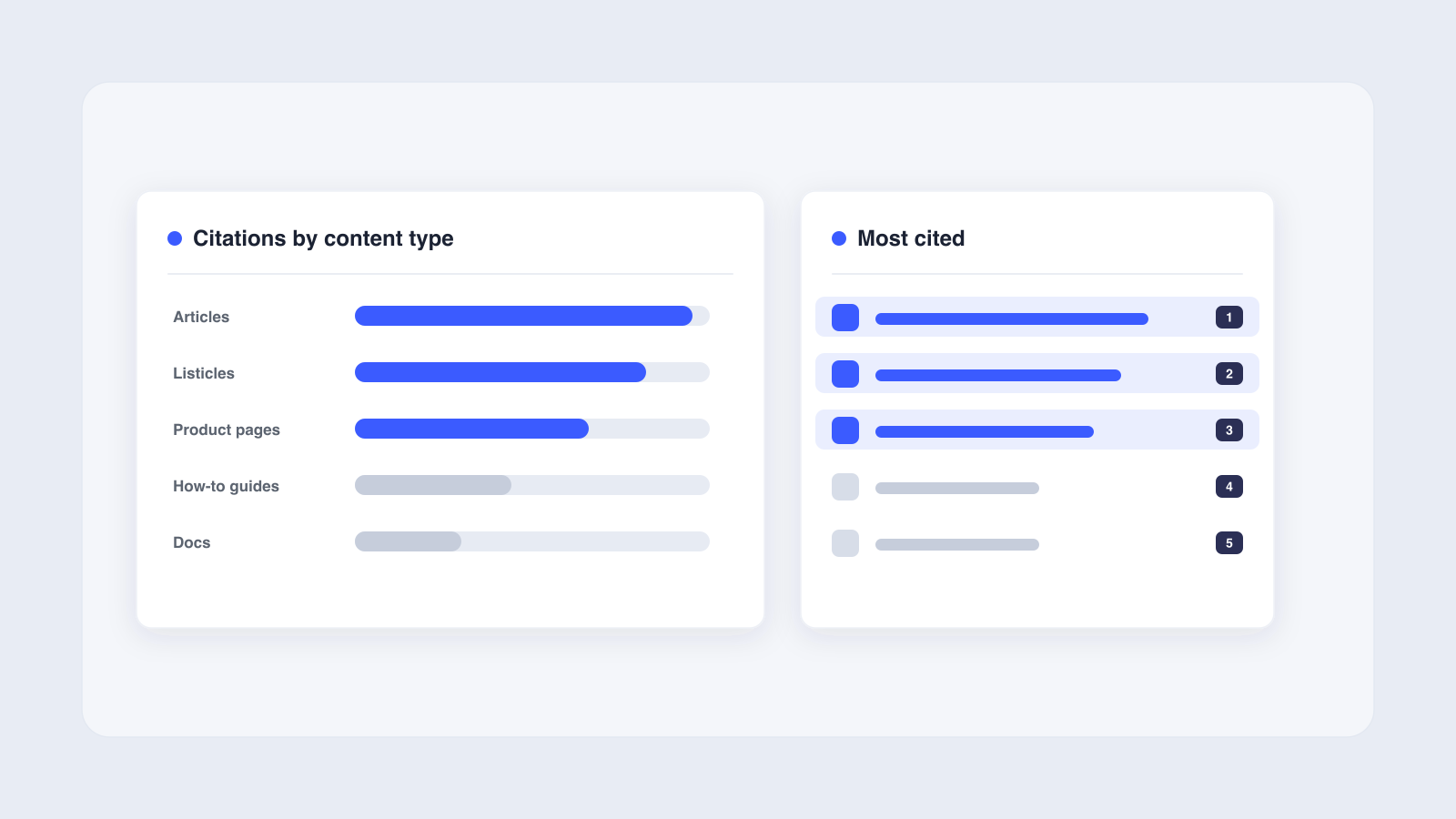
According to DeltaV Digital's study of 25,337 citations across 21,075 AI responses, five content types lead by citation share:
- Articles: 23.7% citation share
- Listicles: 19.6% citation share
- Product pages: 16.3% citation share
- Homepages: 10.8% citation share
- How-to guides: 4.5% citation share
Citation share only measures volume, though. Efficiency is the other half of the equation. The portfolio average across all content types is 1.29 citations per retrieval, meaning that when AI engines retrieve a page to research an answer, that page earns on average 1.29 citations across the dataset. A single AI answer may retrieve and cite multiple pages, so citations per answer is a distinct metric. Corporate and product pages dominate by total volume at 55.8% of all citations across 2.1 million sources, per Geonimo's large-scale source analysis. Yet technical documentation leads by efficiency with a 34% median citation rate, according to Presenc AI's citation rate research.
No single content type wins on both metrics. Every industry has a distinct citation fingerprint that should dictate your strategy. If you want to understand how AI answer engines choose sources, the key is matching the right content format to the right query intent. Our AI Visibility Mapping service analyzes buyer queries across major AI models to identify exactly where your brand is missing in AI-generated answers.
Data-Driven Content: Original Research and Technical Documentation
Technical documentation leads all content types with a 34% median citation rate. Docs are structured, factual, frequently updated, and map cleanly to how AI systems ground their answers. Original data and research posts follow close behind at 31%, despite representing only 14% of citations by volume. That is the strongest efficiency per page published of any format.
Here is the gap most B2B SaaS companies miss: documentation outperforms PR and press releases by 3.8x (34% vs. 9% median citation rate), yet PR often receives more budget. That is a critical misallocation for companies trying to get cited by AI engines.
E-E-A-T signals drive this performance. AI models prioritize content with clear authorship, verifiable methodologies, and credible sources. Proprietary data, academic references, and transparent methodologies all boost citation likelihood. According to Presenc AI's February 2026 study (based on 1,200 pages), industry benchmark reports achieved a 52% citation rate, comprehensive guides with data reached 67%, and case studies with data hit 48%. The same organization's newer June 2026 study, which sampled 2,400+ brands across 18 industries using a median-based methodology, reports materially lower rates across most categories: technical documentation at 34% median, original data and research at 31% median, how-to and tutorials at 26% median, blog and editorial at 18% median, and product and landing pages at 11% median.
Present data with clear statistics, named methodologies, and accessible summaries that AI models can parse and synthesize. A page that says 'our research surveyed 500 B2B SaaS companies in March 2026' is more citable than one that says 'studies show most companies struggle with AI visibility.' Our AI-Optimized Content System creates comparison, recommendation, and answer-first content that AI models use to cite and recommend your brand. For teams building a broader Answer Engine Optimization strategy, data-driven content should be the foundation.
Commercial Content: Comparisons, Product Pages, and Listicles
Comparison pages are the standout finding from the DeltaV Digital study. They represent only 4.1% of citations but post the highest citation rate of any page type at 1.87 citations per retrieval, which is 45% above the portfolio average. When AI engines retrieve a comparison page, they lean on it heavily.
The data gets more striking at the industry level. In B2B cybersecurity, a 'GCC High vs GCC vs Commercial' comparison page earned 4.09 citations per retrieval, the highest of any URL in that industry's top 30. Comparison matrices and reviews achieve a 61% average citation rate, with ChatGPT citing them at 63%.
Listicles hold 19.6% of citation share overall. In B2B technology services specifically, listicles account for 61% of citations. 'Top 10 firms' roundups and 'best tools for X' lists are prime citation targets when buyers ask AI engines for recommendations.
Product pages earned 16.3% of citations but have a low median citation rate of just 11%, making them among the weakest performers per page published. The fix is structured product data: clear specifications, feature matrices, pricing tables, and authentic user reviews from platforms like G2 and Trustpilot give AI models parseable, citable information.
The single most actionable format improvement for B2B SaaS companies is investing in comparison content. It is underproduced relative to how much AI engines trust it. If buyers are asking 'X vs Y' or 'best tool for Z' and you do not have a comparison page, you are leaving citations on the table. This is also where ChatGPT's reliance on third-party sources becomes visible: when your competitors publish comparison content and you do not, AI engines cite them instead of you.
Informational Content: Articles, How-To Guides, and FAQs
Articles lead all page types by citation share at 23.7% with a citation rate of 1.43 per retrieval. Comprehensive, well-structured editorial content remains foundational for AI visibility. Blog content is cited at a disproportionately high rate relative to how much of it exists on the web, and it works especially well on ChatGPT at 22% compared to 15% on Perplexity.
How-to guides hold 4.5% of citation share with a rate of 1.32 per retrieval. Step-by-step guides achieve a 54% average citation rate, with Perplexity leading at 57%. For process-oriented queries, structured walkthroughs outperform narrative content.
FAQ pages achieve a 58% average citation rate, and Google AI Overviews reaches 71% when schema markup is present. Structured FAQs are prime candidates for AI snippets because they present direct answers in a format models can extract cleanly. For teams working to get their brand to appear in ChatGPT, FAQ schema is one of the highest-leverage technical improvements available.
Schema markup and semantic HTML are the technical backbone. FAQ schema, HowTo schema, and Article schema all improve discoverability. Proper heading hierarchy, clear paragraph structure, and descriptive alt text help AI models parse and extract information confidently.
Other strong performers for informational queries include definition and framework pages (46% citation rate), best practices checklists (38%), and tool or resource lists (41%). The common thread is depth and accuracy. AI models favor content that thoroughly addresses a topic rather than thin or superficial pages.
User-Generated Content and Brand-Owned Sources
User-generated content surged from 4.9% of all AI citations in November 2025 to 20.6% by March 2026, driven almost entirely by Reddit and YouTube. AI models find real user opinions, product comparisons, and experience-based answers on these platforms that corporate pages typically lack.
Forums and discussion pages account for 8.2% of total citations by URL format, with a 1.32 citation rate per retrieval. The opportunity is real, but so is the challenge: UGC offers authenticity and relevance without brand control. B2B companies should monitor and participate in relevant Reddit communities and review platforms like G2 and Trustpilot.
Corporate and brand-owned content remains the single largest category at 60.6% of all citations (1,278,980 citations) across 2.1 million sources, according to Geonimo. In 24 of 29 industries studied by Profound, the median company gets more citations from brand sites than any other source bucket. Official brand websites, corporate pages, and homepages are cited particularly for brand-specific queries, official statements, and company information.
The long tail matters more than most teams realize. 73.5% of citations come from outside the top 100 domains, and the top 10 domains account for only 17.4%, per Geonimo's analysis. Smaller brands can compete when they produce the right content types.
Video content is an emerging citation trend at 3.1% of citations by format, especially for tutorials and demonstrations. While still a small share, it is growing as AI engines expand their multimodal capabilities.
Technical and Quality Factors for Higher Citation Rates
Structured data is critical for AI citation. FAQ schema boosts Google AI citation rates to 71%. Implementing FAQ, HowTo, Article, Product, and Review schema where applicable gives AI models the signals they need to confidently parse and cite your content.
Content freshness matters more than most teams assume. Documentation updated within 90 days is cited 1.7x more often than docs older than a year. Regular updates signal relevance and accuracy, making ongoing maintenance a critical driver of citation performance.
Citation patterns vary significantly by AI engine. ChatGPT uses brand sites least (47% of citations) while Gemini relies on them most (69%). Perplexity favors how-to guides (57%) and original research (39%). Claude leads on comprehensive guides with data (69%) and technical documentation (33%). What gets cited on ChatGPT may differ from Perplexity or Gemini, so content should be optimized across models.
Query intent alignment ties everything together. Informational queries favor articles and how-to guides. Commercial queries favor comparisons and listicles. Transactional queries favor product pages. Navigational queries favor homepages and official brand pages. Building content that maps to the intent behind the queries your buyers ask is the foundation of Generative Engine Optimization.
Our AI Visibility Testing Loop continuously tests AI prompts across models, tracks brand mentions, and refines content to improve AI recommendations. For teams ready to act, the strategies for improving brand visibility across ChatGPT, Gemini, and Perplexity start with a multi-engine testing approach.
Frequently Asked Questions
What content format gets cited most by AI search engines?
Do product pages get cited by AI engines?
Does Reddit get cited by AI answer engines?
What is the most underproduced but high-performing content type for AI citations?
Does updating content improve AI citation rates?
- No single content type dominates; strategy must be industry-specific and intent-aligned.
- Comparison pages are the highest-impact opportunity by citation rate, yet remain underproduced across most B2B portfolios.
- Technical documentation and original research lead by efficiency per page published, outperforming PR by a wide margin.
- UGC, driven by Reddit and YouTube, is the fastest-growing citation source category.
- Freshness is a core lever: recently updated documentation is cited significantly more often than aging pages.
Conclusion
The research converges on one principle: no single content type dominates AI citations, so your strategy must be both industry-specific and intent-aligned. For B2B SaaS companies, the decision framework is straightforward. Audit which content formats your buyers encounter in AI answers, identify the gaps, and prioritize the underproduced formats that earn the most citations per retrieval.
Audit your content against the citation data in this article. Identify the gaps where your brand is missing from AI-generated answers, then prioritize the underproduced but high-performing formats that move the needle. Our AI Visibility Mapping identifies exactly where your brand is absent in AI answers, and our 30-Day Visibility Sprint delivers measurable before-and-after improvements in AI mention rates within 30 days through mapping, content deployment, and optimization.
Schedule a visibility assessment with VisibleAuthority to find out which content types are driving citations for your competitors, and where your brand has the biggest opportunity to get cited by ChatGPT, Perplexity, Gemini, and Claude.
We'll run your category through the major models and map exactly where you appear, where competitors win, and what it takes to become the recommendation.