
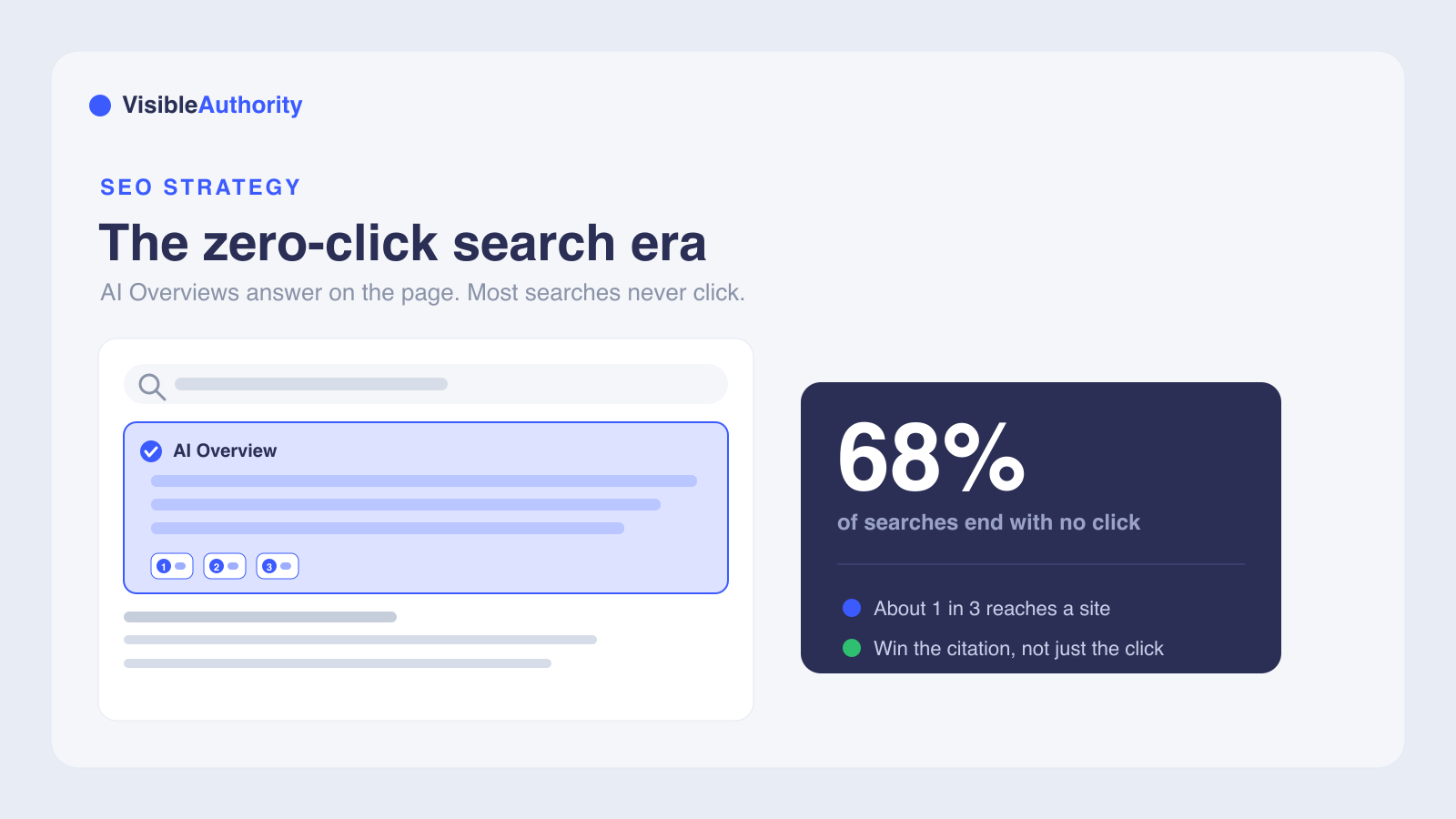
Zero-click searches are queries that get answered right on the results page, so the user never clicks through to a website. They now dominate: SparkToro and Similarweb data show 68% of US Google searches ended without a click in early 2026, up from about 60% in 2024, driven by SERP features and AI Overviews. For SEO this means click-through rate is falling even when rankings hold, so the goal shifts from earning clicks to being the source the answer is built from. Adapt by structuring content for extractability, strengthening E-E-A-T, adding schema, expanding beyond Google to YouTube, Reddit, and answer engines like ChatGPT and Perplexity, and reframing your KPIs around share of voice, brand mentions, and AI citations rather than raw traffic.
If your B2B SaaS company's organic traffic reports look different than they did two years ago, you are not alone. Rankings may hold steady while clicks keep dropping. The reason is measurable. 68.01% of US Google searches ended without a click in the first four months of 2026, according to SparkToro research using Similarweb clickstream data.
That is up from 60.45% in 2024, a 7.56 percentage point increase and the fastest acceleration in a decade. Only about 1 in 3 searches now sends traffic to any website, including yours. This article breaks down how zero-click searches are changing SEO strategy and what your brand can do to stay visible.
Understanding zero-click searches and what drives them
A zero-click search is a query where the user finds the answer directly on the search engine results page without clicking through to any website. The answer appears inside a SERP feature: featured snippets, knowledge panels, People Also Ask boxes, local packs, image packs, and video carousels. Google built these features to satisfy searchers without sending them away, and they work.
AI Overviews are the newest driver of this shift. Google's generative AI summaries now appear on 20% or more of all searches. When they show up, click-through rates drop by nearly 60%, per SparkToro's analysis. Google AI Mode pushes this further. A Semrush study of 69 million sessions found that 93% of AI Mode searches end without a click. That compares to roughly 34% for standard search without an AI Overview and 43% when one is present.
This is a decade-long structural shift, not a sudden disruption. Ten years ago, about 45% of Google searches were zero-click. Today it is 68%, a 23 percentage point increase. The trend accelerated sharply once AI entered the SERP. One important caveat: most studies use desktop and mobile web data but exclude Google's mobile search app. Roughly 60% of searches occur there, and zero-click behavior is likely even higher.
How zero-click searches reshape traditional SEO metrics
Organic click-through rate (CTR) has been the primary SEO KPI for years, and it is declining across the board. Ahrefs found a 34.5% drop in position 1 CTR when AI Overviews are present, based on analysis of 300,000 keywords, a cross-sectional comparison of pages with an AI Overview against those without. A separate before-and-after view is starker: position 1 CTR for AI Overview keywords fell from 7.3% in March 2024 to 2.6% by March 2025, a decline of about 64%.
Seer Interactive's analysis of 3,119 search terms across 42 client organizations tells a sharper story. For queries where an AI Overview appeared but the brand was not cited, organic CTR was 0.52%, down 65.2% year over year. Being cited in an AI Overview yielded 35% more organic clicks and 91% more paid clicks compared to not being cited. Pew Research Center surveyed 900 US adults in March 2025 and found a similar pattern. Users who encountered an AI summary clicked on a traditional result in only 8% of visits, versus 15% without one.
Even queries without AI Overviews are declining. Seer reported organic CTR for non-AIO queries down 41% year over year. Users are clicking less across every query type, and AI Overview queries are falling fastest. For B2B companies, 85% of buyers purchase from their day-one list, the vendors they had in mind before searching, per Bain and Company. If AI does not name your brand in its answer, you likely never make that list.
Adapting content and keyword strategy for direct answers and AI
Content structured for extractability gives AI models something to cite. Clear headings, concise answer-first paragraphs, bullet points, and FAQ formats let AI models parse and reference your content in synthesized answers. The zero-click content mindset means providing genuine value directly in the SERP rather than withholding answers to force clicks.
E-E-A-T (Experience, Expertise, Authoritativeness, Trustworthiness) signals influence whether AI models cite your content. Strong author credentials, sourced claims, and demonstrated expertise make your pages more likely to appear in AI-generated answers. Target high-intent, transactional, and long-tail queries that are less likely to be fully answered by a zero-click feature and more likely to lead to a conversion.
Run SERP analysis before investing in content for a keyword. Check whether it triggers featured snippets, AI Overviews, or knowledge panels. Bain and Company recommends abandoning PDFs and gated content as relics in an AI-driven ecosystem and optimizing for AI crawlability instead.
The stakes are rising for commercial queries specifically. Semrush data shows commercial queries triggering AI Overviews grew from 8.15% to 18.57%, and transactional queries from 1.98% to 13.94%, between October 2024 and October 2025. Diversify content formats beyond text: video and interactive formats boost visibility in generative AI search results. The goal is no longer just ranking for clicks but becoming the trusted source that powers Google's answer.
Technical SEO and structured data for AI visibility
Schema markup helps search engines and AI models understand your content contextually, increasing the chances of appearing in rich results, knowledge panels, and AI Overviews. For B2B SaaS companies, relevant schema types include Organization, SoftwareApplication, FAQPage, Article, and HowTo markup.
Site speed, mobile-friendliness, and crawlability remain non-negotiable. Bain recommends pragmatic technical optimization to set the foundation for LLM readability, making content crawlable and interpretable by large language models. Technical SEO now serves dual purposes: traditional search ranking signals and AI model comprehension signals.
Well-implemented structured data creates a content graph that AI models can traverse when synthesizing answers. Clean site architecture and semantic HTML help AI crawlers identify the most authoritative content on a given topic. Our technical SEO for AI search guide covers these foundations in more detail.
Expanding visibility beyond Google with multi-platform SEO
When buyers stop visiting websites, visibility depends on appearing across Google, YouTube, Reddit, and answer engines. YouTube became the top destination for traditional search in the US, EU, and UK, and the second-most visited domain from AI tools. Reddit threads increasingly supply source material for AI models comparing products and surfacing user experiences.
Perplexity AI and ChatGPT are answer engines that require their own optimization approach, distinct from traditional Google SEO. ChatGPT saw a 44% traffic boost in November 2024, and Perplexity reached 15 million monthly users in late 2024, per Bain and Company. For businesses with geographic presence, local search platforms like Google Business Profile and Apple Maps remain click-driven and measurable.
Google is also keeping more traffic within its own ecosystem. Per SparkToro, 14.3% of US searches resulted in clicks to Google-owned properties in March 2025, up from 12.1% a year earlier. Bain found that 68% of LLM users rely on these platforms for researching and summarizing information, and 42% ask them for shopping recommendations. Answer engine optimization extends your brand presence across the full answer ecosystem, including every search engine and answer platform buyers use.
Measuring SEO performance when clicks decline
Alternative KPIs are replacing CTR as the primary measure of SEO success. Search visibility, share of voice, brand mentions in AI-generated answers, AI citation frequency, and assisted conversions capture what traffic and CTR miss. Local search performance remains click-driven and measurable even as broader organic clicks decline.
Seer Interactive describes current CTR levels as the new baseline likely to continue. The agency recommends reframing your KPI as maintaining share and visibility rather than simply driving traffic. Track how often your brand appears in AI Overviews and answer engines like Perplexity and ChatGPT. Semrush recommends benchmarking and tracking brand mention rates and citations within AI Overviews over time.
Build a before-and-after measurement framework that captures visibility gains even when traffic metrics stay flat or decline. Our brand visibility measurement guide walks through this transition. The AI Visibility Testing Loop continuously tests prompts across ChatGPT, Perplexity, Gemini, and Claude to track brand mentions and refine content for better AI recommendations.
Frequently asked questions about zero-click searches and SEO
What is a zero-click search?
What percentage of Google searches are zero-click?
Do AI Overviews reduce website traffic?
Is SEO dead because of zero-click searches?
How should I measure SEO success without clicks?
Take the next step toward AI-driven search visibility
Zero-click searches represent an evolution of SEO, not its demise. The brands that adapt will capture visibility that competitors lose. Three strategic shifts define the path forward:
- Optimize for extractability and AI citations
- Expand to multi-platform visibility
- Reframe measurement around presence rather than clicks
Seer Interactive's finding makes the urgency concrete: brands cited in AI Overviews earn 35% more organic clicks than those not cited. That citation advantage is a measurable competitive edge. Our 30-Day Visibility Sprint delivers measurable improvements in AI mention rates through mapping, content deployment, and optimization within 30 days.
Assess your current AI visibility across ChatGPT, Perplexity, Gemini, and Claude before competitors capture that share of voice. When a B2B buyer asks an AI model which tool to use in your category, the brands named in that synthesized answer make the day-one list. If your brand is not tested and cited across these models, you are absent from the consideration set before the buyer ever visits your site.
We'll run your category through the major models and map exactly where you appear, where competitors win, and what it takes to become the recommendation.