
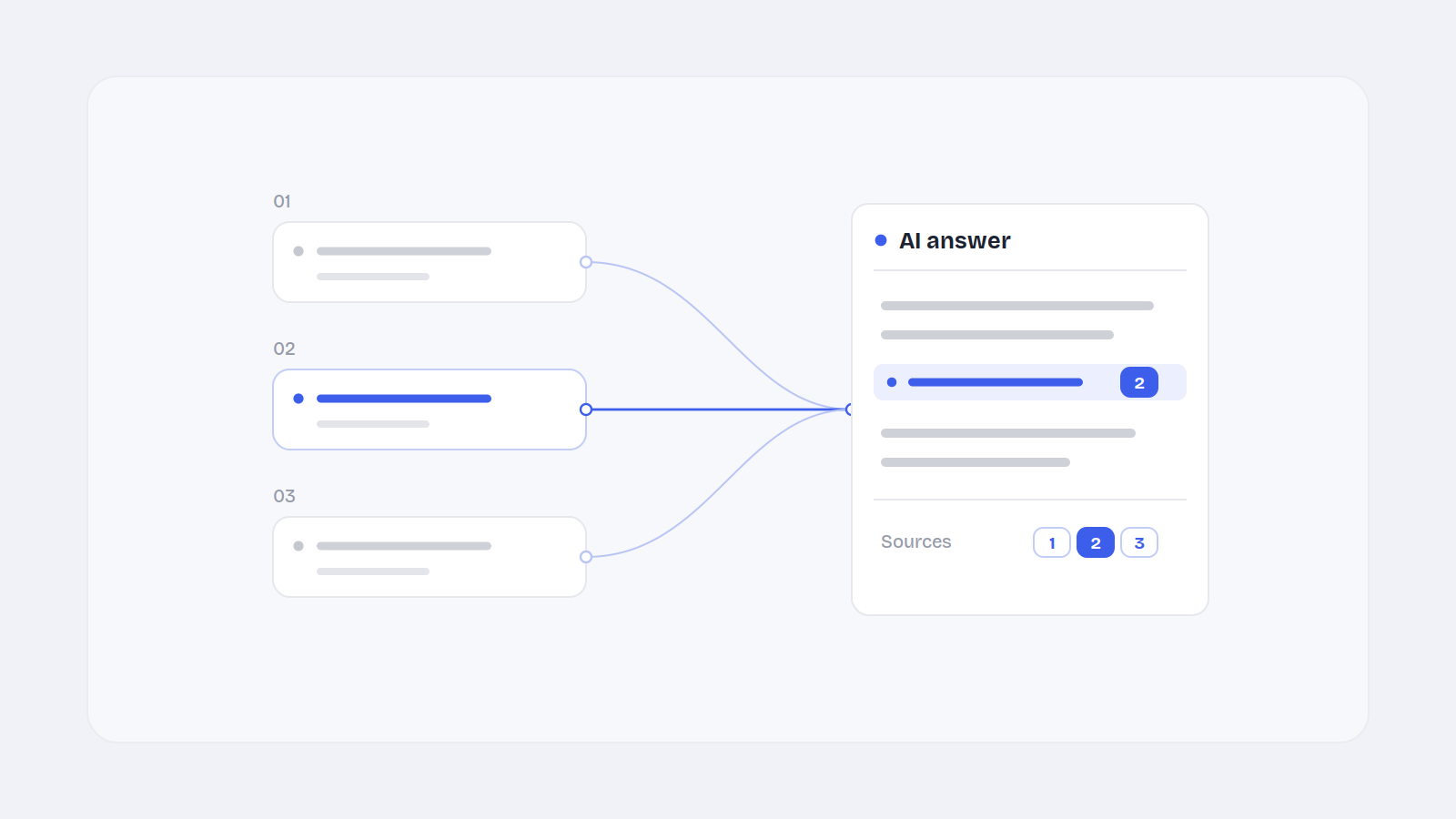
Generative Engine Optimization (GEO) is how you get your brand named, cited, and recommended inside AI-generated answers from tools like ChatGPT, Perplexity, and Google's AI Overviews. It works by earning trust: clear answer-first content, strong entity signals, and citations that AI systems rely on. The goal is simple. Be the one answer the AI gives, not the tenth link.
Your buyers are asking AI models for recommendations, and your brand might not be in the answer. What is Generative Engine Optimization (GEO) and why does it matter in 2026? Because B2B software buyers have shifted from scrolling link lists to asking conversational AI for named recommendations. If your brand is not cited inside those AI-generated answers, you lose consideration at the exact moment a buyer forms their shortlist.
We built this guide for B2B SaaS companies and AI tool startups that depend on being found during buyer research. Below: what GEO is, how it differs from SEO, which strategies produce measurable gains, and how to track AI visibility. Our AI Visibility Mapping process identifies where your brand is missing inside AI answers across ChatGPT, Perplexity, Gemini, and Claude.
What Is Generative Engine Optimization (GEO)?
Generative Engine Optimization (GEO) is the practice of structuring digital content, brand entity signals, and technical infrastructure so generative AI engines cite, quote, recommend, or surface your brand in AI-generated answers. The term was coined by Aggarwal et al. in a November 2023 research paper presented at ACM KDD 2024; the authors were affiliated with Princeton University and IIT Delhi. The paper built the GEO-bench benchmark of approximately 10,000 queries to test visibility tactics systematically.
The core purpose of GEO is to shift focus from ranking in link lists to being named and recommended inside a synthesized AI answer. When a buyer asks ChatGPT or Perplexity for the best tool for their use case, the model retrieves candidate sources, composes a response, and cites a small subset of brands. GEO is the work of making sure your brand is one of them.
This shift from traditional search to generative AI responses is the dominant information retrieval model today. People get answers directly from AI engines rather than scrolling results pages, which means brands absent from those answers never enter the consideration set.
GEO vs. Traditional SEO (and AEO/AI SEO)
Traditional SEO optimizes a page to rank on a results screen. GEO optimizes an entire brand presence to be synthesized into an AI answer. The distinction matters because generative engines deliver a finished answer, naming a small set of brands and leaving the rest out entirely.
Every generative engine follows a three-step process: retrieve candidate sources, synthesize them into a coherent answer, and cite a subset. SEO targets the retrieval stage. GEO targets the synthesis and citation stage. The Princeton study found that keyword stuffing produced negative visibility outcomes, performing 8 to 10% worse than baseline, reinforcing that GEO requires fundamentally different tactics than traditional SEO.
GEO also relates to Answer Engine Optimization (AEO), a broader umbrella for optimizing across answer engines. AEO covers any platform that delivers direct answers rather than link lists. GEO specifically targets generative AI synthesis and citation mechanics, the moment when an LLM decides which brands to name and which sources to cite.
- Focus: SEO targets ranking position in link lists; GEO targets inclusion inside composed AI answers
- Success metrics: SEO tracks keyword positions and organic traffic; GEO tracks citation frequency, Share of Voice, and AI Visibility Score
- Content format: SEO rewards keyword-optimized pages; GEO rewards direct-answer architecture, statistics, and entity clarity
- Optimization targets: SEO optimizes page-level signals for crawlers; GEO optimizes entity signals, third-party citations, and structured data for LLMs
Why GEO Matters in 2026: The Future of Search
Roughly 68% of US Google searches now end without a click, according to SparkToro data. Gartner projects a 25% decline in traditional search volume by 2026. Google reports that AI Overviews reach more than 2.5 billion monthly users. When Google shows an AI Overview, clicks on traditional results drop to 8% of searches, and only 1% of users click a cited source inside the overview, according to Pew Research data from March 2025.
The 61% organic CTR decline figure on queries with AI Overviews was measured by Seer Interactive in September 2025; The Digital Bloom cited Seer's data in a March 2026 report but did not measure it independently. There is a flip side: brands cited within AI Overviews reportedly see a 35% organic CTR boost and a 91% paid CTR boost compared to uncited competitors. Being cited directly drives traffic and revenue.
For B2B SaaS companies, absence from AI-generated recommendations means losing buyers at the awareness and evaluation stages. A growing share of B2B software research begins inside an AI assistant rather than a search bar. Buyers who arrive after an AI recommendation tend to be further along in their decision process, pre-educated and partly pre-sold. GEO functions as a demand channel, not a vanity metric.
Agentic search, where AI assistants autonomously research and compare options on behalf of users, will compress the buyer journey further. Brands not recognized as entities by these systems will not even make the shortlist.
How Generative Engines Work and Select Information
Every generative engine uses some variant of Retrieval-Augmented Generation (RAG). The model generates search queries from the user's question, retrieves candidate documents, scores each for relevance and authority, and synthesizes an answer that quotes or paraphrases the highest-scoring sources with citations.
Entity recognition is the first gate. AI models identify and connect entities like brands, products, and concepts to decide which to include. Without strong entity signals such as Wikidata items, Knowledge Panels, and consistent Organization schema, the engine treats your brand as ambiguous text. Source authority also matters: models prioritize sources demonstrating E-E-A-T, or Experience, Expertise, Authoritativeness, and Trustworthiness.
Citation patterns vary by platform. Semrush's June 2026 data shows approximately 15 cited sources per ChatGPT answer versus 3 for Gemini. Two findings shape GEO strategy: reportedly only 6.82% of ChatGPT results appear in Google's top 10, and brands are reportedly 6.5x more likely to be cited through third-party sources than their own domains. A 2025 Muck Rack study reportedly found 27% of LLM citations originated from journalism. For more on these source-selection factors, structured data and freshness also play significant roles.
Platforms Where GEO Applies
- Google AI Overviews: Cites sources already ranking in top organic results, making classic SEO partially foundational
- ChatGPT: Sources content different from Google; reportedly 68.7% of citations follow heading hierarchies and 61% of cited pages use structured data
- Perplexity: Emphasizes real-time web retrieval with visible citations, favoring fresh content and authoritative mentions
- Google Gemini: Blends Google's search index with conversational synthesis
- Microsoft Copilot: Uses Bing's index and OpenAI models with citation patterns distinct from Google and ChatGPT
- Anthropic's Claude: Prioritizes factual accuracy and well-structured, clearly attributed content
Key Strategies for Generative Engine Optimization (GEO)
The Princeton study tested specific content modifications against a baseline and measured their impact on visibility in generative responses. Five tactics produced measurable gains:
- Add statistics: Embedding relevant data points improved visibility by approximately 41% in the Princeton study
- Include quotations: Adding quotes from authoritative sources improved visibility by approximately 28%
- Cite credible external sources: Referencing authoritative third-party data produced the largest effect for under-ranked content, lifting visibility by 115%
- Improve fluency and readability: Enhancing writing quality added 15-30% visibility gains
- Build entity-first content: Structure content around clear entities (brand name, product categories, use cases) so AI models can identify and recommend your brand
- Expand third-party citations: Focus on review platforms, industry publications, and tier-1 editorial coverage
- Maintain freshness: Generative engines re-cite recent content; stale pages get displaced
For B2B SaaS, the content types that matter most are comparison pages, pricing pages, documentation, and focused FAQs. When a generative engine answers a buying question, it names only a handful of brands, and those brands capture the consideration set. Our AI-Optimized Content System builds exactly this kind of answer-first, comparison-driven content that AI models use to cite and recommend your brand.
Our 30-Day Visibility Sprint delivers mapping, content deployment, and optimization in a structured engagement designed for measurable improvements in AI mention rates within 30 days. We use live AI prompt testing across multiple models to validate and refine visibility strategies, so you see before-and-after results, not theoretical projections.
Measuring GEO Success and Visibility
Traditional SEO rank trackers do not work for GEO. AI responses are non-deterministic, vary by session, and lack standardized analytics tools comparable to traditional SEO platforms.
- Share of Voice: Percentage of AI answers that mention your brand versus competitors for relevant queries
- AI Visibility Score: Composite metric tracking mention rates, citation frequency, and sentiment across platforms
- Citation frequency: How often engines cite your domain, tracked weekly across top queries
- Sentiment analysis: Whether the model describes your brand positively, neutrally, or negatively
AI referral traffic currently sits at approximately 1.08% of all website traffic, with ChatGPT driving roughly 87% of it, making direct traffic an incomplete proxy for GEO success. The most reliable measurement approach is continuous testing across AI models, which is exactly what our AI Visibility Testing Loop does: running live prompts, tracking brand mentions, and refining content based on what the models actually return.
Frequently Asked Questions About GEO
What is the difference between GEO and traditional SEO?
How do I optimize my content for generative AI engines?
Which platforms should I optimize for GEO?
Can GEO replace traditional SEO?
How long does it take to see results from GEO?
- GEO is no longer optional for B2B SaaS companies that depend on being found during buyer research. The shift from link-based to answer-based search is accelerating. AI Overviews reach more than 2.5 billion monthly users, and brands cited inside those overviews see significant CTR boosts while uncite
- The Princeton study proved that targeted optimizations can boost visibility in generative responses by up to 40%. But knowing the tactics is not the same as executing them. Brands need structured content systems, continuous testing across AI models, and a focus on the specific pages buyers ask about
- We specialize in contested B2B SaaS and AI tool markets where AI recommendations directly influence buyer decisions. Start with our AI Visibility Mapping to see exactly where your brand is missing in AI answers, then move into a 30-Day Visibility Sprint for measurable before-and-after results. The b
We'll run your category through the major models and map exactly where you appear, where competitors win, and what it takes to become the recommendation.