
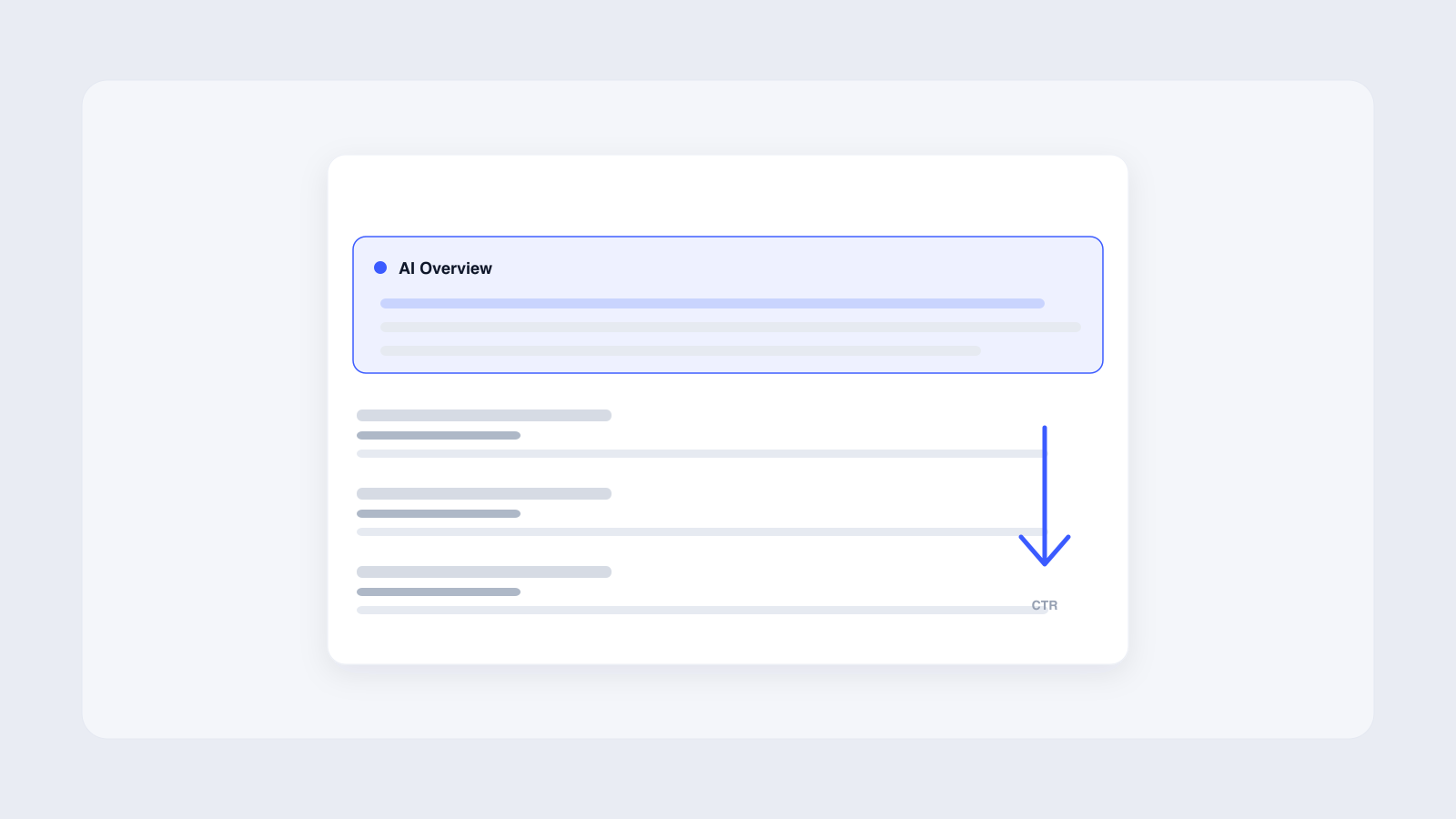
Google AI Overviews are compressing organic click-through rates, expanding zero-click searches, and decoupling rankings from citations. Seer Interactive measured a 61% drop in organic CTR on AI Overview queries, and Ahrefs found position-one CTR fell 58%. Only about 38% of cited URLs still rank in the top 10. But being cited pays: cited pages earn 120% more organic clicks per impression than uncited ones. The shift is from ranking-based to citation-based visibility, so B2B SaaS brands should move from commodity content to differentiated, answer-first analysis that AI models cite.
If you run a B2B SaaS company, you have probably watched your organic search traffic thin out over the past two years. The question on every marketing leader's mind is direct: how are Google AI Overviews changing organic search traffic in 2026? The answer, backed by data from three independent research teams, is that AI-generated answers are compressing click-through rates, expanding zero-click searches, and decoupling traditional rankings from AI citations. They are also creating a new visibility opportunity for brands that adapt fast enough.
Executive summary: what the data says about AI Overviews and organic traffic
Google AI Overviews appear on a growing share of US search results. Pew Research Center found that 18% of Google searches produced an AI summary in March 2025, and 58% of respondents encountered at least one during the month. Coverage has expanded since then, with Seer Interactive's 2026 update confirming AI Overviews now appear on informational, commercial, and transactional queries.
For B2B SaaS companies, the numbers are stark. Seer Interactive documented a 61% drop in organic CTR on AI Overview queries between June 2024 and September 2025, analyzing 3,119 search terms across 42 client organizations and 25.1 million organic impressions. Ahrefs measured a 58% decline in position-one CTR for keywords with AI Overviews using December 2025 data.
The zero-click trend is accelerating. Pew Research Center found that users clicked traditional results only 8% of the time when an AI summary appeared, compared to 15% without one. About 26% of sessions with an AI summary ended without the user visiting any external website, versus 16% for non-AIO sessions.
There is a citation dividend. Seer's 2026 update found that being cited in an AI Overview delivers 120% more organic clicks per impression than not being cited. When a brand was not cited, CTRs declined 67% over 2025, costing approximately 13,000 fewer organic clicks per 1 million impressions. The central shift is from ranking-based to citation-based visibility.
Methodology: how these traffic projections were calculated
Three primary data sources anchor this analysis. Seer Interactive tracked 3,119 informational search terms across 42 client organizations, spanning 25.1 million organic impressions and 1.1 million paid impressions from June 2024 through September 2025. Their 2026 update expanded to 53 brands, 5.47 million tracked queries, and 2.43 billion organic impressions, covering informational, transactional, and commercial intent from January 2025 through February 2026.
Ahrefs analyzed 300,000 keywords, comparing CTR before and after AI Overview rollout. Their citation analysis covered 863,000 keyword SERPs and 4 million AI Overview URLs using data from Ahrefs Brand Radar. Pew Research Center analyzed web browsing data from 900 US adults, capturing 68,879 unique Google searches in March 2025, of which 12,593 produced an AI summary. Data was collected through KnowledgePanel Digital, an Ipsos panel.
Several caveats apply. Seer used a retrospective cohort design, categorizing queries by September 2025 AIO presence and applying that label backward. They note: "We are not claiming AIOs were present for all 15 months." Their 2026 update uses a static AIO status label from the most recent SERP snapshot, and March 2026 figures are described as "directional floors, not predictions." Ahrefs notes that CTR was already declining before AI Overviews due to SERP features like featured snippets and People Also Ask. AI Overviews accelerated an existing trend rather than starting a new one.
How AI Overviews compress organic click-through rates
The Seer Interactive trajectory tells a clear story. Organic CTR on AI Overview queries fell from 1.41% to 0.64% between their January 2025 original study and the September 2025 update. Search Engine Land's coverage of the Seer data headlined the finding as a 61% drop in organic CTR.
Ahrefs provides a longitudinal view. Position-one CTR for AI Overview keywords dropped from 7.3% in December 2023 to 1.6% in December 2025. For every 100 clicks a top-ranking page could historically earn, Ahrefs calculates that Google now keeps 58. The decline affects every position, though position one takes the hardest hit at negative 58%, while position ten sees a smaller negative 19.4%.
Pew Research Center's behavioral data adds a human dimension. Users who encountered an AI summary clicked a traditional search result link in only 8% of visits. Those who did not encounter one clicked nearly twice as often, at 15% of visits. Clicks on links inside the AI summary itself were even rarer, occurring in just 1% of visits.
There are early signs of stabilization. Seer's 2026 update showed organic CTR on AIO-present queries climbing from a floor of 1.3% in December 2025 to 2.4% in February 2026, an 85% increase from the December low. Every informational and transactional organic segment beat Seer's model projections in both January and February 2026. The model had forecasted continuous decline.
This rebound still leaves CTR well below pre-AIO baselines. January 2025 CTR for AIO-present queries was 3.2%. Seer attributes the leveling to "a new Google SERP change" rather than a fundamental shift in user behavior. Meanwhile, Ahrefs' position-one data through December 2025 shows the opposite trend: worsening from a 34.5% decline to 58%. The two studies measure different things. Seer tracks aggregate organic CTR across all positions, while Ahrefs isolates position one specifically. Both can be true simultaneously.
Why zero-click searches are accelerating in 2026
Pew Research Center found that around two-thirds of all Google searches resulted in the user either browsing elsewhere on Google or leaving the site entirely without clicking a link, regardless of AI summary presence. AI Overviews make this behavior more pronounced.
When an AI summary appeared, 26% of sessions ended without the user visiting any external website. Without an AI summary, that figure was 16%. The AI summary gives users enough information to satisfy their query without leaving Google's ecosystem. Only 1% of visits to pages with AI summaries resulted in a user clicking a cited source link inside the summary itself.
For B2B SaaS companies, commodity informational content is the most vulnerable. Definitions, how-to basics, and feature lists are exactly the type of content AI Overviews synthesize without citing a source. Differentiated, opinionated, or proprietary analysis retains more click appeal because AI models need to attribute those insights.
Google AI Mode, a more immersive conversational search experience within Google Search, is designed to keep users in Google's ecosystem longer. As AI Mode matures from an experimental feature to a mainstream search mode, zero-click rates will likely accelerate further. Ahrefs notes that CTR was already declining before AI Overviews existed, driven by SERP features like featured snippets, People Also Ask boxes, and knowledge panels. AI Overviews accelerated a trend that had been underway for years.
How AI Overview impact varies by query intent
Ahrefs found that 99.2% of keywords triggering AI Overviews are informational in intent as of their original April 2025 study. Question queries trigger AI Overviews 57.9% of the time. This concentration on informational queries shaped the early impact narrative.
The picture is shifting. Seer Interactive predicted in September 2025 that AI Overviews would spread to commercial and transactional queries. Their 2026 update confirmed this, expanding analysis to include all three intent types with "directional findings between the intent categories" that are "consistent." Seer's 2026 data shows informational queries trigger an AIO 36% of the time, commercial queries 8%, and transactional queries 5%.
For B2B SaaS companies, this expansion matters. Comparison queries, review queries, and bottom-of-funnel decision-stage searches are increasingly AI Overview territory. When buyers search for software recommendations, they may encounter an AI-synthesized answer before ever visiting a vendor's website. The citation data supports this shift: Ahrefs found that Google is increasingly relying on query fan-out, splitting the initial query into multiple related sub-queries and citing pages that appear most often across those sub-query SERPs. Topical authority across a cluster of related queries, rather than a single ranking page, determines citation presence. You can learn more about building this authority through our topical authority framework.
The citation economy: why rankings no longer control AI visibility
The most significant structural change is the decoupling of organic rankings from AI citations. Ahrefs found that only 37.9% of URLs cited in AI Overviews also appeared in the top 10 organic results. The remaining citations split between positions 11 through 100 (31.2%) and beyond position 100 (31.0%).
This represents a sharp decline from July 2025, when approximately 76% of cited pages came from the direct SERP. By January 2026, that figure had fallen to roughly 38%. A separate BrightEdge analysis published in February 2026 reported about 17% top-10 overlap using different methodology. Both trackers agree on the direction: a first-page ranking is no longer the price of admission to an AI answer.
Ahrefs attributes this shift to Google's increased reliance on query fan-out for source selection, amplified by Gemini 3, which has powered AI Overviews since January 2026. Among cited pages that do not rank in the top 100, 18.2% are YouTube URLs, making YouTube the most cited domain in AI Overviews as of January 2026. YouTube URLs accounted for 5.6% of all AI Overview URLs cited, growing 34% over the prior six months.
The citation dividend is measurable. Seer's 2026 update found that being cited in an AI Overview delivers 120% more organic clicks per impression than not being cited. When a brand was not cited, CTRs declined 67% over 2025 across 311 million organic impressions, costing approximately 13,000 fewer organic clicks per 1 million impressions. Google's AI favors sources with strong E-E-A-T signals: expertise, experience, authoritativeness, and trustworthiness. Original data, proprietary research, and demonstrated subject-matter expertise are what the AI selects for citation. Our AI Visibility Mapping service uses live AI prompt testing across multiple AI models to identify where a brand is missing in AI-generated answers and refine content to improve the likelihood of brand mentions when buyers ask relevant questions.
Measuring success: new metrics for an AI-overview-dominated SERP
Traditional organic position tracking is no longer sufficient. A brand can rank first and still be absent from the AI Overview. A brand can be cited without ranking in the top 100. The metrics that mattered in 2023 do not capture visibility in 2026.
The new metric set includes citation frequency (how often the brand appears as a source in AI Overviews), AI referral traffic (clicks from AI Overview citation links), and overall brand presence within AI-generated answers across models like ChatGPT, Perplexity, Gemini, and Claude. Answer Engine Optimization (AEO) is the framework for measuring this visibility, moving beyond blue-link position tracking to track AI answer presence, citation rates, and brand mention frequency across AI-powered search platforms.
Continuous testing is essential because AI Overviews are dynamic. Citation presence fluctuates as Google updates its models, expands query coverage, and adjusts source selection algorithms. The AI Visibility Testing Loop runs live AI prompts across models to track brand mentions and refine content for AI recommendations, providing the ongoing measurement that static rank tracking cannot. AI search tracking tools can help automate this measurement process.
How publishers and B2B SaaS companies are adapting
Ahrefs documented their own case study: CTR dropped by 3.76 percentage points, a 42% decline relative to baseline. After excluding one anomaly, the decline was 3.98 percentage points, a 44% relative decline. This is a leading SEO tool provider experiencing the same traffic compression as everyone else.
Corroborating data from other researchers paints a consistent picture. Ahrefs cites Kevin Indig's finding of greater than 50% CTR decline, Authoritas at 47.5%, and the Daily Mail reporting 80 to 90% lower CTR on AI Overview queries. The range varies by site type and query set, but the direction is unanimous.
The strategic pivot for B2B SaaS companies is to shift from commodity informational content, which AI Overviews answer directly, to differentiated, opinionated, and proprietary analysis that AI models cite as sources. Google states there is no AI-specific markup or special schema for AI Overview eligibility. Being indexed and snippet-eligible remains the technical foundation. GEO and traditional SEO serve different purposes, and both are needed.
Forecasting 2026: where AI Overviews go from here
AI Overviews are powered by Gemini 3 as of January 2026, replacing earlier Gemini model variants. The model upgrade coincides with Google's increased reliance on query fan-out for source selection, which expands the pool of citable pages beyond the direct SERP.
YouTube's dominance as the most cited domain in AI Overviews signals that Google's AI is drawing from its own properties and video content, beyond traditional web pages. YouTube URLs accounted for 5.6% of all AI Overview URLs cited, growing 34% over the prior six months.
The expansion into commercial and transactional queries, confirmed by Seer's 2026 update, means AI Overviews are no longer confined to informational searches. B2B SaaS buyers searching for comparison queries, reviews, and recommendations will increasingly encounter AI-synthesized answers before reaching vendor websites. As more brands optimize for AI citation, competition for cited-source positions will intensify. GEO strategies for 2026 need to account for this maturation, making structured, answer-first content a baseline requirement rather than a differentiator.
Strategic adaptation: what B2B SaaS companies should do now
The first step is auditing AI visibility. Brands need to map where they appear and where they are missing in AI-generated answers across major AI models. Without this diagnostic, any content investment is a guess.
The second step is creating answer-first content. Comparison, recommendation, and definitive-answer content that AI models cite and recommend attracts more clicks than generic blog posts that AI Overviews can synthesize without attribution. Measuring brand visibility in AI search requires tracking citation frequency, AI referral traffic, and brand mention rates across models.
The third step is building E-E-A-T signals. Author expertise, original data, proprietary research, and demonstrated experience are what Google's AI selects for citation. Commodity content is the most vulnerable to being summarized without attribution.
The fourth step is continuous testing. AI Overviews are dynamic, and citation presence fluctuates as Google updates models and expands coverage. Running live AI prompts across models to track brand mentions and refine content is an important way to monitor changing AI visibility, alongside conventional analytics like Search Console and referral data.
The 30-Day Visibility Sprint delivers measurable improvements in AI mention rates through mapping, content deployment, and optimization within a defined 30-day window. If your B2B SaaS company is losing organic traffic to AI Overviews and needs a before-and-after baseline, book a sprint to find out where you stand and what to fix first.
Frequently asked questions about AI Overviews and organic traffic
How much organic traffic are websites losing from Google AI Overviews?
Are organic clicks recovering from AI Overview impact in 2026?
Does being cited in an AI Overview increase website traffic?
Do you need to rank in the top 10 to be cited in an AI Overview?
What percentage of Google searches show AI Overviews in 2026?
We'll run your category through the major models and map exactly where you appear, where competitors win, and what it takes to become the recommendation.