
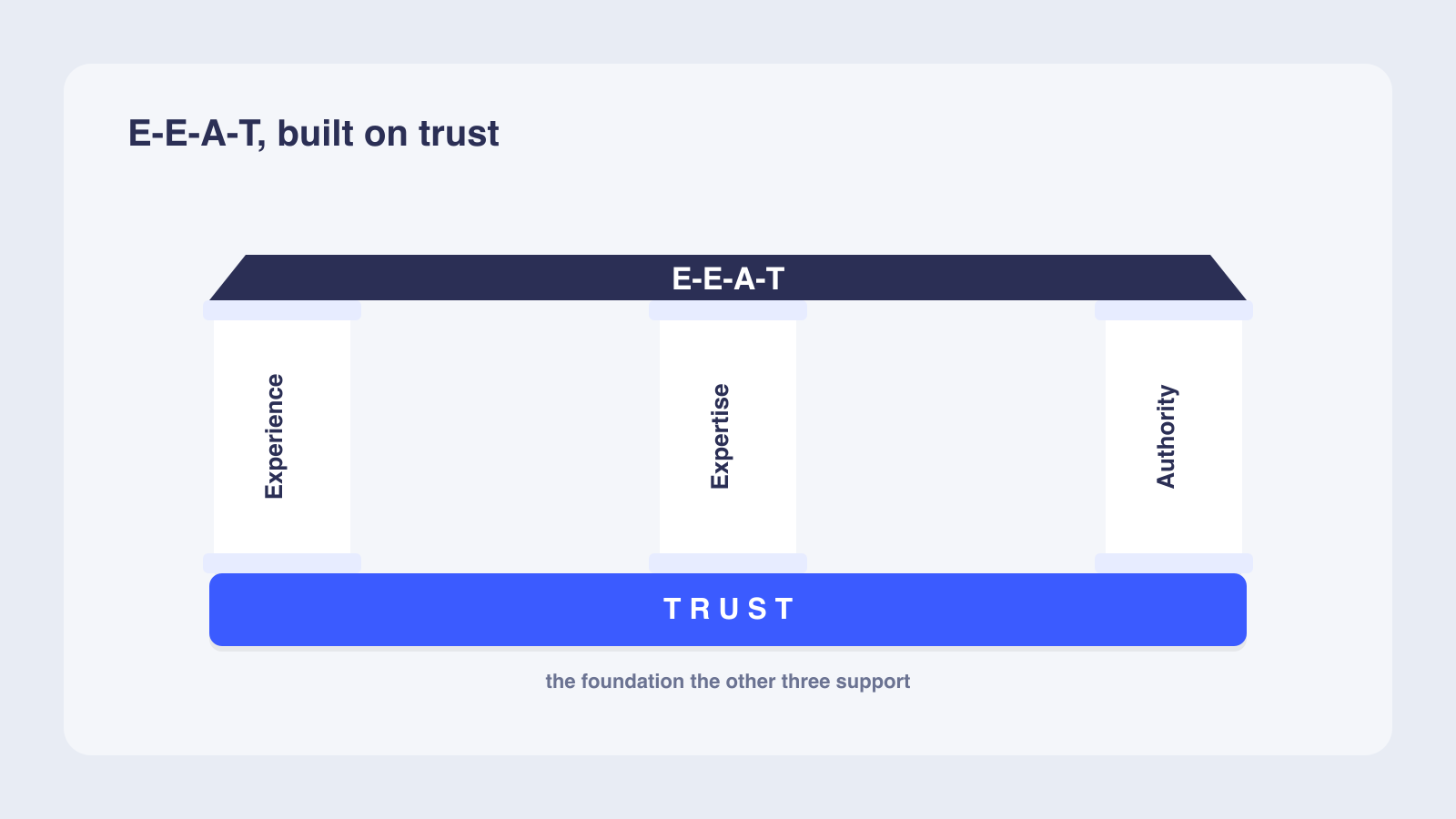
E-E-A-T stands for Experience, Expertise, Authoritativeness, and Trustworthiness, a framework from Google's Search Quality Rater Guidelines that human raters use to judge page quality. It is not a ranking factor or a score you can add to a page; it is inherent in the overall experience of your site. You demonstrate it by making credibility visible: verifiable author bios with real names, photos, and credentials; transparent sourcing and citations; original research, data, and first-hand examples; and clear trust signals like a real About page, contact details, and editorial policies. Trust is the center of the framework, and the other three pillars feed it. The weightier the topic, especially Your Money or Your Life pages on health, finance, or safety, the more evidence you need. The same signals that satisfy human raters also help AI answer engines decide whether to cite you.
E-E-A-T stands for Experience, Expertise, Authoritativeness, and Trustworthiness, a framework from Google's Search Quality Rater Guidelines that human raters use to evaluate page quality. If you are asking what E-E-A-T is and how to demonstrate it on your website, the short answer is simple. You make your credibility visible through verifiable author credentials, transparent sourcing, original research, and clear on-site trust signals. It is a set of content quality principles that, when applied well, helps build user trust and indirectly supports search performance.
This guide breaks down each pillar, explains how E-E-A-T relates to Google's rater guidelines and YMYL topics, and walks through the specific on-site changes you can make to demonstrate each one. The same trust signals that satisfy human quality raters also influence how AI answer engines like ChatGPT, Perplexity, and Google AI Overviews decide which sources to cite and recommend.
What does E-E-A-T mean for your website?
E-E-A-T is a content quality framework that Google's human quality raters use to assess whether search results meet user needs. According to Google's Search Central guidance, the framework helps Google's automated systems identify content that demonstrates experience, expertise, authoritativeness, and trustworthiness.
Not a ranking score
John Mueller confirmed at Search Central Live NYC that you cannot add E-E-A-T to pages the way you might add keywords or metadata, according to Search Engine Journal. E-E-A-T is inherent in the overall experience of researching and consuming content from a site. Google's Danny Sullivan has reiterated that E-E-A-T is not a score, not a ranking factor, and not an algorithm, but a template for how raters evaluate individual pages.
Trust is the center of the framework
Google's guidelines state that trust is the most important member of the E-E-A-T family. Google's own example: a financial scam is untrustworthy even if the content creator is a highly experienced and expert scammer considered the go-to source on running scams. The other three pillars contribute to trust, but content does not necessarily need to demonstrate all of them to be trustworthy.
The extra E for experience
Google added the second E (Experience) to the original E-A-T in December 2022 to emphasize first-hand or life experience with the topic, as Search Engine Land reported at the time. Google explained the distinction with a tax example.
If you need tax return advice, you want an expert in accounting. If you want reviews of tax preparation software, you want someone who has actually used the product. Experience and expertise can overlap, but a product review from someone who personally used the product carries more weight than one from someone who has not.
How do the four pillars of E-E-A-T work?
Each pillar asks a different question about the content creator and the page. Raters consider the purpose, type, and topic of the page, then assess which combination of E-E-A-T signals applies. The pillars can overlap, but trustworthiness anchors the other three.
| Pillar | The question it asks | How to demonstrate it |
|---|---|---|
| Experience | Does the creator have first-hand or life experience with the topic? | Original photos, screenshots, process documentation, proprietary data, and case studies |
| Expertise | Does the creator have the necessary knowledge or skill? | Formal credentials for YMYL topics; detailed, accurate work for lifestyle or product content |
| Authoritativeness | Is the creator or site a go-to source for the topic? | Consistent quality output, inbound links from reputable sites, industry mentions, citations |
| Trustworthiness | Is the page accurate, honest, safe, and reliable? | Transparent sourcing, real About and contact details, honest claims; this pillar anchors the rest |
Experience
Experience asks whether the content creator has first-hand or life experience with the topic. Google described low E-E-A-T as a restaurant review written by someone who has never eaten at the restaurant. To demonstrate experience, include original photos, process documentation, screenshots, proprietary data, and case studies that could only come from someone who did the work.
Expertise
Expertise asks whether the content creator has the necessary knowledge or skill for the topic. Different topics require different levels and types of expertise to be trustworthy. According to the Search Quality Rater Guidelines, Google's example is home electrical rewiring advice from a skilled electrician versus the same advice from an antique-homes enthusiast with no wiring knowledge. For YMYL topics like medical or financial advice, formal credentials matter more. For lifestyle or product content, demonstrated competence through detailed, accurate work can suffice.
Authoritativeness
Authoritativeness asks whether the content creator or website is known as a go-to source for the topic. It is built through consistent, high-quality output, inbound links from reputable sites, industry mentions, and being cited by other creators in the same field. Without trust, even an authoritative-seeming page fails the E-E-A-T assessment.
Trustworthiness
Trustworthiness asks whether the page is accurate, honest, safe, and reliable. It is the foundational pillar that the other three depend on. A page can demonstrate experience, expertise, and authoritativeness and still fail if the content is inaccurate or deceptive. Google notes that the type and amount of trust needed depends on the page and its purpose: a personal blog about a hobby needs less evidence than a page giving medical dosage advice.
How does E-E-A-T relate to Google's rater guidelines and YMYL?
E-E-A-T comes from Google's Search Quality Rater Guidelines, a document human raters use to evaluate search results. Google uses it to calibrate algorithms, similar to how a restaurant uses feedback cards from diners. YMYL (Your Money or Your Life) topics require the highest E-E-A-T scrutiny because they could significantly impact health, financial stability, or safety.
Rater guidelines and ranking connection
Google assesses E-E-A-T through three lenses: what you say about yourself (About page, author profiles), what others say about you (reviews, news articles, independent sources), and what is visible on the page (content quality, reviews, comments). Rater data helps Google check whether its systems produce helpful results. Google has more than 10,000 search quality raters who collectively perform millions of sample searches, according to Google's own blog.
YMYL topics need the most evidence
Google updated its rater guidelines in September 2025 to add AI Overview examples and clarify YMYL definitions, though the rating guidance itself did not change, according to Search Engine Land. Pages on clear YMYL topics require the most scrutiny for page quality rating, and informational YMYL pages require a high level of expertise to be trustworthy. However, pages sharing first-hand life experience on YMYL topics can also be considered high E-E-A-T, as long as the content is safe and consistent with well-established expert consensus.
How do you demonstrate E-E-A-T on your website?
Demonstrating E-E-A-T means making your credibility visible through specific, verifiable on-site elements. Each pillar maps to concrete changes you can implement across your pages, from author bios to editorial policies. A quick test: open your most important page in an incognito window and ask whether a first-time visitor can tell who wrote it, what makes them qualified, and how to contact your company.
Author bios and bylines
Include a full name, headshot, title or position, detailed bio, contact information, and links to published work on a dedicated author page. Each article should carry a byline where one might be expected, according to Search Engine Journal. Keep information consistent across the site and avoid fabricated credentials or AI-generated headshots. A strong bio uses concrete specifics: over 160 SEO projects since 2021 beats experienced SEO professional.
About and contact pages
Tell your company story with real team photos and names. List a physical address, phone, and email. Link all legal and policy pages in the footer. These elements let raters verify what you say about yourself, which is the first lens Google uses for E-E-A-T assessment. Stanford's Web Credibility Project found that showing a real organization behind your site, and making it easy to verify accuracy through third-party support, both increase perceived credibility.
Reviews and editorial policies
Document a transparent review process, name reviewers alongside authors for sensitive topics, and maintain an editorial calendar to refresh important pages regularly. The same transparent sourcing and clear authorship that satisfy human quality raters also help AI answer engines decide whether to cite your content, as explained in our AI search visibility guide.
What E-E-A-T mistakes should you avoid?
Four common E-E-A-T mistakes undermine content credibility more than any others. Each one is preventable with a clear editorial standard and a consistent review process.
- Fabricating author profiles with AI-generated headshots, made-up names, or false credentials. Google explicitly calls this deception and says any form of deception makes a page untrustworthy to both users and automated systems.
- Treating E-E-A-T as a score you can optimize. John Mueller confirmed you cannot add E-E-A-T to pages; it is inherent in the overall experience of researching and consuming content from a site.
- Inconsistent information across pages. Different name spellings, titles, or broken profile links signal carelessness and reduce trust. Keep author names, photos, and roles consistent everywhere, including external profiles like LinkedIn.
- Adding schema markup without substance. Structured data amplifies existing credibility, but a falsely claimed credential in a schema block remains false information.
Fabricated authorship is the most damaging mistake
Google's helpful-content guidance states that fabricating creator profiles using AI-generated headshots, made-up names, or false credentials is a form of deception. Reverse image search quickly reveals stock photos and AI-generated portraits. Credentials that cannot be verified, such as an award with no name attached, also erode trust when a reader or rater checks. A short bio where everything is verifiable beats a long one with claims nobody can confirm.
Schema without substance fails
Structured data is not required for AI Overviews and is not itself a ranking factor, but 2025 analyses reported by Search Engine Land found that pages with well-implemented schema tended to show up more often in AI Overviews. Schema helps AI models identify entities like authors and organizations and verify credentials. The fix is to correct the underlying content first, then add structured data to amplify it.
How to run an E-E-A-T audit on your website
A full E-E-A-T audit checks each page type on your site for the four pillars, prioritizes YMYL content, and schedules recurring reviews to keep evidence current. Work through the checklist below for every page type your site publishes.
- Check each page type: articles, product pages, About pages, landing pages, and blog posts all need E-E-A-T signals.
- Prioritize YMYL pages first: begin your audit with these pages.
- Verify author consistency: confirm names, photos, titles, and profile links match across every page and external profile.
- Review evidence on the page: check for original research, screenshots, citations, and first-hand documentation that could only come from someone who did the work.
- Schedule a recurring audit every few months to keep author bios, statistics, and citations current.
Quick test for experience signals
Search your brand name in ChatGPT and note what it gets wrong about your company, your authors, or your products. If the AI cannot identify your authors or cite your original research, your E-E-A-T signals are too weak for AI answer engines to pick up. As covered in our guide on how AI crawlers read content, crawlers like GPTBot and PerplexityBot fetch HTML and favor content with clear authorship, original data, and transparent sourcing.
Prioritize YMYL pages first
Start with YMYL pages and confirm that every claim has a citation, every author has verifiable credentials, and every statistic links to its source. Then work outward to lower-risk content.
Frequently asked questions
Is E-E-A-T a Google ranking factor?
What is the difference between E-A-T and E-E-A-T?
Does E-E-A-T apply to all websites or just YMYL?
How do I show first-hand experience in my content?
Can schema markup improve my E-E-A-T?
What makes a good author bio for E-E-A-T?
Next steps
If you want help measuring how AI answer engines perceive your brand's authority, the 30-Day Visibility Sprint maps where your brand appears in AI-generated answers and deploys content to improve it. You can learn how to get cited in AI Overviews, or request a visibility audit to see measurable before-and-after results in 30 days.
We'll run your category through the major models and map exactly where you appear, where competitors win, and what it takes to become the recommendation.