
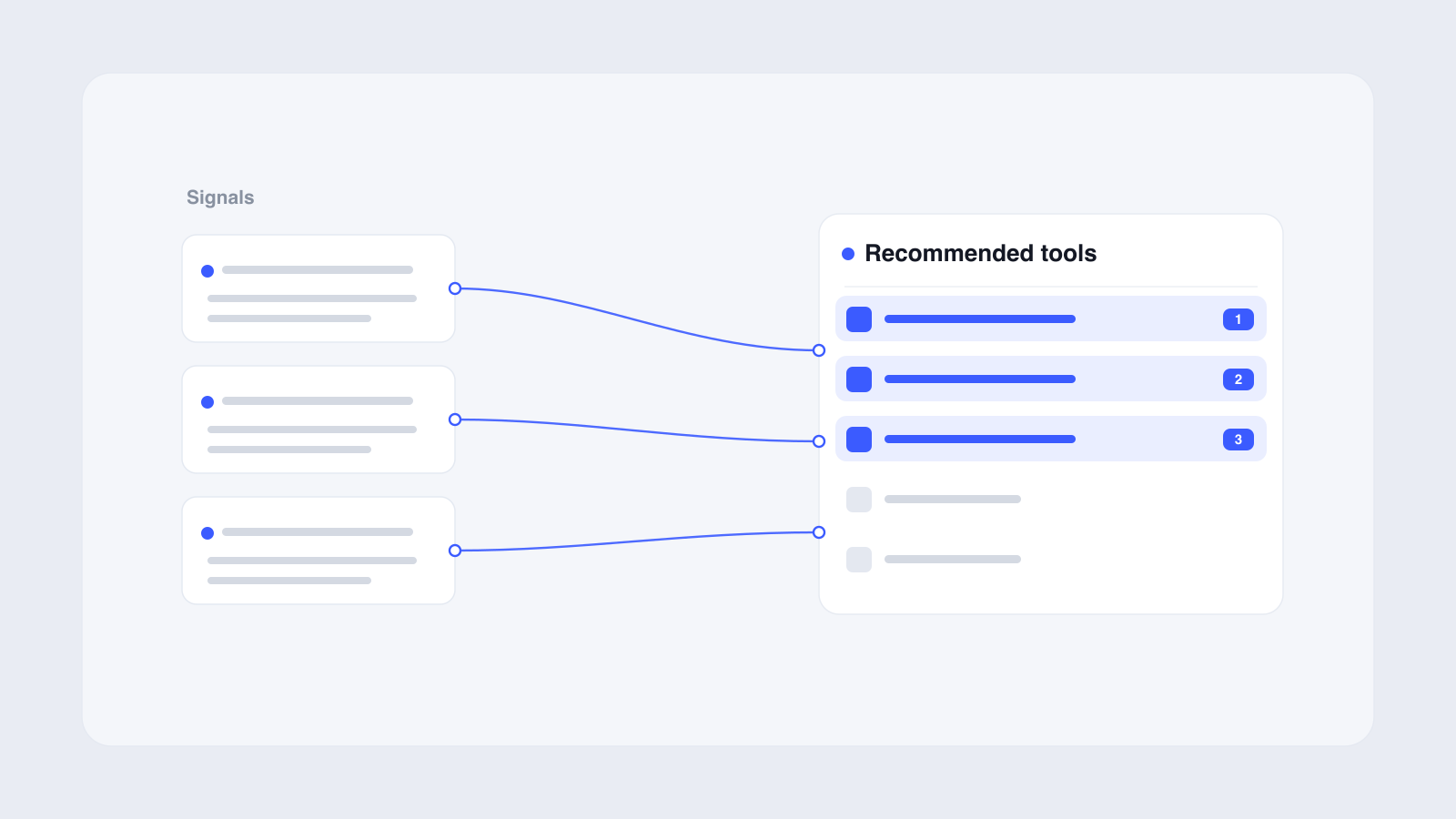
Large language models like ChatGPT recommend brands by combining what they learned during training with live web retrieval at answer time. They classify the buyer's intent, retrieve current sources through search tools, and favor brands that are mentioned often, consistently, and credibly across those sources. The recommendation you see is a blend of what the model already believes about your category and what it can pull in fresh, and both halves respond to signals you can shape.
Introduction: Understanding LLM Brand Recommendation Mechanisms
For founders at B2B SaaS companies earning $10K to $200K MRR, this matters more every day. Buyers now ask ChatGPT, Perplexity, Gemini, and Claude open-ended category questions like 'best CRM for startups' or 'top project management tools for distributed teams,' and the models return a condensed shortlist of three to five names. If your brand is not on that shortlist, you are invisible at the moment of highest buying intent.
'How do large language models like ChatGPT decide which brands to recommend?' is one of the most important questions a B2B marketing leader can ask in 2026. OpenAI, Google, Anthropic, and Perplexity do not publish their ranking algorithms, so this article synthesizes what is verifiable from academic research, large-scale empirical studies, and observed answer teardowns. The goal is a clear, evidence-based explanation of the real mechanisms, plus a practical checklist your team can act on this month.
The Core Architecture: Training Data, RAG, and Real-time Retrieval
LLMs use two distinct knowledge layers: static pre-training data that gives the model general world knowledge, and dynamic retrieval (RAG or web search) that fetches live information at answer time. For brand recommendations, the dynamic layer does the heavy lifting, though the balance depends on the model.
Pre-training data encodes general knowledge about well-known brands like Salesforce and HubSpot, but this knowledge is frozen at the training cutoff and may be outdated or incomplete for newer B2B SaaS companies. A multi-industry study of 3,750 responses across 50 brands found that GPT-5.2 'relies primarily on parametric knowledge' (training data), while 'Perplexity uses real-time web retrieval' and 'Gemini combines parametric knowledge with web grounding' (arxiv.org). This means the same query can produce fundamentally different recommendations depending on which model the buyer uses.
When a user asks a commercial question, models that use live retrieval classify the intent, call a browse or search tool, and pull structured product data, reviews, comparison articles, and 'best of' lists from the web. ChatGPT uses Bing-powered web search; Perplexity uses its own search index; Gemini leverages Google's search infrastructure; Claude uses web search via Anthropic's tooling. Each retrieves from different source pools, which is one reason the same query yields different brands across models. For more on this, see our guide to appearing in ChatGPT recommendations.
Key Signals and Factors Influencing Brand Selection
LLMs evaluate brands using a combination of query understanding, entity recognition, citation frequency across reputable sources, third-party review presence, cross-source consensus, and recency. The models weight these factors differently, but they converge on the same principle: brands that are talked about consistently across the web get recommended.
Query understanding comes first. The model classifies what the user is really asking, and a category query produces different brands than a needs-based query with specific constraints. Research using the BRP@k framework shows that 'brands omitted from ordinary recommendations can remain conditionally retrievable when distinctive cues are supplied' (arxiv.org). Entity recognition follows: the model must identify your brand as a distinct entity with a clear, consistent description across sources, and brands described inconsistently across websites, review platforms, and forums produce a fuzzy, low-confidence picture.
> A brand described the same way across many sources produces a sharp, confident signal, while a brand described ten different ways dilutes itself.
Citation frequency and cross-source consensus compound each other. Brands mentioned across high-authority domains like review sites, industry publications, and comparison articles are more likely to be retrieved, and when multiple independent sources agree your brand belongs in a category, the model gains confidence. Recency also plays a role, particularly for fast-moving categories like AI tools where a review from 2024 may carry less weight than one from 2026. For more on why competitors appear instead of you, see why ChatGPT recommends your competitors.
LLM-Specific Differences in Recommendation Logic
Different AI assistants recommend different brands for the same query. Cross-model agreement on the top-recommended brand was only 41.6% across 250 queries in a 2026 multi-industry study, meaning a top position on one model does not reliably translate to another (arxiv.org).
The Ranklytics AI Citation Study, which analyzed 22,139 AI answers across ChatGPT, Claude, and Gemini with 212,758 brand mentions across 30,462 distinct companies, found dramatic differences in how many brands each model names per answer. Claude names approximately 14.0 brands per answer, Gemini about 9.5, and ChatGPT roughly 4.5, a 3.1x difference on identical prompts (ranklytics.ai). A tracked site was named in 10.3% of Gemini answers but only 2.0% of Claude answers, a 5.2x spread.
The practical implication for B2B teams is clear: you cannot optimize for 'AI' as a monolith. A brand that appears in ChatGPT may be absent from Claude, and vice versa. Testing across all four major models (ChatGPT, Perplexity, Gemini, and Claude) is essential, and single-platform monitoring will miss cross-platform differences. For a structured approach, see how to measure your brand visibility across AI models.
Optimizing Brand Visibility for LLM Recommendations
You can improve your likelihood of being recommended by AI models through Generative Engine Optimization (GEO), ensuring your brand is clearly recognized as an entity, consistently mentioned across high-authority third-party sources, and described in the same language buyers use when asking AI for recommendations. Here is a six-step framework any B2B team can execute this month:
- Entity clarity audit. Search for your brand name in ChatGPT, Perplexity, Gemini, and Claude. Does each model correctly identify what you do, your category, and your key differentiators? If not, your entity is unclear and the model cannot confidently recommend you.
- Third-party presence audit. Are you listed on G2, Capterra, and relevant 'best of' listicles? Are there recent Reddit threads mentioning your brand? If not, prioritize getting listed and reviewed on these platforms.
- Consistent positioning. Ensure your brand description is consistent across your website, review profiles, and press mentions. Use the same category labels and differentiators everywhere so the model builds a sharp, specific picture.
- Comparison and answer-first content. Publish content that directly answers the questions buyers ask AI: comparison pages, 'how to choose' guides, and category-defining articles. This is what models retrieve and synthesize into their answers.
- Recency signals. Keep reviews, listings, and content fresh. Encourage recent customer reviews on G2 and other platforms, particularly for fast-moving categories.
- Prompt testing. Run the same category and needs-based queries across all four models weekly. Track which brands appear, in what position, and how results change over time.
Model behavior is not fully public, and no strategy can guarantee a specific ranking position; the goal is to increase the probability of being recommended, not to guarantee it. At VisibleAuthority, we use AI Visibility Mapping to analyze buyer queries across ChatGPT, Perplexity, Gemini, and Claude, identify where a brand is missing, and deploy answer-first content that models can retrieve and cite. Learn more about Generative Engine Optimization as a framework for this work.
Limitations and Challenges of LLM Brand Recommendations
LLM brand recommendations are inherently stochastic: the same query can produce different brands and rankings on repeated attempts. A single observation is unreliable, and evaluating your visibility from one prompt tells you very little.
Research using the BRP@k framework emphasizes that LLM recommendation must be evaluated 'as a stochastic retrieval-and-ranking process rather than from individual generated lists' (arxiv.org). A separate study on repeated queries found that a single run captures only 62 to 77% of the brands that five repeated queries would surface (arxiv.org). The multi-industry study used a five-repetition protocol per query to account for this variance. Biases in training data can also over-represent brands that were prominent at training time and under-represent newer entrants, particularly in fast-moving categories. Hallucinations are a risk too: models can confidently name brands that do not fit the query or attribute features incorrectly.
Because model behavior is not fully public and recommendations vary across runs, no agency or strategy can guarantee a specific position. Be skeptical of anyone who promises guaranteed AI rankings. AI visibility requires ongoing monitoring, not one-time optimization, as a brand that is well-recommended today may drop as models update, new content is published, and competitors increase their web presence. The exact weighting of signals remains uncertain, and model updates can shift recommendation behavior without notice.
Conclusion: Navigating the Future of AI-Driven Brand Discovery
LLMs recommend brands through a stochastic retrieval-and-ranking process that blends training data with live web retrieval. Prominence is driven by entity clarity, cross-source consensus, third-party presence, and recency. Different models produce different recommendations, and no strategy can guarantee rankings. The six-step checklist from the optimization section is a starting point any B2B team can execute this month.
As more B2B buyers use AI assistants for vendor research and category questions, AI visibility will become as important as traditional search visibility, arguably more so for contested SaaS categories where buyers ask open-ended questions. VisibleAuthority maps AI visibility across ChatGPT, Perplexity, Gemini, and Claude, and our 30-Day Visibility Sprint delivers measurable before-and-after results through mapping, content deployment, and optimization. Book a free AI visibility audit to see where your brand stands and what it takes to get recommended.
For further reading, explore our guides on why ChatGPT recommends your competitors, appearing in ChatGPT recommendations, and measuring brand visibility in AI search.
- LLMs recommend brands through a stochastic process blending training data with live web retrieval; both halves respond to signals you can shape.
- Prominence is driven by entity clarity, cross-source consensus, third-party presence, and recency, not by historical fame alone.
- Different models produce different recommendations: cross-model agreement on the top brand was only 41.6% across 250 queries in a 2026 study.
- A single prompt captures only 62 to 77% of the brands that five repeated queries would surface, so repeated testing is essential.
- No strategy can guarantee a specific AI ranking position; the goal is to increase recommendation probability through consistent, credible, and frequent web presence.
FAQ: How LLMs Decide Which Brands to Recommend
Does ChatGPT just list its favorite brands from training data?
Will AI recommendations create a winner-takes-all market for established brands?
Do different AI assistants recommend the same brands?
Can my brand appear in AI recommendations if it is not well-known yet?
How often should I test my brand visibility across AI models?
We'll run your category through the major models and map exactly where you appear, where competitors win, and what it takes to become the recommendation.