
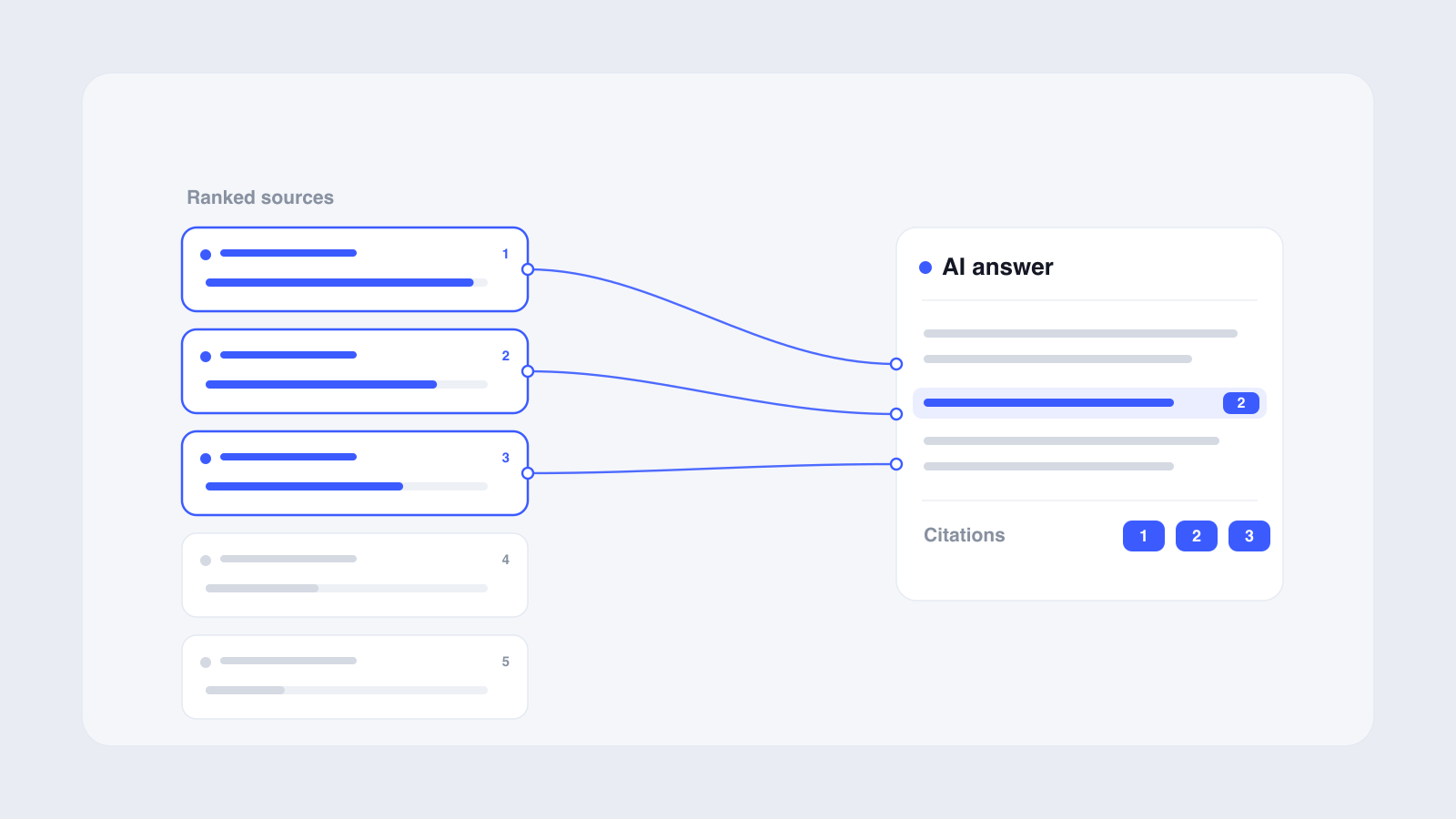
How do AI search engines like ChatGPT and Perplexity decide which sources to cite? The answer involves two stages: first they retrieve candidate pages from a live search index, then they generate an answer and attribute a small subset of those pages as citations. Each engine retrieves differently, ranks candidates using different signals, and cites only a fraction of what it reads. The exact ranking logic is proprietary, but the pipeline and signals are well-documented across official documentation and independent research.
Citations matter because they drive trust, transparency, and user verification in generative AI outputs. When an engine cites your page, it exposes your brand to buyers at the exact moment they are forming a purchase decision. This guide maps the full citation pipeline engine-by-engine, covers what makes a passage quotable, and provides a practical checklist to make your pages citation-ready. We also honestly acknowledge what is and is not public about each engine's ranking logic.
Understanding this pipeline reveals why some pages earn citations while others get read and discarded.
The Multi-Stage AI Citation Pipeline: From Query to Citation
Every AI answer engine follows a fixed sequence: query understanding, candidate retrieval, candidate ranking, synthesis, and citation attachment. This process is typically implemented through Retrieval-Augmented Generation (RAG), which Google describes as a technique, also known as grounding, used to improve the quality and freshness of AI responses by retrieving relevant web pages from a search index.
The pipeline starts with query understanding, where the model rewrites or expands the user prompt into a search-ready form. The engine then retrieves a pool of candidate URLs from its search index. An internal scorer re-ranks those candidates based on relevance, authority, freshness, and extractability. The model generates an answer from the top passages and attaches citations to specific claims that need source support.
A critical distinction: being retrieved is necessary but not sufficient for being cited. AirOps analyzed 548,534 pages retrieved by ChatGPT and found that only 82,108, roughly 15% earned any citation at all. The reranking layer between retrieval and citation filters aggressively, which means most pages the engine reads never make it into the visible answer. A cited source is also not proof that the engine's answer was actually built on it. Engines may read ten pages and cite three, and those three may not have materially shaped the generated text.
Core Criteria for AI Source Selection and Ranking
A source is more likely to be cited when it closely matches the query's wording, comes from a widely-trusted domain, states clear and verifiable facts, and is technically accessible to AI crawlers. These signals are not equally weighted, and traditional SEO metrics explain surprisingly little about citation behavior.
Profound's analysis of over 250 million AI responses found the strongest predictors of citation were entity richness (a 267% citation lift), cosine similarity to the query (7.3x at 0.88+), and content clarity (+32.83%). Traditional SEO metrics told a different story: traffic had an r-squared of just 0.05 and backlinks 0.038, meaning they explain almost nothing about whether a page gets cited. Ahrefs' 75,000-brand study by Louise Linehan and Xibeijia Guan found branded web mentions were the strongest predictor of appearing in AI Overviews, correlating around 0.664, versus roughly 0.326 for Domain Rating.
- Relevance and semantic matching: pages whose language closely mirrors the query get retrieved and ranked higher
- Authority and trust: domain reputation, author expertise, and entity verification (Ahrefs found branded web mentions correlate ~0.664 with AI Overview appearance)
- Freshness and recency: engines weight recency differently (Perplexity weights freshness at 40% of its ranking signal; Claude has low freshness sensitivity)
- Content extractability: structured content like headings, lists, and tables is easier for models to parse; semantic HTML tables receive 2.5x more citations than equivalent paragraph content, per The Stacc research cited in the Machine Relations Index v2
- Content specificity: pages stating precise statistics with clear attribution are more likely to be cited than vague claims
- Cross-source consistency: engines favor sources that corroborate information found across multiple independent sources
How ChatGPT Selects and Cites Sources
ChatGPT search retrieves candidate URLs from third-party search plus its own OAI-SearchBot index, re-ranks them with an internal scorer, passes top passages to the generation step, and attaches inline citations plus a Sources panel of roughly 8 to 10 sources. OpenAI's documentation confirms that ChatGPT search works by retrieving information relevant to a user's prompt from selected data sources and parsing that information to generate a response.
Wikipedia is ChatGPT's most-cited source, though the reported share varies by dataset. Ahrefs reports Wikipedia at 16.3% of ChatGPT citations (based on 78.6M queries), while Profound's larger 680M-citation dataset places it at 7.8%, corroborated by two additional sources. The discrepancy likely reflects different measurement methodologies: the 16.3% figure may measure share among top-cited pages rather than all citation slots. ChatGPT does not cite Reddit at measurable rates, according to the Machine Relations Index v2. OpenAI has not published its full ranking algorithm, so the specifics of how candidates are scored remain undisclosed. What is verifiable is that OAI-SearchBot is OpenAI's web crawler for search retrieval, and blocking it in your robots.txt removes your pages from the candidate pool entirely. For more on the technical requirements, see our guide on technical SEO for AI search visibility and our 2026 guide to appearing in ChatGPT.
How Perplexity AI Determines Citations
Perplexity rewrites the user query, retrieves from its custom PerplexityBot index plus real-time web search, and ships every answer with numbered inline citations and source cards. It is a citation-first product by design, showing the most sources of any major engine at roughly 20 or more per answer and citing on 100% of queries.
Perplexity's architecture is built around real-time retrieval. According to research from LLM Reach, Perplexity weights freshness at 40% of its ranking signal, serves results 3.3 times fresher than Google, and maintains sub-document indexing at 5 to 7 token snippets. It holds the highest per-query citation rate at 13.8%. Perplexity's source mix is the broadest of any engine, with YouTube at 16.1% and Wikipedia at 12.5% of citations. Unlike ChatGPT and Claude, Perplexity does cite Reddit at measurable rates. For strategies targeting multiple engines, see our guide on improving brand visibility on ChatGPT, Gemini, and Perplexity.
Google AI Overviews, Gemini, Claude, and Microsoft Copilot
Each engine uses a different retrieval backend and trust heuristic, which means the same domain can appear in one engine's citations and be absent from another's, even for identical queries. The Machine Relations Index v2 measured 10,661 answer runs across 17,266 domains and found that among the top 100 most-cited domains, 71 are cited by all six engines. The remaining 29 show measurable gaps where an engine either never surfaces that domain or does so rarely enough to fall below the evidence floor.
Google AI Overviews pull from Google's core Search index via RAG, showing inline links plus cards for roughly 3 domains, with YouTube at 9.5%, Reddit at 7.4%, and Quora at 3.6% of citations. Google AI Mode uses the same index with query fan-out, tilting toward YouTube and local sources. Gemini grounds with Google Search and displays sources as chips per Google's terms. Claude runs Anthropic's server-side web search with inline citations always on, favoring blogs and institutional sites while avoiding Reddit. Microsoft Copilot uses Bing's retrieval index and uniquely exposes its grounding queries, the actual search phrases used for retrieval. For more on why engines rely on third-party sources, see our analysis on why ChatGPT recommends competitors and how to fix it and our guide on GEO vs SEO differences.
| Engine | Primary Index | Top Sources | Freshness Sensitivity |
|---|---|---|---|
| ChatGPT | Bing + OAI-SearchBot | Wikipedia (16.3%, Ahrefs) | Low to moderate |
| Perplexity | PerplexityBot + real-time web | YouTube (16.1%), Wikipedia (12.5%) | Very high (40% of signal) |
| Google AI Overviews | Google core index | YouTube (9.5%), Reddit (7.4%) | Moderate |
| Google AI Mode | Same index + query fan-out | YouTube, local sources | Moderate |
| Gemini | Google Search grounding | YouTube | Moderate |
| Claude | Anthropic server-side search | Blogs, institutional sites | Low |
| Microsoft Copilot | Bing retrieval | Varies | Moderate |
Key Differences: ChatGPT vs. Perplexity AI
ChatGPT and Perplexity differ fundamentally in retrieval backend, citation density, source transparency, and freshness sensitivity. Understanding these differences is essential for optimizing across both engines rather than treating them as interchangeable.
| Dimension | ChatGPT | Perplexity |
|---|---|---|
| Search index | Bing + OAI-SearchBot | PerplexityBot + real-time web |
| Avg sources shown | ~8 to 10 | ~20 or more |
| Top source | Wikipedia (16.3%, Ahrefs) | YouTube (16.1%), Wikipedia (12.5%) |
| Reddit citation | Not at measurable rates | Cited at measurable rates |
| Freshness weight | Low to moderate | 40% of ranking signal |
| Citation display | Inline links + Sources panel | Numbered inline citations + source cards |
The Reddit divergence is the clearest example of how engine-specific trust heuristics shape visibility. Reddit holds the highest overall citation rate in the Machine Relations Index at 12.6%, appearing in roughly one of every eight answer runs. But that rate is driven entirely by four engines: Gemini, Google AI Mode, Google AI Overviews, and Perplexity. A brand relying on Reddit threads for AI visibility would appear in Google's AI products and Perplexity but remain invisible to ChatGPT and Claude users. This is why cross-engine testing is non-negotiable for any serious AI visibility strategy, and why we explore this further in our complete guide to Answer Engine Optimization.
The Role of Retrieval-Augmented Generation (RAG) in Citation
RAG is the foundational technology that enables AI models to retrieve information from external knowledge bases and combine it with pre-trained knowledge to generate cited responses. The retrieval step determines the candidate pool, and the generation step determines which candidates become citations. A page can be retrieved as a candidate but never cited in the final answer, which makes retrieval necessary but not sufficient.
RAG quality depends on search index quality, the re-ranking model, and the generation model's ability to extract and attribute specific passages. A 2024 academic study by Wallat et al. (arXiv:2412.18004) found that up to 57% of citations were "post-rationalized": the model answered from its own memory, then attached a retrieved page that happened to agree. Being cited is not proof the engine relied on your page to build its answer. Engines with live web retrieval like Perplexity and ChatGPT search can cite fresh information, while engines relying more on training data have lower freshness sensitivity. For a strategic framework on this, see our GEO 2026 guide.
Implications for Generative Engine Optimization (GEO) and Content Strategy
Traditional SEO metrics differ sharply from GEO signals. Ahrefs found that 76% of AI Overview citations came from Google's organic top 10 in mid-2025, but by February 2026 that share fell to 38% after Google's Gemini 3 upgrade widened the source pool. Ranking well raises your odds but no longer guarantees a citation, and not ranking in the top 10 no longer excludes you. The citation eligibility floor is still gated by classic SEO (crawlable, indexable, snippet-eligible), even as citation selection drifts away from rank position. Both things are true at once, which is why "AI killed SEO" and "AI is just SEO" are both wrong, as Patrick Stox notes in his analysis of how AI citations work. For a deeper comparison, see our guide on GEO vs SEO differences and whether you need both.
To optimize for AI citations, write answer-first content that opens sections with direct 1 to 2 sentence answers an AI could quote. Make passages quotable with clear definitions, lists, tables, and original data. Front-load key information, since 44.2% of citations come from the first 30% of a page's content, per The Stacc research. Build third-party corroboration by getting mentioned on sites engines already trust. Ahrefs' 75,000-brand study found branded web mentions were the strongest predictor of appearing in AI Overviews, correlating around 0.664. For deeper guidance, see our articles on how to get your website cited by ChatGPT and other AI search engines and how to build topical authority for AI search.
Make Your Page Citation-Ready: Practical Checklist
Use this checklist to make your pages citation-ready across ChatGPT, Perplexity, Gemini, Claude, and Google AI Overviews. Each item addresses a specific signal or technical requirement that research has linked to higher citation rates.
- Write answer-first openings (1 to 2 sentence direct answers) at the top of every section
- Use semantic HTML: headings, lists, tables, definition lists
- Front-load key facts and statistics in the first 30% of the page
- State precise statistics with clear attribution
- Ensure server-side rendering or prerendering (no JavaScript-only content)
- Allow AI crawlers in robots.txt: GPTBot, OAI-SearchBot, PerplexityBot, Google-Extended
- Add structured data (Schema.org) for articles, FAQs, and data
- Build author expertise signals (author bios, credentials, E-E-A-T)
- Get mentioned on third-party sites engines trust (Wikipedia, G2, Reddit, industry publications)
- Keep content fresh; update publication and modification dates
- Test your pages with live AI prompts across ChatGPT, Perplexity, Gemini, and Claude
Conclusion: Mapping Your AI Visibility Across Engines
AI citation selection is engine-specific, volatile, and not fully predictable, but the pipeline, signals, and technical requirements are knowable and optimizable. The brands that win in AI search will be those that write answer-first content, ensure crawler access, build third-party corroboration, and continuously test across engines rather than treating AI visibility as a one-time setup. Cross-engine divergence is real: the same domain can appear in Perplexity's citations and be absent from ChatGPT's for identical queries, which makes fragmented strategies a liability for B2B SaaS companies and AI tool startups where AI recommendations directly influence buyer decisions.
At VisibleAuthority, we map AI visibility across ChatGPT, Perplexity, Gemini, and Claude using our AI Visibility Mapping process, which analyzes buyer queries across major AI models to identify where a brand is missing in AI-generated answers. We also run a 30-Day Visibility Sprint that delivers measurable improvements in AI mention rates through mapping, content deployment, and optimization. Our AI Visibility Testing Loop continuously tests AI prompts across models to track brand mentions and refine content, and our AI-Optimized Content System creates comparison, recommendation, and answer-first content that AI models use to cite and recommend your brand. To see where your brand appears and where it is missing in AI-generated answers, book a free AI visibility audit with our team. For further reading, explore our guides on how to get your website cited by ChatGPT and other AI search engines and technical SEO for AI search visibility.
- AI answer engines cite sources in two stages: retrieval from a search index, then generation with citation attribution from a small subset of retrieved pages
- Traditional SEO metrics explain almost nothing about citation behavior; entity richness, semantic match, and content clarity are far stronger predictors
- Each engine has distinct source preferences: ChatGPT favors Wikipedia, Perplexity favors YouTube and Wikipedia, Google favors YouTube and Reddit, Claude favors blogs
- Crawler access is the citation eligibility floor; blocking OAI-SearchBot, PerplexityBot, or Google-Extended removes your pages entirely
- Being cited does not guarantee your content shaped the answer; a significant share of citations may be post-rationalized by the model
Frequently Asked Questions
How does ChatGPT choose which sources to cite?
How does Perplexity choose its sources?
Does ranking high in Google help you get cited by AI?
Why does ChatGPT cite Wikipedia but Perplexity cites Reddit?
How accurate are AI citations?
We'll run your category through the major models and map exactly where you appear, where competitors win, and what it takes to become the recommendation.