
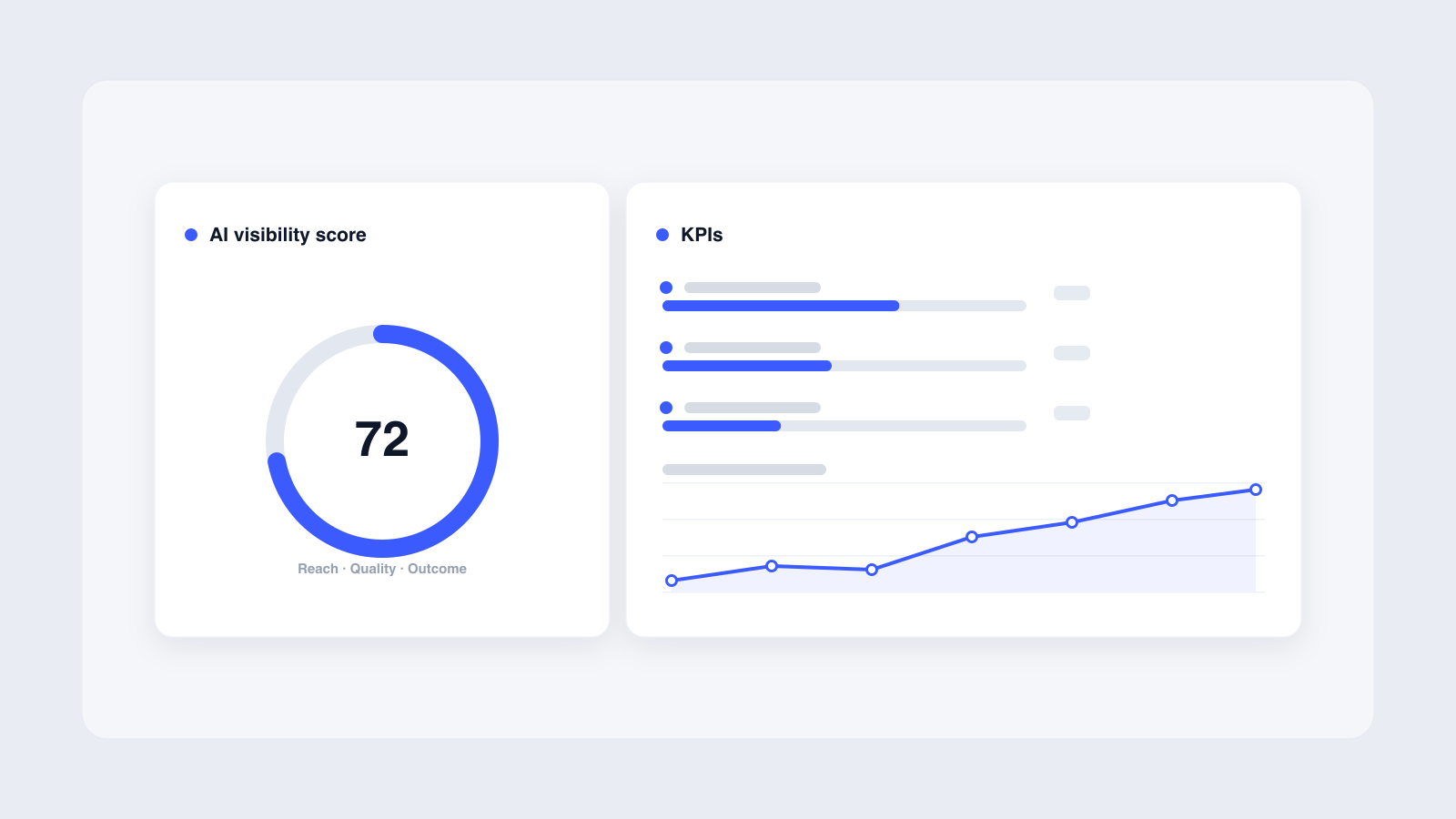
AI search analytics measures whether your brand shows up in AI-generated answers, something keyword rankings and organic traffic cannot capture. Track it in three layers: reach (mentions, prompt coverage), quality (recommendation rank, sentiment, cited pages), and outcome (AI referral conversion, ROI per prompt). The core KPIs are AI Visibility Score, Mentions per Prompt, Prompt Coverage, Recommendation Rank, Daily Citations, and AI Share of Voice, tracked weekly across ChatGPT, Gemini, Perplexity, Claude, and Google AI Overviews.
Your SaaS company ranks #1 on Google for your category keywords. But when a potential buyer asks ChatGPT for a recommendation, your brand is completely absent from the answer. This gap between search rankings and AI recommendations is why ai search analytics has become a critical discipline for B2B SaaS companies.
Google AI Overviews now trigger on approximately 25.11% of searches, based on analysis of 21.9 million queries by Conductor. The composition has shifted from informational toward commercial and navigational queries, exactly the comparison and brand searches B2B SaaS buyers run. US zero-click rates eased from 24.5% to 22.4% between December 2025 and March 2026 (Datos Q1 2026 report), showing that even as zero-click softens, AI-mediated discovery is reshaping how buyers find brands.
Why Traditional SEO Metrics Fall Short in AI Search
Traditional KPIs like keyword rankings, organic traffic, and click-through rates cannot capture whether your brand appears in AI-generated answers. You can rank #1 on Google and still be invisible in ChatGPT, Perplexity, Gemini, and Claude recommendations. The ai search visibility metrics kpis framework is what B2B SaaS companies need to adopt, and it is the foundational shift we help companies navigate at VisibleAuthority through our AI Visibility Mapping, which analyzes buyer queries across major AI models to identify where your brand is missing.
The Three-Layer AI Search Metrics Framework
We organize ai search analytics measurement into three layers, each answering a different question about your brand performance in AI answers:
- Reach metrics: mentions, prompt coverage, and distribution by LLM. "Are we showing up at all?"
- Quality metrics: recommendation rank, sentiment, and cited pages. "Are we positioned favorably?"
- Outcome metrics: AI referral conversion and ROI per prompt. "Is visibility influencing pipeline?"
Tracking only mentions without quality or outcome data creates false confidence. A brand mentioned frequently but described inaccurately is worse off than one not mentioned at all. Seer Interactive's complementary framework maps to these layers: AI Signal Rate ("be seen"), Answer Accuracy Rate ("be believed"), and AI Influenced Conversion Rate ("be chosen").
Core AI Search Visibility Metrics KPIs to Track
These five indicators form the core set of ai search visibility metrics KPIs every B2B SaaS company should monitor:
- AI Visibility Score: a 0-to-100 benchmark of brand presence versus competitors. This is the single trend line to report to leadership.
- Mentions per Prompt: how often your brand appears across real buyer prompts. The average brand mention rate is approximately 16-17%, while leading companies reach 56.5%, nearly 3x the market average (AthenaHQ State of AI Search Report 2026).
- Prompt Coverage: the share of buyer prompts where your brand appears. Below 40% signals a significant competitive gap; above 70% indicates strong category ownership.
- Recommendation Rank: your average position within a generated answer. Being named first shapes the buyer's shortlist, so position matters as much as presence.
- Daily Citations: how often AI references your domain. AI directly cites a brand's domain in only 16.1% of responses on average (AthenaHQ).
AI Share of Voice: Marketing Metrics for Competitive Positioning
AI Share of Voice (SoV) measures the percentage of AI-generated category responses that include your brand compared to all tracked competitors. Unlike absolute mention counts, SoV is relational: it moves when competitors gain or lose ground. Leading brands average 33.6% SoV, #2 brands average 19.5%, and #3 brands average 13.3% (AthenaHQ). This drop-off shows how quickly AI answers consolidate around a small number of recommended brands.
For B2B SaaS, ai share of voice marketing metrics are the most important competitive indicator because they directly reflect whether AI models recommend your brand or a competitor's when buyers ask comparison questions. Track SoV weekly. AI responses shift rapidly with model updates and competitor publishing, and monthly tracking misses competitive moves that happen in days.
How to Measure AI Search Visibility Metrics KPIs
A valid ai search analytics measurement framework requires a minimum of 50 representative queries, run at least 3 times per platform over rolling 7-day windows for statistical validity (Mentionova). Testing one or two prompts is anecdotal, not data. AI models produce different answers on different days, so multiple runs are essential to capture variance.
- ChatGPT (leads B2B AI referral share at approximately 62.6%)
- Claude (18.5% B2B referral share)
- Gemini (10.6% B2B referral share)
- Perplexity (7.3% B2B referral share)
- Grok, Copilot, and Google AI Overviews
The B2B AI referral figures come from the Goodie longitudinal report. The AI landscape itself evolves rapidly, with new models and capabilities emerging monthly across major providers (ModelPriceWatch State of LLM Pricing). A Brand Canon, a living document of your brand's claims and positioning, helps measure whether AI accurately represents you. Our AI Visibility Testing Loop implements this methodology as a continuous service, running live AI prompt tests across models to validate and refine visibility strategies.
Category Ownership Tiers: Which KPIs Matter Most
Kevin Indig's Growth Memo research tracked 1,094 categories across 50,000+ brands and 600,000+ citations in ChatGPT. Three tiers emerged: Owner (15.2% of categories, settled with one brand leading by 5+ points), Emerging Leader (approximately 31%, contestable), and Unsettled (53.7%, wide open). The critical insight: 89.3% of AI search volume sits in categories with no clear owner when analyzed by actual demand rather than category count. The competitive landscape is still forming, and early movers can establish dominance.
There is no one-size-fits-all AI search KPI. If your category is unsettled, focus on AI Signal Rate: maximize mentions and prompt coverage. If another brand owns your category, shift to Answer Accuracy Rate: ensure the model describes you correctly when you appear. For all tiers, track AI Influenced Conversion Rate. SoV above 30% with a 5+ point lead suggests ownership; 15-30% suggests emerging leader status; fragmented SoV below 15% suggests an unsettled category. Ai share of voice marketing metrics are what help identify which tier you fall into in the first place.
Building Your AI Visibility Dashboard
Your dashboard should track ai search visibility metrics kpis across all three layers and major AI platforms. Core components include the AI Visibility Score trend line, SoV by category, Mentions per Prompt by platform, Prompt Coverage percentage, Recommendation Rank distribution, and sentiment analysis.
Use weekly monitoring with monthly executive summaries. Track AI referral traffic by source, since each platform sends different audience profiles and conversion rates. The broader AI ecosystem shapes how models process and surface content, with fragmentation across providers affecting citation behavior and platform reach (IntuitionLabs LLM API comparison). Common pitfalls include tracking too few queries, ignoring sentiment, focusing on one AI model, and failing to benchmark against competitors. Our AI-Optimized Content System creates the comparison, recommendation, and answer-first content that AI models cite and recommend, giving your dashboard metrics something positive to track.
FAQ: AI Search Analytics and KPIs
What are the most important AI search visibility metrics KPIs to track?
How is AI share of voice calculated for marketing metrics?
How often should I monitor my brand's AI search visibility?
Which AI search engines should I track for visibility metrics?
What is a good AI brand mention rate to target?
Conclusion: Turning Metrics Into Action
Measuring AI search visibility requires a fundamentally different ai search analytics framework than traditional SEO, one built on reach, quality, and outcome layers across multiple AI platforms. With 89.3% of AI search volume in categories with no clear owner, the window to establish category leadership is open but narrowing. VisibleAuthority helps B2B SaaS companies move from measurement to measurable improvement. Our 30-Day Visibility Sprint delivers before-and-after results in AI mention rates through mapping, content deployment, and optimization, all within 30 days. Schedule your AI visibility assessment to see where your brand stands across ChatGPT, Perplexity, Gemini, and Claude before competitors fill the gap.
This metrics framework draws on data from the Semrush AI Visibility Index (126M+ prompts analyzed), AthenaHQ State of AI Search Report 2026, Seer Interactive's AI search KPI research, and Mentionova's measurement framework. VisibleAuthority specializes in Answer Engine Optimization for B2B SaaS and AI tool startups, helping companies increase visibility inside AI-generated answers from ChatGPT, Perplexity, Gemini, and Claude.
We'll run your category through the major models and map exactly where you appear, where competitors win, and what it takes to become the recommendation.