
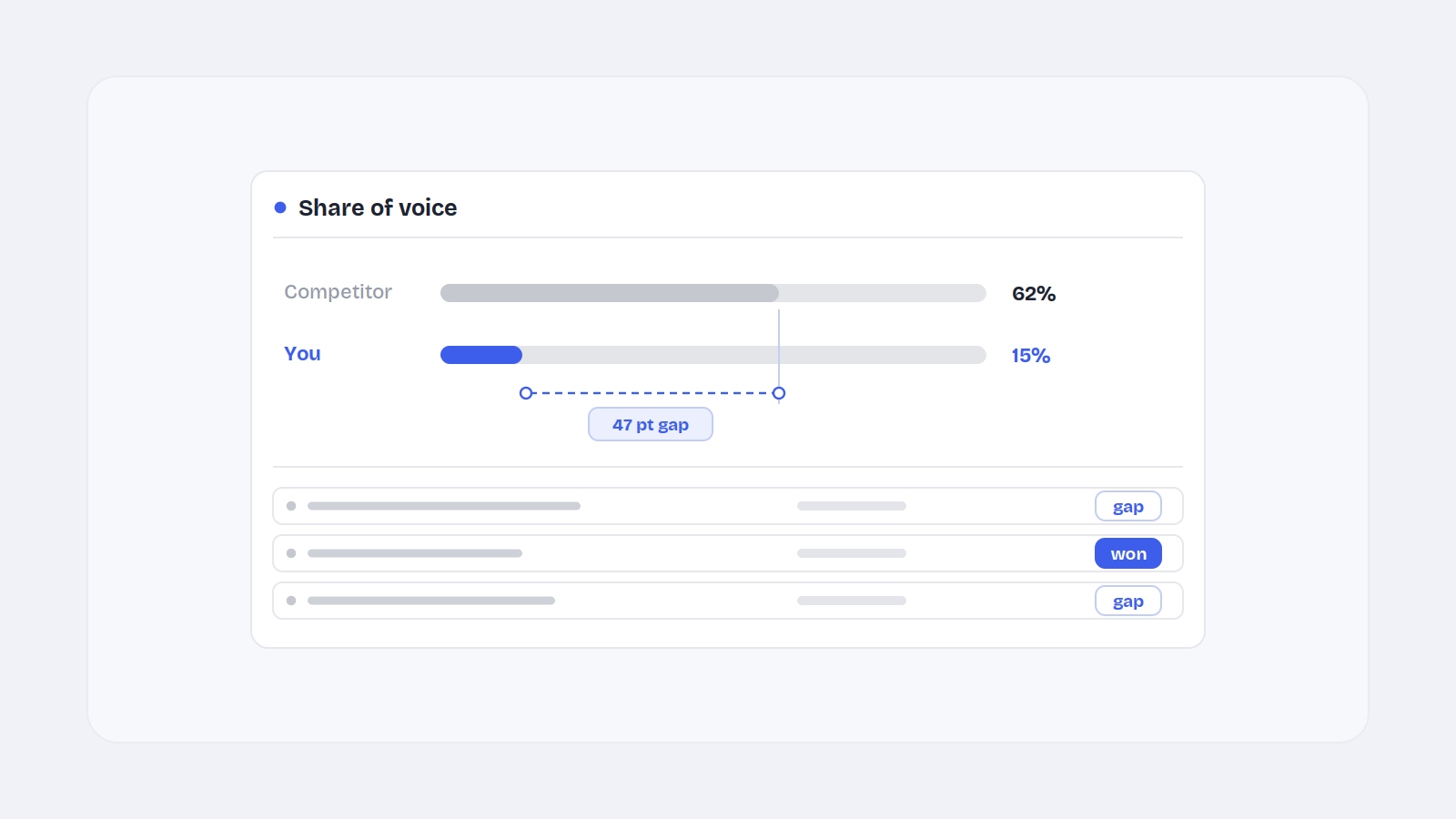
A keyword gap analysis shows which searches your competitors win and you miss, so you can measure your share of voice and decide which gaps are worth closing. In AI search, run the same idea on prompts: find the questions where the AI recommends a rival instead of you, then build the content and citations that earn you the mention.
If your competitors appear in AI-generated answers when buyers ask which tool to buy, and you do not, that keyword gap is quietly costing you revenue. Most B2B SaaS companies still run a keyword gap analysis the old way, checking rankings and calling it done.
This guide covers how to calculate share of voice for both traditional search and AI answers, find the gaps that matter, and turn them into a content plan. Whether you sell B2B SaaS at $10K MRR or $200K MRR, the methodology is the same.
What Is a Keyword Gap Analysis?
A keyword gap analysis identifies the search terms your competitors rank for that your brand does not. Each uncovered gap represents lost visibility, lost clicks, and potentially lost revenue.
Traditional gap analysis focuses on ranking positions in Google. That approach still matters. But buyers now ask ChatGPT, Perplexity, and Gemini for recommendations, and those models pull from a fundamentally different set of sources. Only 8 to 12 percent overlap exists between results in AI-generated answers and those ranking well in traditional search, according to Rankmetry's analysis.
A common weakness compounds the problem: teams build keyword lists around terms they already rank for rather than terms representing commercial opportunity. If you only look where you already have presence, you will never find the gaps that matter.
Understanding Share of Voice in SEO
Share of Voice (SOV) measures the percentage of total market visibility your brand captures for a defined keyword set. The formula: your brand's visibility divided by total market visibility, multiplied by 100.
SOV matters more than individual rankings. A position-three ranking on a 100,000-volume keyword outweighs a position-one on a 200-volume keyword, and SOV weights that automatically. Rankings in isolation are vanity metrics.
Two flavors exist. Organic SOV estimates clicks using CTR curves and search volume. Paid SOV uses Google Ads Impression Share, which Google surfaces directly.
One concept worth knowing: Excess Share of Voice (ESOV), the gap between your SOV and your Share of Market. If you hold 15% SOV but 10% market share, your ESOV is +5. A positive ESOV often precedes growth. SOV is most useful as an input to gap analysis, broken down by intent cluster and funnel stage.
How to Calculate Share of Voice: Step-by-Step
Here is the six-step process to calculate share of voice for your keyword set.
- Define your keyword set based on commercial opportunity, not just terms you already rank for.
- Define a competitor set based on commercial overlap. Benchmark against true competitors, not every domain in the keyword set.
- Record search volume and your ranking position for each keyword.
- Apply a CTR curve to each position. Position one is roughly 30%, position two about 15%, position three around 10%, declining rapidly after that.
- Multiply CTR by search volume to estimate clicks for each keyword. Sum across the entire set.
- Divide your total estimated clicks by the total estimated clicks for all ranking domains. Multiply by 100 to get your SOV percentage.
Here is a worked example with four keywords. Keyword one, "crm software," has a search volume of 40,000; you rank at position two, where CTR is roughly 15%, yielding 6,000 estimated clicks. Keyword two, "sales pipeline tool," has a volume of 10,000; you rank at position one, where CTR is roughly 30%, yielding 3,000 clicks. Keyword three, "lead tracking software," has a volume of 5,000; you rank at position four, where CTR is roughly 8%, yielding 400 clicks. Keyword four, "best crm for startups," has a volume of 8,000; you rank at position seven, where CTR is roughly 3%, yielding 240 clicks. Your total estimated clicks across these four keywords: 9,640. If total estimated clicks across all ranking domains for these keywords are 32,000, your SOV is 9,640 divided by 32,000, multiplied by 100, or approximately 30%. Most SEO platforms automate this calculation, as outlined in Backlinko's SOV guide.
Conducting a Keyword Gap Analysis
Start by identifying three to five true competitors based on commercial overlap: same target audience, similar product category, comparable price point.
- Pull each competitor's ranking keyword set using an SEO tool like Semrush, Ahrefs, or SE Ranking.
- Compare keyword sets to identify terms competitors rank for that your brand does not. This is your keywords gap.
- Filter gaps by search volume, intent, and commercial relevance to prioritize high-impact opportunities.
- Categorize gaps by funnel stage to align content creation with the buyer journey.
One pitfall to avoid: do not benchmark against every domain in a keyword set. If you sell project management software, your competitor set should be other project management tools, not every site ranking for "team collaboration."
Share of Voice in the Age of AI Search
AI search has disrupted the SOV landscape. Organic click-through rates dropped roughly 61% for queries where Google AI Overviews appear, according to Seer Interactive's analysis. If you measure traditional SOV alone, your visibility picture is getting darker even when rankings hold steady.
According to Fuel Online's analysis, reported via DesignRush, 62% of brands are "technically invisible" to generative AI. Separately, Semrush's 2026 research found that approximately 62% of AI citations are "ghost citations," instances where AI platforms cite a page as a source but the brand name never appears in the answer text. When buyers ask ChatGPT or Perplexity for recommendations, most brands simply do not appear.
AI SOV measures how often your brand is named or recommended inside AI-generated answers across ChatGPT, Perplexity, Gemini, and Claude. The formula parallels traditional SOV: your AI mentions divided by total AI mentions across all brands in your category, multiplied by 100.
But AI SOV comes with non-determinism. The same prompt can produce different answers on different runs. Day-to-day fluctuations of plus or minus 10 percentage points are normal, per Rankmetry tracking data. Track AI SOV as a range and use monthly averaging.
When measuring AI SOV, distinguish three mention types. A named mention means the AI answer explicitly names your brand in its recommendation. A domain-only mention means the answer cites your domain as a source without naming your brand in the text. A ghost mention means the answer references your page but neither names your brand nor visibly cites your domain. Counting ghost mentions at full weight inflates AI SOV by 30 to 50% in most verticals. Weight named mentions at 1.0, domain-only at 0.5, and ghost at zero, per the Rankeo framework.
Turning Gap Analysis Into Action
Finding gaps is half the work. The other half is closing them. Use SOV as an input to content strategy by breaking it down by intent cluster, product category, and funnel stage. Prioritize gaps where competitors capture high-intent traffic you are missing.
For AI visibility, create answer-first content: comparison pages, recommendation content, and structured answers to buyer questions. Our AI-Optimized Content System is built for this, creating content that AI models use to cite and recommend your brand.
Continuous testing matters. Our AI Visibility Testing Loop continuously tests AI prompts across models, tracks brand mentions, and refines content to improve AI recommendations over time.
Here is a 30-day action plan. Week one: map gaps using keyword research and AI testing. Week two: deploy answer-first content targeting high-priority gaps. Week three: test AI prompts to measure mention rates. Week four: refine and measure before-and-after AI SOV. This mirrors our 30-Day Visibility Sprint, which delivers measurable improvements in AI mention rates within 30 days.
Tools for Measuring Keyword Gap and SOV
The tools landscape split in late 2025 into two camps: traditional SEO platforms adding AI visibility features, and dedicated AI visibility specialists.
For traditional gap analysis and organic SOV, Semrush, Ahrefs, and SE Ranking all offer gap features and estimated traffic data. Google Search Console provides free impression and click data for tracked keywords. For paid SOV, Google Ads and Microsoft Ads surface Impression Share directly.
For AI visibility, the Semrush AI Visibility Toolkit scores brands 0 to 100 based on mentions, citations, and SOV. Ahrefs Brand Radar tracks AI SOV through ChatGPT and AI References reports. Dedicated AI visibility specialists like Profound and Scrunch AI focus exclusively on measuring brand presence inside generative answers. No two tools calculate AI SOV the same way, and no industry-wide standard exists as of 2026.
Beyond SEO and AI visibility tools, social and PR SOV platforms like Brandwatch, Talkwalker, Sprout Social, and Meltwater measure brand mention share across social and PR channels. The case for measuring AI visibility is growing: GrowByData reported an 800% increase in LLM referral traffic, evidence that AI visibility is becoming a measurable revenue channel. We recommend combining traditional SOV measurement with AI visibility testing. Our AI Visibility Mapping service analyzes buyer queries across major AI models to identify exactly where your brand is missing in AI-generated answers.
Frequently Asked Questions
What is a keyword gap analysis and why does it matter?
How do you calculate share of voice for SEO?
What is Excess Share of Voice (ESOV)?
Why does AI share of voice fluctuate so much?
How is AI share of voice different from traditional SOV?
- The methodology is consistent: define your keyword set, identify true competitors, calculate SOV, find the gaps, and prioritize by commercial intent. But measuring only traditional SOV leaves you blind to where buyers increasingly research. Traditional and AI surfaces draw from fundamentally differe
- Gap analysis is an ongoing process. AI search continues to evolve through 2026, and the brands that win will be the ones measuring and refining continuously. If you want measurable improvements in AI mention rates, our AI Visibility Mapping identifies where your brand is missing in AI-generated answ
- VisibleAuthority specializes in Answer Engine Optimization for B2B SaaS and AI tool startups.
We'll run your category through the major models and map exactly where you appear, where competitors win, and what it takes to become the recommendation.