
B2B SaaS founders keep asking us one question: "What is llms.txt and should my website have one?" The buzz around this file has grown loud enough that engineering teams are getting requests from marketing to implement it. The conversation is full of conflicting signals. Some blogs call it a citation silver bullet. Google says it ignores the file entirely. AI companies send mixed messages about whether they actually read it.
This guide cuts through the noise with evidence-based answers: what llms.txt is, how it works, what the research says about its impact on AI citations, and whether your specific site type should bother.
What Is llms.txt? A Clear Definition
llms.txt is a proposed Markdown convention placed at a website's root (for example, example.com/llms.txt) that gives large language models and AI agents a curated, machine-readable overview of a site's most important content. Think of it as a business card for your domain, written for AI systems rather than human visitors.
The file includes a brief description of what your business does, links to your most valuable pages, and categorized sections that help AI models understand your site architecture. Jeremy Howard of Answer.AI introduced the concept in 2024 through llmstxt.org as a community-driven proposal, not an official web standard recognized by any standards body.
Its purpose is helping AI models summarize your offerings, extract key entities, and generate accurate, attributable responses when someone asks about your brand. The file provides context, not commands. An AI crawler can read it, understand what your site is about, and use that context when processing your pages. It is a business-to-agent signal designed to make your content easier to parse.
If you are wondering whether your website should have one, that is exactly the question this guide answers with verifiable evidence and a practical decision framework. For a broader understanding of how this fits into AI visibility strategy, see our complete guide to Answer Engine Optimization.
Why Was llms.txt Created? The Problem It Solves
Large language models face a specific challenge when they process web content: most of what they retrieve is noise. A typical web page contains navigation menus, footer links, ad scripts, and cookie banners that consume context window tokens without adding meaning. By the time an LLM reaches your actual product description, it may have already spent significant processing capacity on irrelevant markup.
LLMs also struggle to identify which parts of a complex, multi-section page represent authoritative content versus supporting material. A pricing page might contain ten sections, but only two matter to a buyer asking about your plans. The model has to guess which sections to prioritize, and it does not always guess correctly.
llms.txt addresses these problems by providing a clean, structured Markdown summary that an LLM can parse directly into its context window. Instead of wading through HTML boilerplate, the model gets a concise overview of your most important content with direct links. However, the reality is messier than the proposal suggests. A Common Crawl analysis of 584,107 llms.txt files found that 22.56% contain no links, 2.54% are domain parking pages, and some even contain prompt injections, which is far from a guarantee of clean, relevant content.
Documentation platforms like Mintlify and GitBook now auto-generate llms.txt files for their users, signaling real industry traction in the developer documentation segment. These platforms recognize that AI coding assistants benefit from a structured entry point to their docs, and they have built support for the format directly into their publishing workflows.
How Does llms.txt Work? Structure and Syntax
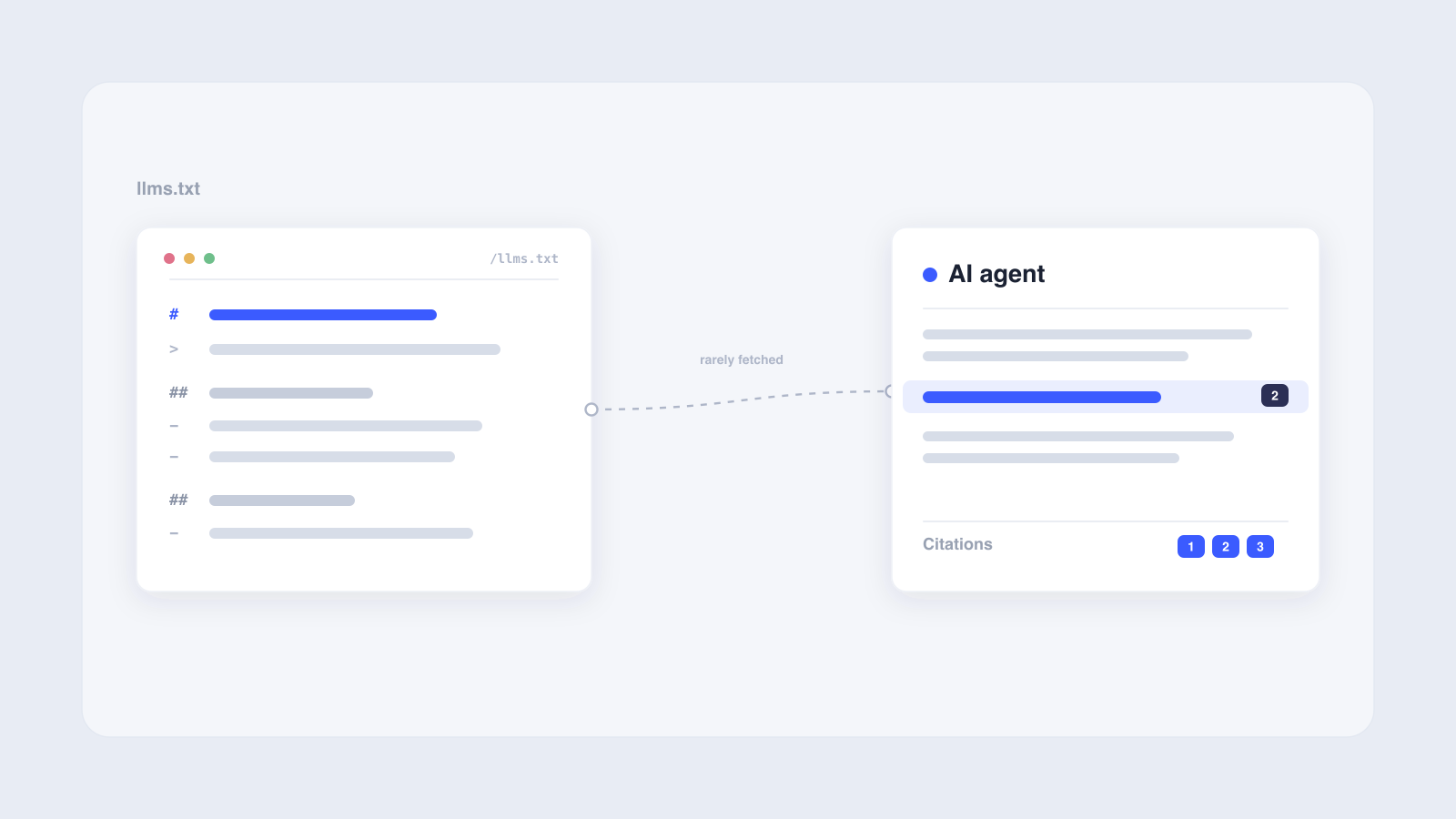
The llms.txt file uses a straightforward Markdown format. It starts with an H1 title for your project or site name, followed by an optional blockquote summary describing what your site offers. Then comes a series of categorized link lists pointing to your key resources.
A typical structure looks like this:
# Your Company Name
> Brief summary of what your company does and who it serves.
## Documentation
- [Product Docs](url): Description of the documentation
- [API Reference](url): Description of the API reference
## Tutorials
- [Getting Started](url): Description of the guide
The convention includes a two-file model. The compact /llms.txt serves as an index with links and summaries designed to fit within an LLM's context window. A companion file, /llms-full.txt, embeds the full text of every linked page for agents that want the complete corpus in a single request. The index is lightweight and meant for quick parsing; the full version can reduce the need for repeated retrieval when an agent chooses to use it.
Both files live at your domain root. The index file gives models a fast overview, while the full file provides deeper content in one place. Some content management systems and SEO plugins now generate llms.txt files automatically, which means the presence of the file does not always indicate a deliberate optimization decision. If your CMS created one by default, verify that the content is accurate and current before assuming it is working in your favor.
llms.txt vs. robots.txt vs. sitemap.xml: Key Differences
These three files serve fundamentally different purposes, and confusing them leads to costly mistakes. Here is how they compare.
robots.txt controls crawler access. It tells bots like GPTBot, ClaudeBot, and Google-Extended which pages they may or may not crawl. It is about permission, not content. Blocking an AI crawler in robots.txt means that crawler cannot access your pages at all, regardless of whether you have an llms.txt file. This is the most common GEO mistake businesses make, often through legacy settings or overcautious security configurations.
sitemap.xml is a flat XML list of URLs that helps search engines discover pages. It aids indexing but provides no context about what your content means or which pages matter most. A sitemap tells a crawler "these pages exist" without explaining why they matter.
llms.txt provides curated context and links to useful content for AI systems. It does not grant or block access, nor does it tell AI what to cite. It is a content curation layer that helps models understand your site's purpose and structure.
- robots.txt: Purpose is access control. Format is plain text. Audience is all web crawlers. Mechanism is allow/disallow rules.
- sitemap.xml: Purpose is page discovery. Format is XML. Audience is search engines. Mechanism is URL listing.
- llms.txt: Purpose is content context. Format is Markdown. Audience is AI models and agents. Mechanism is curated links and summaries.
Each file serves a distinct function. llms.txt complements robots.txt and sitemap.xml but does not replace either. You need all three for a technically sound web presence. For a deeper look at the technical foundations that support AI visibility, read our guide on technical SEO for AI search engines.
The Impact of llms.txt on Generative Engine Optimization (GEO)
Generative Engine Optimization (GEO) is the practice of optimizing content for visibility and citation within AI-powered search and generative models like ChatGPT, Claude, Perplexity, and Gemini. Citation signals, meaning structured and machine-readable data that helps LLMs provide accurate and attributable answers, are central to this practice.
Research from Princeton University and IIT Delhi, published in their GEO paper at KDD 2024, found that specific GEO strategies can boost content visibility in AI-generated responses by up to 40%. Those strategies include answer-first content structure, citation-worthy sentences with concrete facts and numbers, and strong E-E-A-T signals.
- SE Ranking analyzed approximately 300,000 domains to see whether sites with llms.txt get cited more often by AI. Finding: no meaningful correlation. They built a machine learning model to predict which sites get cited, and that model actually performed better when they removed the llms.txt variable, meaning the file was adding noise rather than signal.
- Trakkr analyzed 37,894 domains that were already cited by AI to check whether having llms.txt made citation more likely. Finding: no evidence that llms.txt presence improves citation rates.
- Limy analyzed a dataset of more than 500 million AI bot visits, meaning individual requests by AI crawlers to websites. Finding: only 408 of those visits were requests for /llms.txt. This shows the file is rarely fetched, though this measures bot behavior, not citation rates.
These are two distinct types of findings. The SE Ranking and Trakkr studies examine whether the file correlates with citation rates; it does not. The Limy study examines whether AI crawlers actually fetch the file; they almost never do. The takeaway: llms.txt is one layer of a comprehensive GEO strategy, not a standalone solution. Clean content, clear entity definitions, and earned third-party mentions remain the strongest citation drivers. For a broader view, see our Generative Engine Optimization guide for 2026.
At VisibleAuthority, our AI Visibility Mapping service analyzes buyer queries across major AI models to identify exactly where your brand is missing from AI-generated answers. That mapping is the real starting point for improving citations, not a text file at your root domain.
Is llms.txt an Official Standard? Adoption Status in 2026
llms.txt is a proposed, community-driven convention. No major standards body has adopted it, and no single platform enforces it. The file has existed for roughly 18 months, and adoption tells a nuanced story.
SE Ranking found that 10.13% of 300,000 scanned domains have an llms.txt file. Trakkr found 13.3% adoption among AI-cited domains. HTTP Archive found 5.61% adoption among the top 10,000 sites. These numbers suggest meaningful uptake in specific segments but stalled growth broadly.
Several AI companies engage with the format to varying degrees. OpenAI publishes an llms.txt file for its developer documentation. Anthropic publishes one for Claude's platform and references it in agent-writing guidance. Google's Gemini publishes one. Perplexity has been observed retrieving and using llms.txt files. Mistral reads the file where present.
Google's position is clear. Gary Illyes confirmed in summer 2025 that Google does not support llms.txt. John Mueller compared it to the deprecated meta keywords tag. Google Search Central's guidance, updated in 2026, states the file will neither help nor hurt your visibility.
There is even a mixed signal within Google itself. Chrome's Lighthouse tool added an llms.txt check in May 2026 as part of its Agentic Browsing audit, while Google Search Central says the file is not used. Two teams within the same company hold opposite stances, which tells you the industry has not reached consensus.
Adoption is meaningful in developer documentation but stalled elsewhere. The market has not found compelling evidence to adopt broadly, and Google's explicit non-support limits the format's reach for traditional search visibility.
Should Your Website Have an llms.txt File? A Decision Framework
The answer depends on your site type and what you are trying to achieve. Here is our balanced recommendation by category.
- Developer docs, SDK, and open-source projects: Yes. Publish both llms.txt and llms-full.txt. AI coding assistants like Cursor and Claude Code benefit significantly from structured documentation summaries. This is where the format delivers its clearest value.
- B2B SaaS marketing sites: Yes, a minimal llms.txt. It costs roughly 15 minutes to create, poses minimal risk, and positions you for agent-readiness. But the bigger lever is Schema.org structured data and clean, answer-first content.
- E-commerce stores: Optional, low priority. Product schema, Offer markup, and machine-readable product feeds deliver more measurable lift than llms.txt. Focus your engineering hours there first.
- News and publishers: Optional. Article schema and AI Preferences protocols are higher-leverage for your content type.
- Local businesses: Yes, a minimal version, but LocalBusiness schema is the stronger signal for your needs.
The core principle: create llms.txt for agent-readiness, not as a shortcut to being cited. Never substitute it for clean content, clear entity definitions, and earned third-party mentions. Our AI-Optimized Content System creates comparison, recommendation, and answer-first content that AI models use to cite and recommend brands, which is what actually moves citation rates. For more on getting your brand recommended inside AI answers, see our guide on getting your brand to appear in ChatGPT.
The 15-minute investment to create an llms.txt file is reasonable for most B2B SaaS sites. Just do not mistake it for a strategy.
How to Implement llms.txt: Best Practices and Steps
Implementation is straightforward. Here are the steps we recommend.
Step 1: Identify your most valuable content. Pull together documentation, API references, key product pages, and comparison content that you want AI systems to understand and cite.
Step 2: Write the file in Markdown format. Start with an H1 containing your site or project name, add a blockquote summary of what your site offers, then organize links by category (Documentation, API Reference, Tutorials, and so on).
Step 3: Optionally create llms-full.txt by concatenating the full text of your linked pages. This gives agents that want the complete corpus a single file to retrieve.
Step 4: Place the file at your domain root (example.com/llms.txt) and verify it is publicly accessible with a 200 status code. Test it in a browser before moving on.
Step 5: Keep it current. Auto-generate if possible using documentation platforms like Mintlify or GitBook, or set up a CI/CD pipeline to regenerate the file when content changes.
Step 6: Set realistic expectations. Monitor whether AI assistants improve their responses about your brand after implementation, but recognize that llms.txt alone is unlikely to move citation rates. The real validation comes from continuous testing across AI models.
The specification is available at llmstxt.org, and several documentation platforms auto-generate the file. If you want to continuously test whether content changes (including llms.txt) actually improve your AI recommendations, our AI Visibility Testing Loop runs live prompt testing across multiple AI models to track and refine brand mentions over time. To understand the measurement side, check our AI search tracking tools buyer's guide.
Testing matters because the only way to know whether llms.txt helps your brand is to measure AI mention rates before and after implementation.
Frequently Asked Questions
Does Google use llms.txt for search rankings or AI Overviews?
Will adding an llms.txt file improve my AI citations in ChatGPT or Perplexity?
Is llms.txt a Markdown file, and where does it go?
Which types of websites benefit most from llms.txt?
Can llms.txt replace robots.txt or sitemap.xml?
- llms.txt is a proposed Markdown convention, not an official standard.
- Approximately 10% of domains have adopted it after 18 months.
- No evidence links llms.txt presence to improved AI citations.
- Google does not use it, though some AI companies like Anthropic and Perplexity do engage with it.
- The format is best suited for developer docs and B2B SaaS sites; optional for e-commerce and publishers.
- Create it for agent-readiness, not as a citation shortcut.
For a deeper look at how AI citation works, read our guide on getting cited by ChatGPT and other AI search engines.
Creating an llms.txt file takes about 15 minutes, costs nothing, and will not harm your site. But do not expect it to move the needle on whether ChatGPT, Perplexity, or Claude recommends your brand. Comprehensive Answer Engine Optimization is what actually drives AI recommendations.
Before implementing any standalone tactic, assess where your brand currently stands in AI-generated answers. The most effective path starts with visibility mapping, then content creation, then continuous testing.
For B2B SaaS companies and AI tool startups where AI recommendations directly influence buyer decisions, the stakes are too high to bet on a single file.
Next Steps for AI Visibility
- Assess your current AI visibility across ChatGPT, Perplexity, Gemini, and Claude
- Implement llms.txt as a quick-win baseline, then invest in comprehensive AEO
- Use VisibleAuthority's AI Visibility Mapping to identify where your brand is missing in AI-generated answers
- Explore the 30-Day Visibility Sprint for measurable before-and-after results
Conclusion: The Bottom Line on llms.txt
- llms.txt is a low-cost, low-risk addition that improves agent-readiness but has no proven impact on AI citation frequency.
- VisibleAuthority's 30-Day Visibility Sprint delivers measurable improvements in AI mention rates through mapping, content deployment, and optimization within a structured 30-day engagement.
Ready to find out where your brand stands in AI-generated answers? Our AI Visibility Mapping analyzes buyer queries across major AI models to pinpoint exactly where you are missing. Then our 30-Day Visibility Sprint deploys content and optimization to close those gaps with measurable before-and-after results. Explore our AI visibility resources and start turning AI answers into a revenue channel.
We'll run your category through the major models and map exactly where you appear, where competitors win, and what it takes to become the recommendation.