
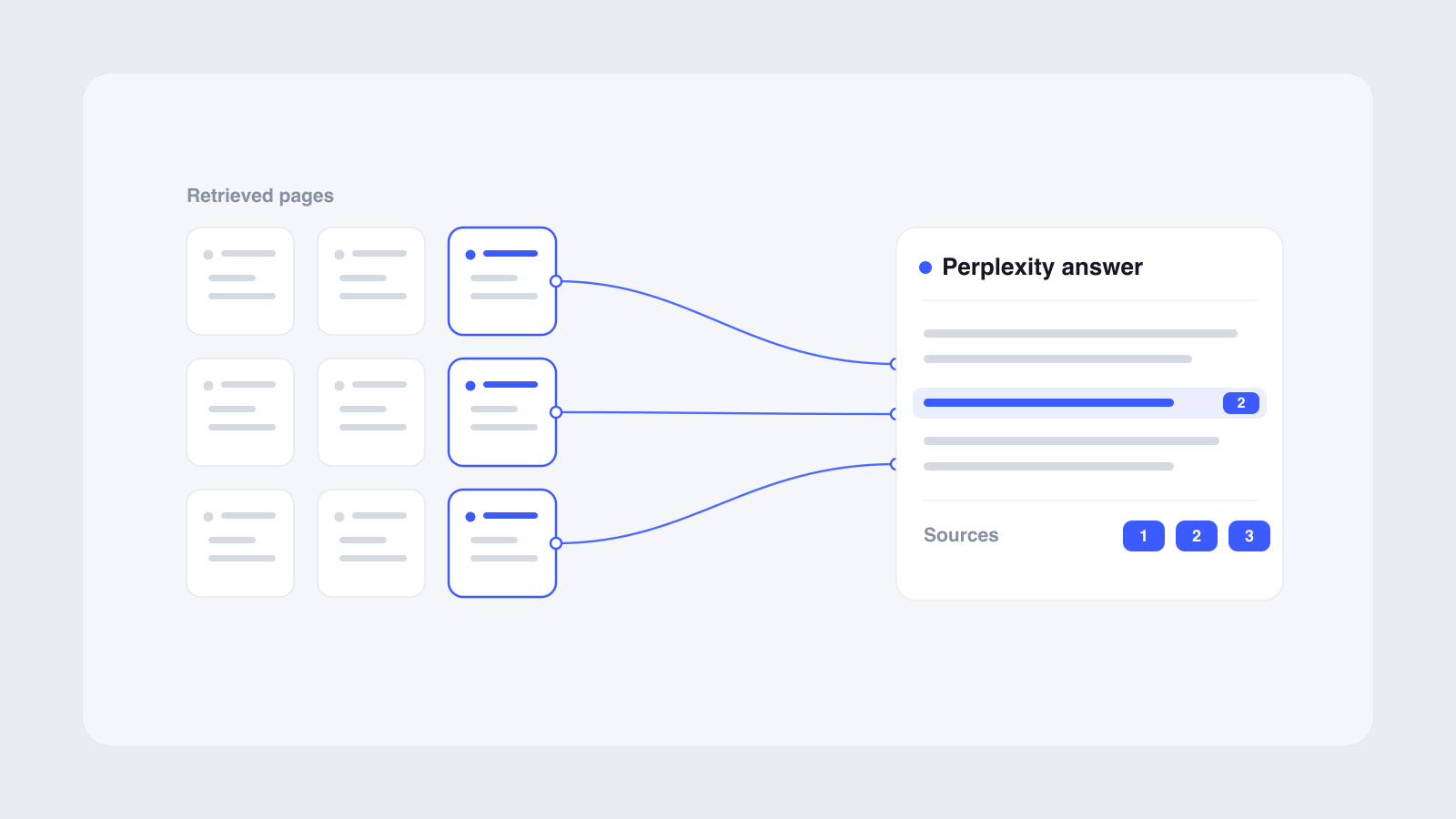
To rank in Perplexity you need four things working together: technical accessibility so PerplexityBot can read your pages, answer-first content that states the answer up front, authority signals like named authors and third-party mentions, and active freshness. Perplexity cites only 3 to 4 sources per answer, so the goal is to earn a place in that short citation list rather than climb a ranking.
Perplexity is rewriting how B2B software buyers discover vendors. Instead of a list of ten blue links, buyers receive a clean answer with numbered citations to a handful of sources. How do I get my brand to rank in Perplexity's AI answers? You need technical accessibility, answer-first content, authority signals, and active freshness management.
The Rise of Perplexity AI and GEO: What Ranking Means Now
To rank in Perplexity, you need a combination of technical accessibility, answer-first content, authority signals, and freshness. Perplexity is a real-time answer engine that synthesizes responses using Retrieval-Augmented Generation (RAG) and attaches numbered citations to its sources. It operates its own index built by PerplexityBot alongside Bing's index for retrieval.
Visibility here is effectively binary: cited or invisible. Unlike Google's SERP model, where a page ranking on page two still technically exists, Perplexity selects only 3 to 4 sources to cite from a pool of roughly 10 retrieved pages. For B2B SaaS brands, this means Generative Engine Optimization (GEO) is about earning a spot in that finite citation list, not slowly climbing a leaderboard.
Understanding Perplexity's AI Ranking Factors
Perplexity decomposes a user question into 3 to 5 sub-queries and searches each independently using hybrid lexical-semantic search (BM25 plus embedding retrieval). A neural cross-encoder reranker then scores each passage for relevance. The engine weighs five core signals: authority (trusted, well-linked sites), freshness, factual density (concrete, verifiable facts), structure (machine-liftable content), and topical relevance (close match to the parsed question).
Freshness is the strongest single factor. ConvertMate's research found that recency accounts for roughly 40% of Perplexity's ranking weight. Content updated two hours ago was cited 38% more often than month-old content. Perplexity has the strongest recency bias of any major AI platform.
Ensure Technical Accessibility for PerplexityBot
Perplexity operates two crawlers: PerplexityBot, which builds the search index, and Perplexity-User, which fetches pages in real-time for user queries. Blocking either removes your site from Perplexity's retrieval pool entirely. Visit yourdomain.com/robots.txt and search for "PerplexityBot" in your Disallow directives. If it is blocked, your site relies entirely on Bing's secondary index, which is weaker for Perplexity citations.
Beyond crawler access, ensure your content is extractable. Site speed, mobile-friendliness, and clean HTML structure all facilitate AI extraction. If your main content renders only after heavy JavaScript execution, Perplexity may not see it. Server-side rendering or static HTML gives the reranker clean text to score.
Optimize Content Structure for AI Extraction and Citations
Lead with the direct answer. Put a correct, clear answer to the target question in the first 100 words, then prove it underneath. This answer-first, inverted pyramid formatting rewards pages that say the thing cleanly and early. Use question-based headings that mirror how buyers phrase queries, and write in self-contained sections. Perplexity often pulls one passage out of context, so a paragraph that only makes sense after three others above it is a poor citation candidate.
Implement structured data using Schema.org JSON-LD. Rankbits analysis identifies five schema types Perplexity values: Article with dateModified for freshness verification, FAQPage (especially valuable because Perplexity is fundamentally a Q&A system), HowTo (mapping to instructional queries), Organization for entity identification, and Product for commercial-intent queries. A 2026 audit found 71% of sites had schema, but only 22% passed validation. Validate using Google's Rich Results Test and the Schema Markup Validator.
Build Brand Mentions, Entity Recognition, and Off-Site Authority
Perplexity needs to recognize your brand as an entity to cite it accurately. Use explicit, consistent mentions of your brand, products, and key entities within your content. Connect your brand to knowledge graph entries through Organization schema. E-E-A-T signals matter: named authors with real bios, cited sources for every statistic, and consistent brand naming across the web all build the entity trail that Perplexity's reranker uses to verify credibility.
Off-site authority is equally critical. Perplexity cites more than just a brand's own site; it concentrates on a small set of high-trust domains. Earn authentic mentions on industry publications, reputable blogs, news sites, and review platforms. External validation widens your surface area. Build a credible, well-linked site and earn mentions elsewhere. Anonymous content fails credibility filtering, so your about page, consistent NAP, and third-party mentions all contribute to whether Perplexity trusts you enough to cite.
Prioritize Data Freshness and Leverage Preferred Citation Sources
Given that recency accounts for roughly 40% of ranking weight, freshness is a discipline, not a nicety. Run quarterly refresh cycles for statistics-heavy pages. Add visible "last updated" dates and bump dateModified only when content genuinely changes. Time-anchored language like "as of September 2026" beats evergreen vagueness like "currently" in both retrieval and synthesis.
Citation source patterns matter. A June 2026 analysis of 3.1 million US queries using Ahrefs' Brand Radar tool found YouTube (32.4%), Reddit (16.6%), and Wikipedia (8.2%) as the most-cited domains overall. But B2B SaaS questions tell a different story. In a custom analysis of 12 B2B-SaaS buyer questions (Aug 2026), vendor's own sites accounted for 46% of citations, review/authority media 21%, niche blog/roundup 28%, Reddit just 1%, and YouTube 4%. How-to questions favored vendor blogs (68%), while "best X" questions favored independent roundups (27%).
Tools and Strategies for Perplexity GEO Monitoring
Perplexity publishes no position report. You must ask the engine your target questions repeatedly and record which sources it returns. Manual spot-checks fall short: they drift, miss intermittent citations, and cannot show trends. Systematic monitoring means tracking dozens of questions across Perplexity, ChatGPT, Gemini, and Google AI Overviews week over week.
This is where VisibleAuthority's AI Visibility Testing Loop becomes essential. It continuously tests AI prompts across models, tracks brand mentions, and refines content to improve AI recommendations. The system identifies the mention-citation gap: queries where Perplexity mentions your topic area but cites a competitor instead. Closing that gap is the core of a Perplexity-specific GEO strategy. Track citation count, share of voice, mention rate, and citation trend over time to measure progress.
Conclusion: Continuous Iteration for Perplexity AI Visibility
Ranking in Perplexity requires technical accessibility, answer-first content, authority signals, freshness, and systematic monitoring. GEO is iterative by nature. The 54% source churn observed over eight weeks on B2B SaaS queries means visibility is never a one-time fix. Continuous monitoring, testing, and adaptation based on performance data keep you in the citation set.
VisibleAuthority's 30-Day Visibility Sprint delivers measurable improvements in AI mention rates within 30 days through mapping, content deployment, and optimization. If you are ready to close the mention-citation gap and start appearing in the answers your buyers actually read, the 30-Day Visibility Sprint is your next step.
- Perplexity visibility is binary. It cites only 3 to 4 sources from about 10 it retrieves, so you are either in the citation set or invisible.
- Freshness is the single strongest signal, around 40% of ranking weight. Recently updated pages get cited far more often than month-old content.
- Lead with the answer in the first 100 words, use question-based headings, and add valid Schema.org JSON-LD, especially FAQPage and Article with dateModified.
- Entity trust drives citations. Named authors, cited statistics, consistent brand naming, and third-party mentions all tell Perplexity you are safe to cite.
- GEO is ongoing. B2B SaaS source lists turned over about 54% in eight weeks, so continuous monitoring and quarterly refreshes keep you in the answers.
Frequently Asked Questions About Perplexity AI Visibility
How does Perplexity decide which sources to cite?
Do I need schema markup for Perplexity AI?
Can I check if Perplexity is crawling my site?
How often do Perplexity's cited sources change?
Why is my brand not showing up in Perplexity AI answers?
We'll run your category through the major models and map exactly where you appear, where competitors win, and what it takes to become the recommendation.