
When a buyer asks Gemini to recommend the best project management tool for a mid-sized SaaS team, does your brand show up in the answer? For most B2B SaaS companies, the answer is no, and the revenue gap widens every month. If you're asking how do I get my brand to appear in Gemini's AI-generated answers, you're already ahead of competitors still focused only on traditional search rankings.
The shift from blue links to synthesized AI answers is the most significant change in search behavior since mobile. Gemini, Google's AI model, shapes buyer decisions by recommending specific brands inside its responses. This guide walks through the exact strategies to earn those recommendations, from technical discoverability to ongoing measurement.
Understanding Gemini's AI-Generated Answers and Brand Visibility
Gemini reached 750 million monthly active users as of Q4 2025 and overtook Perplexity in March 2026 as the second-largest AI chatbot referral source at 8.65% of AI referral traffic. That scale means your prospects are asking Gemini about software categories, comparing tools, and making shortlist decisions before they ever visit your website.
The question of how to appear in Gemini's AI-generated answers is fundamentally different from traditional SEO. You are not chasing a ranking position. You are competing for a mention inside a synthesized paragraph where Gemini decides which brands to name and recommend. This emerging discipline is called Generative Engine Optimization (GEO), and it requires a distinct playbook.
Google states there are no special AI optimizations beyond standard Search best practices. But brands that apply strategic GEO efforts consistently earn more citations. The strategies ahead cover five areas: technical discoverability, entity clarity, content optimization, third-party validation, and ongoing measurement. If you are new to the broader field, our Answer Engine Optimization fundamentals guide provides foundational context.
For more on multi-model visibility, see our guide to improving brand visibility on Gemini, ChatGPT, and Perplexity.
How Gemini Generates AI Answers and Cites Sources
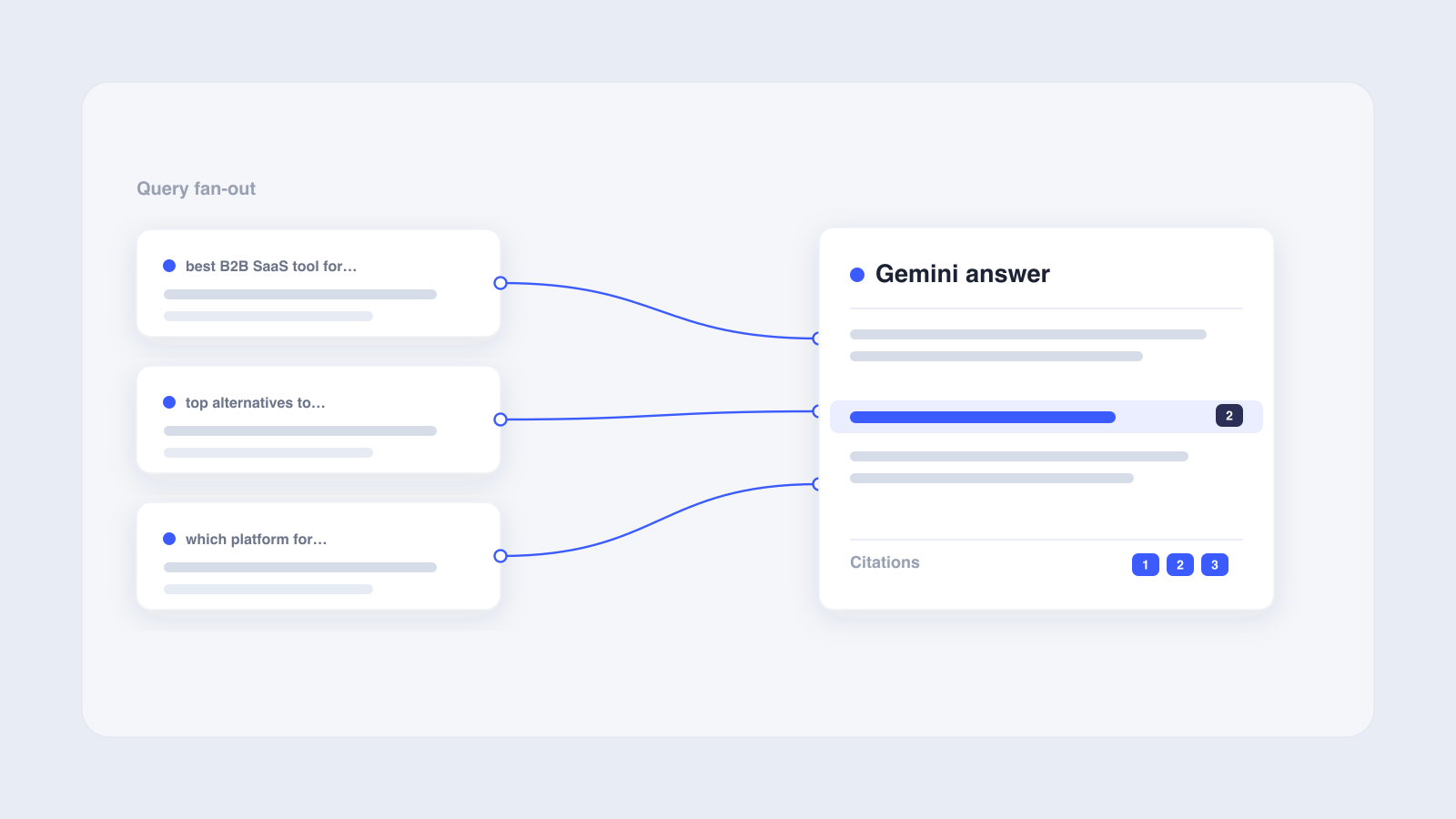
Gemini does not search the web the way a human does. For many prompts, it answers from what the model already knows with no live lookup at all. For queries where fresh or specific information would help, the model determines whether a Google Search can improve the answer, automatically generates one or multiple search queries, runs them, and synthesizes a response with citations attached.
This process is Retrieval-Augmented Generation (RAG), and Gemini uses Google's search index as its primary retrieval system. The model takes the prompt, generates several internal sub-queries in what's called the fan-out query pattern, retrieves candidate passages from Google's index plus the Google Knowledge Graph, and ranks them. Each answer then goes through Gemini's Double-Check mechanism, which cross-references every claim against Google Search results, creating a practical accuracy filter that deprioritizes unverifiable content.
Gemini is the most selective of Google's AI surfaces. According to Profound's analysis, Gemini cites approximately 6.6 sources per answer and names about 4.4 brands. Compare that to AI Overviews, which cite 11.1 sources, and AI Mode, which pulls 15.2 sources per answer. Every citation slot in Gemini is contested, and the model favors corroboration over coverage.
Here is the critical implication: only about a third of companies cited in one Google AI surface appear in the others. A Profound May 2026 study tracking 15,155 brand and category pairs across Gemini, AI Overviews, and AI Mode confirmed this fragmentation. You cannot optimize once and assume visibility everywhere. Each surface needs its own approach.
Technical Prerequisites: Ensuring Discoverability and Crawlability
Before any content strategy matters, your pages must be technically eligible for Gemini to find and cite. The first checkpoint is Google-Extended, the bot that controls whether your content can be used for Gemini model training and grounding. You should verify that Google-Extended is allowed in your robots.txt on every important section of your site, including subdomains, blogs, and knowledge bases.
There is an important nuance here. Google-Extended controls eligibility for AI training and grounding, but Googlebot and standard preview controls govern Search features like AI Overviews and AI Mode. Blocking Google-Extended does not remove you from Search AI answers. Both controls need to be configured correctly for full Gemini visibility.
The technical fundamentals also include proper indexing in Google Search Console, clean sitemaps, optimized robots.txt, mobile-friendliness, and core web vitals. Run a site:yourdomain.com check on key pages. If a URL does not return in Google's index, Gemini will not cite it. Pages competing with themselves (multiple URLs for the same topic, or http/https/www variants) split signal, so pick a canonical URL per topic and consolidate.
JavaScript rendering is another common blocker. Google-Extended does not always execute client-side JavaScript the way a browser does. Pages where body copy loads via React or Vue without server-side rendering often appear empty to AI bots. Use Google Search Console's URL Inspection tool or a headless browser to confirm your rendered HTML contains actual content.
The Gemini 3 rollout in 2026 made technical health a moving target. Gemini 3 became the default model on January 27, 2026, and the citation graph reorganized within weeks. A 100,000-keyword industry study published April 29, 2026 reported that roughly 42% of previously cited domains were replaced after the model swap. Each response now pulls about 32% more citations, the candidate set widened, and the winners changed. Technical health must be maintained continuously, not checked once.
Building Brand Authority and Entity Clarity (E-E-A-T)
E-E-A-T (Experience, Expertise, Authoritativeness, Trustworthiness) is Google's quality framework, and it directly influences Gemini's citation confidence. Named authors with credentials, firsthand experience, and primary data give Gemini something to stand behind. Without strong E-E-A-T signals, your content is less likely to pass Gemini's Double-Check verification.
Structured data (Schema Markup) is load-bearing for Gemini for two reasons. First, it validates the brand entity by giving Gemini a structured way to connect your website to other entity signals like LinkedIn, Wikipedia, and Crunchbase through sameAs links. Second, it signals content type so Gemini can decide whether a page is a candidate for the sub-query the fan-out actually fired.
Organization, Product, and FAQPage schema are the most impactful types. After the Gemini 3 reset, FAQ schema became the most concrete recovery lever. An industry recovery playbook recommended adding 6 to 10 question-answer pairs per page in FAQPage schema, validated against the Google Rich Results Test, and reported faster citation recovery on pages that did this within 30 days.
Your brand must be an unambiguously identifiable entity in Google's Knowledge Graph. Claim the Knowledge Panel where eligible, verify your Google Business Profile, and maintain NAP Consistency (Name, Address, Phone) across every platform. Wikipedia and Wikidata entries are critical because Wikidata feeds the Knowledge Graph directly. Build a Wikipedia presence only if notability standards are met. Never pay for placement; it gets reverted and damages reputation.
Removing entity ambiguity is the goal. Google must confidently connect your pages to your brand as a known, authoritative entity before Gemini will cite you. For B2B SaaS companies in contested markets, building topical authority for AI search creates the depth of coverage that signals expertise to both Googlebot and Gemini.
Optimizing Content for AI Extraction and Citation
Gemini extracts facts from pages, not paragraphs. Structure your content so the model can pull clean, quotable statements without guessing. Clear headings, concise answer blocks near the top of pages, FAQ sections, numbered lists, comparison tables, and semantic HTML all make extraction cleaner and more reliable.
Lead with the claim, then support it. A reader or model should get the answer from the first line of a section, not the fourth paragraph. Keep passages self-contained: each section should make sense pulled out of context, because that is exactly how Gemini will use it. Avoid vague or hedging language that reduces citation confidence. Definitive, factual statements get cited; tentative ones do not.
Brand-owned content receives 55 to 63% of citations for brand-specific queries in AI Mode, which shares the Gemini model. That is dramatically higher than AI Overviews, where brand-owned content gets 15 to 25% of citations. For B2B SaaS companies, this means your product pages, pricing pages, and comparison content are valuable citation targets.
AI Mode cites commercial content at 14.2% versus 4.4% in AI Overviews. This signals that Gemini surfaces are increasingly willing to cite commercial and transactional pages. Create content across subtopics: comparisons, objections, specific use cases, and adjacent questions to satisfy the query fan-out retrieval. Our AI-Optimized Content System builds this type of comparison, recommendation, and answer-first content designed specifically for AI citation.
Show that your work is current. Visible update dates and live figures signal the freshness Gemini prefers when a query triggers a search. Use descriptive headings, short paragraphs, and tables for comparative facts. This formatting serves both human readers and AI extraction equally well.
Cultivating Third-Party Validation and Brand Mentions
For non-brand and category queries, third-party editorial sources matter more than your own website. Gemini favors editorial and reference sources over company self-claims. When a buyer asks what the best CRM for startups is, Gemini reaches for outside reads rather than your homepage.
Gemini's most-cited domains reflect this preference: Reddit at 1.85%, YouTube at 0.69%, and Wikipedia at 0.62% of citations. Wikipedia held its citation share through the Gemini 3 reset at 33% of the source set. These are community-driven and reference content sources, and most of them are properties your brand does not own.
Digital PR is essential. Secure mentions, reviews, and citations from reputable industry publications, analyst reports, and comparison sites. Single mentions in respected industry-specific publications carry weight as third-party validation. When multiple independent sources describe your brand consistently, Gemini's confidence in citing your information increases significantly.
Create content on platforms Gemini already trusts. Publish YouTube tutorials, engage genuinely in Reddit communities, maintain a Wikipedia entry where notable, and contribute articles to industry publications. Third-party validation serves as evidence that satisfies Gemini's Double-Check verification mechanism, making claims about your brand verifiable and citation-worthy.
Avoid relying solely on own-domain content. The sources that put a brand in front of Gemini are mostly ones the brand does not control. Our AI Visibility Mapping service identifies exactly where your brand is missing across these external surfaces, analyzing buyer queries across major AI models to find the gaps.
Measuring and Monitoring Brand Visibility in AI Answers
You cannot improve what you do not measure. Gemini visibility requires a structured tracking process, not one-off prompt checks. Build a prompt set of 20 to 50 real buyer questions, sample each prompt repeatedly from clean sessions to get a rate, and record mentions, recommendations, citations, competitors, and accuracy.
Key metrics include mention rate (how often the brand is named), recommendation rate (how often presented positively), citation share (how often your domain is a cited source), share of voice (fraction of brands surfaced versus competitors), and accuracy (whether Gemini's statements about your pricing, features, and positioning are correct). These metrics, detailed in Webalert's Gemini visibility tracking methodology, give you the directional signals needed to iterate.
Recommended tracking cadence has three layers. Weekly, track 30 to 50 priority queries in Gemini and log citation changes. Monthly, refresh content on the top 5 to 10 decayed pages by updating statistics and refreshing publication dates so dateModified advances. Quarterly, run an entity-graph review verifying Wikipedia and Wikidata are current. For a deeper dive, see our guide on measuring brand visibility in AI search.
The clean path from keyword to click to conversion is breaking down, replaced by triangulation. You need to read several directional signals together: visibility tracked continuously, which sources and competitors appear, how Gemini describes your brand, self-reported attribution on signup forms, and sales call notes where buyers mention vetting via AI. Explore dedicated AI search tracking tools to systematize this process.
Our AI Visibility Testing Loop continuously tests AI prompts across models, tracks brand mentions, and refines content to improve recommendations. This is not a one-time audit. It is an ongoing cycle of testing, analysis, and content refinement that keeps pace with model updates like the Gemini 3 rollout that replaced 42% of previously cited domains.
Actionable Checklist for Gemini AI Visibility
Here is a concise checklist to implement every strategy in this guide:
- Verify Google-Extended is allowed in robots.txt for all key site sections
- Confirm every priority page is indexed in Google Search Console using URL Inspection
- Check rendered HTML for JavaScript-dependent pages using a headless browser
- Implement Organization, Product, and FAQPage schema with sameAs links to external profiles
- Add 6 to 10 question-answer pairs per page in FAQPage schema, validated with Google Rich Results Test
- Claim your Knowledge Panel and verify Google Business Profile
- Maintain NAP Consistency across all platforms and directories
- Build or update Wikipedia and Wikidata entries where notability standards are met
- Publish answer-first content with definitive claims in the first line of each section
- Create comparison tables, numbered lists, and FAQ sections for AI extractability
- Secure mentions on Reddit, YouTube, industry publications, and comparison sites
- Build a prompt set of 20 to 50 buyer queries and sample weekly for mention rates
- Refresh top decayed pages monthly with updated statistics and dates
Common Pitfalls to Avoid in Generative Engine Optimization (GEO)
Several mistakes undermine Gemini visibility efforts. Understanding the GEO vs traditional SEO differences helps avoid applying outdated tactics to a fundamentally different surface.
- Assuming Google-Extended controls Search AI features. It does not. Googlebot and standard preview controls govern Search, including AI Overviews and AI Mode.
- Ignoring JavaScript rendering. Google-Extended does not always execute client-side JavaScript. Pages loading content via React or Vue without SSR may appear empty to AI bots.
- Relying solely on own-domain content. Gemini's most-cited domains are Reddit, YouTube, and Wikipedia. The sources that put your brand in front of Gemini are mostly ones you do not own.
- Running one-off prompt checks. Answers vary and are personalized. A single check is not a reliable measurement. Sample repeatedly to establish rates.
- Paying for Wikipedia placement. It gets reverted and damages reputation. Build a presence only if notability standards are genuinely met.
- Assuming API grounding output replicates the consumer Gemini app. It does not, and should not be presented as such.
- Keyword stuffing. Gemini extracts semantic meaning, not keyword density. Forced repetition reduces content quality and citation confidence.
- Gemini is the most selective Google AI surface, citing 6.6 sources per answer and naming 4.4 brands, compared to 11.1 sources in AI Overviews and 15.2 in AI Mode
- The Gemini 3 rollout in January 2026 replaced roughly 42% of previously cited domains, making continuous monitoring essential
- Technical fundamentals (Google-Extended, indexing, JavaScript rendering) are prerequisites; without them, no content strategy matters
- Third-party validation on Reddit, YouTube, and Wikipedia matters more than own-domain content for category queries
- Brand-owned content receives 55 to 63% of citations for brand-specific queries in AI Mode, making product and comparison pages high-value targets
- Weekly testing with 30 to 50 buyer queries is the minimum cadence for reliable visibility measurement
Start Building Your Gemini Visibility Today
Earning citations in Gemini's AI-generated answers is not a one-time project. It requires technical readiness, entity clarity, answer-first content, third-party validation, and continuous measurement. The brands that win in Gemini are the ones that treat AI visibility as an ongoing discipline, not a checkbox.
VisibleAuthority specializes in exactly this work for B2B SaaS companies and AI tool startups. Our 30-Day Visibility Sprint delivers measurable improvements in AI mention rates within 30 days through mapping, content deployment, and optimization. We combine AI Visibility Mapping to find your gaps, our AI-Optimized Content System to build citation-worthy content, and the AI Visibility Testing Loop to track and refine continuously.
Ready to see where your brand stands in Gemini today? Start with a free AI visibility audit that analyzes your brand representation across major AI models including Gemini. You will get a clear picture of where you are missing, which competitors are showing up, and what it will take to earn your place in AI-generated answers.
Frequently Asked Questions
How long does it take for a brand to appear in Gemini's AI-generated answers?
Does blocking Google-Extended affect my brand's visibility in Gemini?
Is ranking in Gemini the same as ranking in Google AI Overviews?
Can I optimize for Gemini without doing traditional SEO?
How often should I test my brand visibility in Gemini?
We'll run your category through the major models and map exactly where you appear, where competitors win, and what it takes to become the recommendation.