
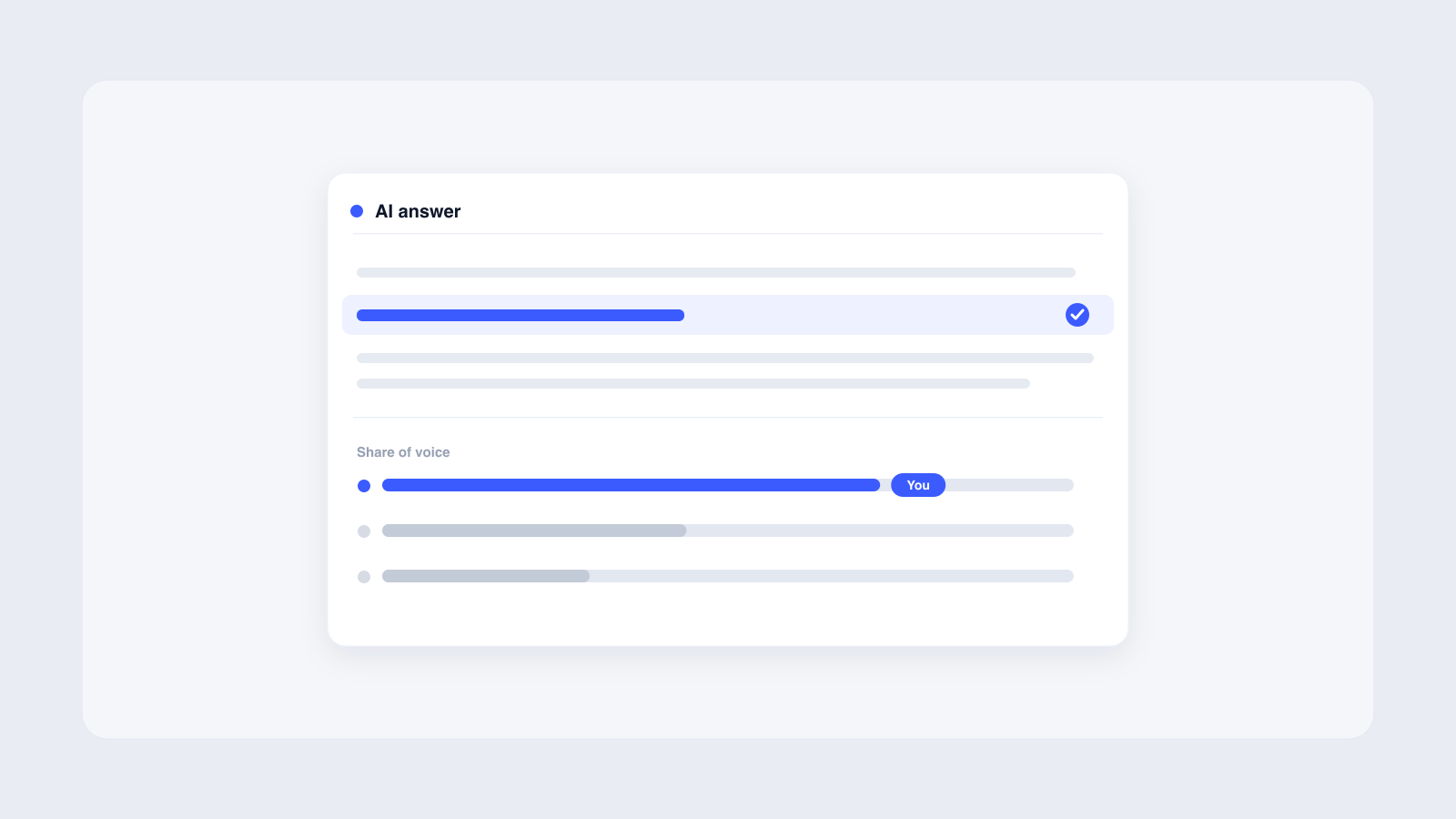
To get Claude to recommend your brand, first measure where you stand with an AI agent analytics platform, then close the gaps. Track mention rate, citation rate, share of voice, position, prompt coverage, sentiment, and model coverage across Claude, ChatGPT, Gemini, and Perplexity. Allow ClaudeBot and Claude-SearchBot to crawl your site, earn third-party authority, and deploy answer-first content for the prompts where competitors appear and you do not. Re-measure after 30 days, since AI visibility changes take weeks, not days.
When a B2B buyer asks Claude to recommend a brand in your category, the response names a handful of competitors. If you want to know how to get Claude to recommend your brand in its answers, you first need to see where you stand. An AI agent analytics platform shows you exactly where your brand appears in AI-generated answers, where competitors are winning, and what to do about it.
What is an AI agent analytics platform and how does it work
An AI agent analytics platform monitors, measures, and reports on how AI agents and crawlers discover, interpret, and reference your brand across LLM-generated answers and agentic search results. The platform does three things. Detection identifies which AI agents visit your site and which LLMs mention your brand, including crawlers like ClaudeBot, Claude-User, and Claude-SearchBot.
Traditional web analytics tools like Google Analytics were built for human clicks and keyword rankings. They cannot tell you whether Claude named a competitor instead of you when a buyer asked a recommendation question. AI agent analytics fills this gap by tracking visibility within conversational AI answers that cite only a handful of domains per response. The shift is from SEO metrics like rankings and CTR to GEO metrics like mention rate, citation share, prompt coverage, and answer position.
| Dimension | Traditional web analytics | AI agent analytics |
|---|---|---|
| Data source | Human clicks, page views, search queries | LLM-generated answers, AI crawler logs, prompt responses |
| What it measures | Website traffic, keyword rankings, backlinks | Brand mentions, citations, sentiment, position in AI answers |
| Primary metrics | Sessions, CTR, bounce rate, keyword position | Mention rate, citation rate, share of voice, prompt coverage |
| Output format | Dashboards on traffic trends | Prompt-by-prompt visibility reports, competitor benchmarking |
| Use case | Optimize website for human visitors | Optimize brand visibility in AI recommendations |
Why your business needs AI agent analytics in 2026
B2B software buyers increasingly ask Claude, ChatGPT, and Perplexity for recommendations instead of scrolling Google results. A 2026 study across 1,200 buyer-intent prompts found that Claude cites a median of 3.6 unique domains per answer, with the blended median across all engines at 3.4. That is far fewer than Google's ten blue links, making every citation slot competitive.
Research on Generative Engine Optimization by Aggarwal et al. found that AI engines favor earned media, meaning third-party authoritative sources, over brand-owned content. Without analytics, you cannot see whether your earned media is translating into AI mentions or whether competitors are winning those slots.
- No baseline: you have no starting measurement, so you cannot prove whether your AEO investments are moving the needle
- Invisible competitor gaps: you cannot see which prompts competitors win and where you are absent
- No revenue attribution: when a Claude recommendation influences a $5K to $25K deal, you have no way to connect that revenue to AI visibility
- No way to measure AEO ROI: without tracking mention rate over time, you cannot justify continued investment to stakeholders
- No early warning for inaccuracies: if an AI model shares outdated pricing or incorrect features, you will not know until a prospect tells you
What a strong AI agent analytics platform actually measures
Two more metrics matter. Agentic traffic from crawlers like ClaudeBot and Claude-User indicates whether your content is indexed for AI retrieval. Accuracy checks whether AI models share correct information about your products.
| Metric | What it measures | Why it matters | Target benchmark |
|---|---|---|---|
| Mention rate | Percentage of prompts where your brand appears | Foundational GEO metric showing overall visibility | Track against your top 3 competitors |
| Citation rate | How often AI models cite your content as a source | Indicates authority and content relevance | Above category median |
| Share of voice | Your mention rate vs. competitors | Shows relative visibility in your category | Top 3 in your competitive set |
| Sentiment | Positive, neutral, or negative tone of mentions | Negative mentions require immediate correction | 70%+ positive or neutral |
| Position in answer | Where your brand appears (first, middle, last) | First-position brands win buyer attention | First or second mention |
| Prompt coverage | Which buyer queries trigger your brand | Reveals topical gaps in AI visibility | All commercial-intent prompts |
| Model coverage | Performance across Claude, ChatGPT, Gemini, Perplexity | Each model has different trust signals and behaviors | Present on all four models |
Comparing the leading AI agent analytics platforms
For B2B SaaS brands, the first question is whether Claude names you when buyers ask for recommendations. If not, which competitors appear instead? Prompt testing across Claude, ChatGPT, Gemini, and Perplexity reveals that gap and turns it into an optimization plan. For a look at the tools that do this, see our AI search tracking tools buyer's guide.
| Platform | AI models covered | Key metrics | Competitor benchmarking | Best for |
|---|---|---|---|---|
| airops.com | ChatGPT, Perplexity, Google AI Mode | Brand mentions, AEO tracking, traffic data | Yes | Enterprise content operations teams |
| otterly.ai | ChatGPT, Perplexity, Google AI Overviews | Brand mentions, GEO audit, alerts | Limited | Small teams starting with AI visibility |
| peec.ai | 7 AI platforms | Mentions, share of voice, sentiment, competitive benchmarking | Yes | Analytics teams needing broad model coverage |
| Goodie | Multiple platforms including Claude | Query-triggered brand responses, competitor visibility comparison | Yes | Teams monitoring Claude-specific visibility |
| Profound | 9+ AI search engines | Visibility score, share of voice, sentiment, prompt volumes | Yes | Enterprise teams needing proprietary prompt data |
| LLM Pulse | 10+ AI models | Brand visibility percentage, citation position, sentiment | Yes | Cost-conscious teams needing multi-model tracking |
| Adobe Brand Visibility | ChatGPT, Google AI Overviews, Google AI Mode, Gemini | Mentions, citations, sentiment, position, visibility score, agentic traffic | Yes | Enterprise teams using Adobe Experience Cloud |
How to evaluate and choose the right platform for your stack
Start with your primary GEO goal: establishing a baseline, tracking competitors, measuring AEO ROI, or monitoring for inaccurate AI answers. Your goal determines which features matter most. Check AI model coverage to ensure the platform tracks at minimum Claude, ChatGPT, Gemini, and Perplexity. If your buyers use one model more than others, prioritize platforms with deep coverage of that model. Evaluate prompt customization: can you define your own buyer-relevant prompts, or are you limited to generic industry queries? The ability to upload your own prompt set matters for B2B SaaS companies with niche use cases. Assess competitor tracking to confirm the platform monitors competitor mention rates and alerts you when a competitor gains visibility on prompts where you previously appeared.
Review reporting and alerting for automated alerts when your mention rate drops or a competitor overtakes you on a high-value prompt. Consider integration with your existing stack; for most B2B SaaS teams, Slack or email alerts are sufficient. Factor in scalability: if you plan to track hundreds of prompts across multiple models, check pricing tiers and prompt limits. Test ease of setup: the best platforms offer guided onboarding with an initial visibility audit so you get value within the first week.
- Which AI models does the platform track, and does it include Claude, ChatGPT, Gemini, and Perplexity at minimum?
- Can I upload my own custom prompts, or am I limited to pre-built industry query sets?
- Does the platform track competitor mention rates and alert me when a competitor gains visibility on my prompts?
- What automated alerts does the platform send for mention rate drops, inaccurate information, or competitor overtakes?
- How does the platform integrate with my existing analytics stack, CRM, or reporting tools?
- What are the pricing tiers and prompt limits, and how do they scale as I add prompts or models?
- Does onboarding include an initial visibility audit, and how quickly can I see my first baseline?
Integrating AI agent analytics into your GTM workflow
AI visibility data should flow into your weekly and monthly workflows. When a Claude or ChatGPT recommendation influences a deal, log it in your CRM. Over time, this builds a corpus of AI-attributed pipeline that justifies AEO investment. Set a weekly prompt benchmarking cadence: run the same 20 to 50 buyer-relevant prompts across tracked models. Log changes in mention rate, position, and sentiment. Create a monthly AI visibility report for stakeholders covering mention rate trends, competitor share of voice, top-gained and top-lost prompts, and recommended actions. When the platform identifies a prompt cluster where your brand is absent, assign content creation to fill that gap. Our AI Visibility Testing Loop integrates prompt benchmarking with content refinement so B2B SaaS teams can close the loop between measurement and optimization without switching tools.
- Run your 20 to 50 tracked prompts across Claude, ChatGPT, Gemini, and Perplexity
- Log results: mention, position, sentiment, and competitors present
- Flag any drops in mention rate or new competitor appearances
- Assign one content task to fill the highest-impact gap identified
- Review competitor movements on your top-value prompts
- Prepare a one-line summary for leadership on mention rate trend vs. last week
Common mistakes teams make with AI agent analytics
Teams new to AI agent analytics make seven common mistakes. Treating AI visibility as a one-time check fails because Claude's responses change based on live web content. A single snapshot is meaningless without longitudinal tracking. Focusing only on brand name mentions misses context. A negative or inaccurate mention is worse than none. Tracking too many prompts drowns teams in data. Start with 20 to 50 high-intent buyer prompts. Comparing to industry averages instead of direct competitors makes share of voice numbers look better but tells you nothing about your actual market. Ignoring model-specific differences leads to failed strategies. Claude is more conservative than ChatGPT and weights editorial coverage differently. Measuring mentions without acting on gaps turns analytics into vanity. Finally, blocking AI crawlers to protect content removes your brand from training data and live answers entirely.
- Treating AI visibility as a one-time check: set a weekly or biweekly tracking cadence instead
- Focusing only on mention count and ignoring sentiment: monitor context, sentiment, and accuracy alongside frequency
- Tracking too many prompts: start with 20 to 50 high-intent buyer prompts, not hundreds of generic queries
- Comparing to industry averages: benchmark against direct competitors, not broad category benchmarks
- Ignoring model-specific differences: track each model separately; strategies do not transfer evenly across Claude, ChatGPT, Gemini, and Perplexity
- Measuring mentions but not acting on gaps: every gap should trigger a content, PR, or entity optimization action
- Blocking AI crawlers in robots.txt: allow ClaudeBot, Claude-User, and Claude-SearchBot to stay visible in Claude's answers
Getting started: from zero to your first AI visibility baseline
Follow these steps to establish your first AI visibility baseline. Step 1: Define your prompt set. List 20 to 50 buyer-relevant questions your prospects would ask an AI assistant. Focus on commercial-intent prompts like 'best [category] for [use case]' and '[your category] vs [competitor].' Step 2: Choose a platform that covers your target AI models and lets you upload custom prompts to identify where your brand is missing. Step 3: Run your baseline across Claude, ChatGPT, Gemini, and Perplexity. Log whether your brand appears, in what position, with what sentiment, and alongside which competitors. Step 4: Rank prompts by revenue impact and competitiveness. Step 5: Pick the highest-impact gap and deploy one fix. Update a comparison page, add schema markup, pursue a third-party review, or publish a use-case case study. Step 6: Re-measure after 30 days using the same prompt set. AI visibility changes take weeks, not days. Step 7: Set a recurring 30-minute weekly benchmarking session and assign one optimization action per week.
- Define 20 to 50 buyer-relevant prompts with commercial intent
- Choose a platform covering Claude, ChatGPT, Gemini, and Perplexity
- Run your baseline across all four models and log every result
- Rank gaps by revenue impact and competitiveness
- Deploy one optimization action for your highest-impact gap
- Re-measure after 30 days using the same prompt set
- Set a weekly 30-minute benchmarking cadence
These are the most common questions B2B SaaS teams ask when evaluating an AI agent analytics platform for the first time.
Frequently asked questions about AI agent analytics platforms
What is the difference between AI agent analytics and traditional web analytics?
How many AI models should an AI agent analytics platform cover?
Can AI agent analytics track what my competitors are doing in AI search?
How long does it take to see results from AI agent analytics?
Do I need an AI agent analytics platform if I already use SEO tools?
Take the next step: map your AI visibility today
If you do not know where your brand appears in AI answers, you cannot improve it. Every day without a baseline is a day your competitors may be gaining share of voice in the prompts your buyers ask. Analyzing buyer queries across Claude, ChatGPT, Gemini, and Perplexity identifies exactly where your brand is missing and what to do about it.
- What you get: a prompt-by-prompt breakdown of where you stand, a competitor gap analysis, and a prioritized action plan for improving AI recommendations
- How long it takes: one week from request to delivered assessment
- How to request it: reach out to our team to schedule your assessment
We'll run your category through the major models and map exactly where you appear, where competitors win, and what it takes to become the recommendation.