
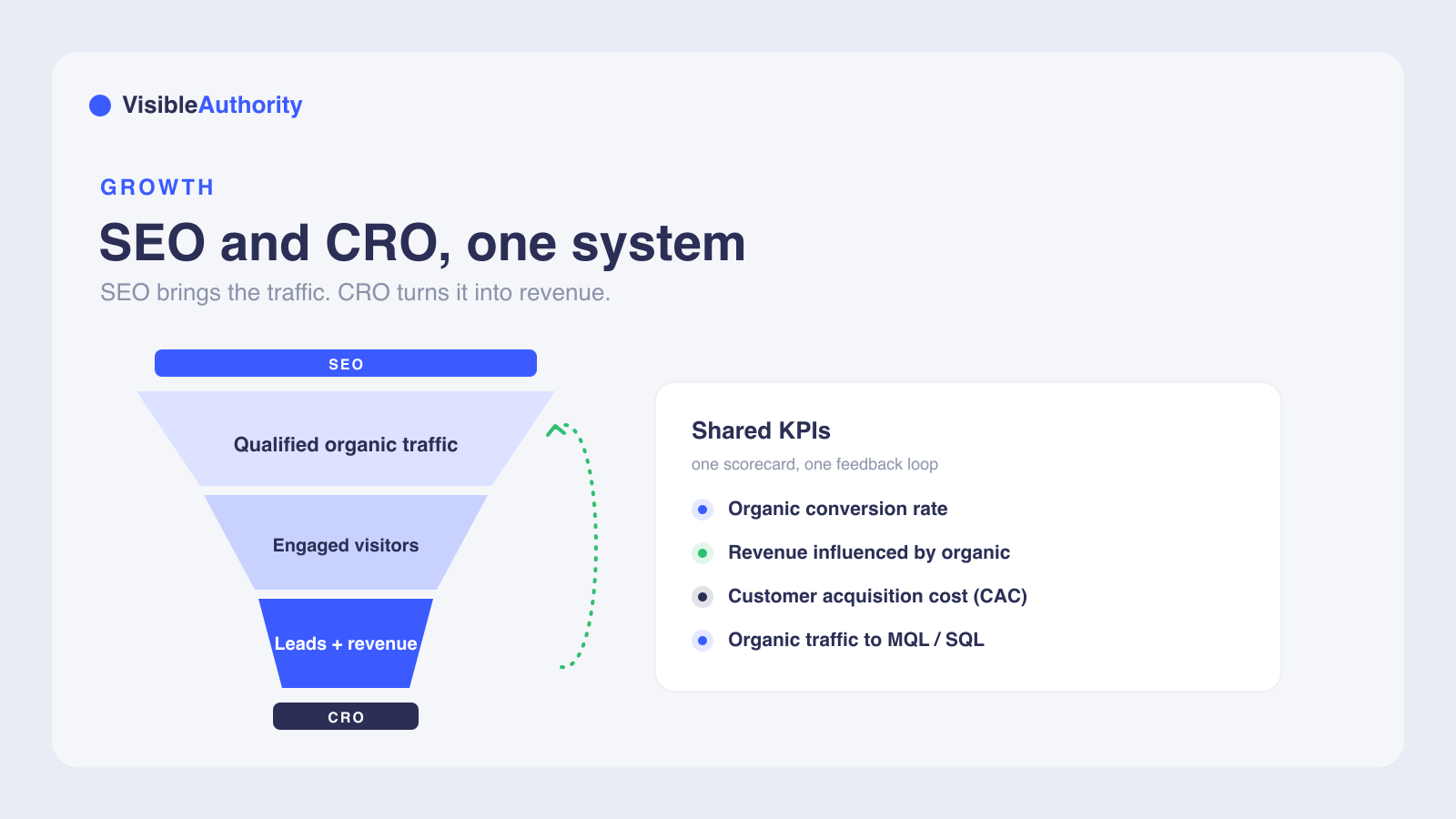
SEO and conversion rate optimization work together because they solve two halves of the same problem: SEO earns the visibility that brings qualified visitors from search, and CRO turns those visitors into leads and revenue once they arrive. They also reinforce each other, since the changes that lift conversions, like faster pages, clearer structure, and intent-matched content, are the same signals search engines reward. Run them as one system around shared KPIs such as organic conversion rate, organic-influenced revenue, and customer acquisition cost, with a single view of user intent. Test them sequentially rather than at the same time, running the CRO test first and then the SEO test on the winning version, so variant experiences do not contaminate the signals Google reads.
How do SEO and conversion rate optimization work together? If your organic traffic reports keep improving while signups and demo requests stay flat, that gap is costing you revenue every month. Traffic without conversions is a leaky bucket, and most B2B SaaS teams treat the two disciplines as separate workstreams run by separate people.
SEO brings buyers to your site. CRO decides what they do when they arrive. Run them together and each one makes the other measurably better; run them apart and you pay for traffic you never convert. This guide covers how the two disciplines connect, where they conflict, and the exact steps to integrate them.
How SEO and CRO complement each other
SEO and CRO target the same business outcome from opposite ends of the funnel. SEO earns visibility in search results so qualified visitors find your pages. CRO turns those visitors into leads, sign-ups, and revenue once they land. Each discipline alone produces a ceiling: rankings without conversions waste the traffic, and conversions without traffic cap growth.
The two strategies work best as one system. SEO increases traffic and CRO converts that traffic, so aligning the two lifts the share of organic visits that turn into leads and revenue rather than leaving that value on the table. The rest of this article defines each discipline, shows where they intersect, and gives practical steps for integration.
What SEO brings to the table
SEO increases organic visibility and drives qualified traffic from search engines. The work spans four areas: keyword research to find the terms buyers actually search, on-page optimization to align content with those terms, technical SEO to make pages fast and crawlable, and off-page SEO to build authority through backlinks. Together these capture attention at the top of the funnel, before users ever reach your site.
What CRO brings to the table
CRO maximizes the percentage of visitors who complete a desired action: a form submission, a purchase, or a sign-up. The toolset includes user experience (UX) improvements, A/B testing, calls to action (CTAs), and landing page optimization. CRO picks up where SEO leaves off, turning arriving visitors into customers at the bottom of the funnel by making the next step obvious and friction-free.
The feedback loop between SEO and CRO
SEO brings the right audience and CRO ensures that audience takes action, which creates a feedback loop where insight from one discipline improves the other. Search data tells you what users want; CRO tools show what they actually do. Qualified traffic, the kind that matches user intent and is likely to convert, sits at the center of that loop and matters to both teams.
The loop also runs on engagement signals, but handle them with care. Lower bounce rates, longer time on page, and stronger engagement are often read as signs a page satisfies intent, yet Google has said engagement signals are weak, indirect ranking inputs rather than a lever you pull directly. The more reliable overlap is this: good CRO work quietly becomes good SEO work because the changes that lift conversions, such as faster load times and clearer structure, are the same factors search engines use to judge page quality.
A published TokenEx case study documents the combined effect: aligning SEO and CRO on a single blog post produced a 282 percent increase in organic traffic quarter over quarter and a 500 percent increase in conversion rate. One page, two disciplines, and both metrics moved in the same direction because the content matched the intent behind the query.
| SEO | CRO | |
|---|---|---|
| Primary goal | Drive organic visibility and qualified traffic | Convert visitors into leads and revenue |
| Primary metrics | Rankings, organic traffic, click-through rate | Conversion rate, bounce rate, revenue per visitor |
| Main tactics | Keyword research, on-page optimization, technical SEO, link building | A/B testing, CTA optimization, landing page optimization |
| Funnel position | Top of funnel: capture attention | Bottom of funnel: drive action |
Shared objectives that prevent team silos
Both disciplines ultimately feed the same business goals: revenue, lead generation, customer acquisition, and brand loyalty. Silos produce predictable failures. A team chasing traffic alone generates visits with poor lead quality; a team optimizing conversions alone has high conversion rates on too little volume to matter.
Shared KPIs fix the incentive problem. Track revenue influenced by organic traffic, organic traffic to MQL and SQL rates, and customer acquisition cost (CAC) for the organic channel. Then set a collaboration cadence: weekly standups for quick wins, monthly reviews of performance data, and quarterly planning sessions to align priorities.
User intent as the bridge between rankings and conversions
Search intent drives both SERP rankings and visitor conversions, which makes it the natural bridge between the two teams. Four intent types matter: informational, navigational, commercial, and transactional. Informational queries call for blog posts and guides. Navigational queries call for easy-to-find product and pricing pages. Commercial queries call for comparisons. Transactional terms call for lean landing pages with fast load and clear CTAs.
When a page does not match the mindset behind the query, visitors bounce, which hurts both SEO engagement signals and conversion rates. Someone searching for pricing who lands on a 2,000-word guide leaves in seconds. Titles and meta descriptions carry the same double duty: they need target keywords for SEO and persuasive copy for CRO to maximize click-through rate from the SERP.
Technical factors that serve both disciplines
Core Web Vitals measure loading performance, interactivity, and visual stability. Google's targets are LCP at or under 2.5 seconds, INP under 200 milliseconds, and CLS under 0.1. These metrics have been a Google ranking factor since 2021, and they also keep users on the page long enough to convert in the first place.
Page speed hits conversions hard. According to Google research, the probability of a user abandoning a page increases by 32 percent if loading time goes from 1 to 3 seconds, and 53 percent of visitors abandon mobile sites that take more than 3 seconds to load. Because Google uses mobile-first indexing, the mobile version of your site is the reference for ranking, so a poor mobile experience damages both disciplines at once.
Site architecture works the same way. A structure that is easy for users to find their way through is also easy for search engines to crawl, benefiting conversion paths and indexation together. HTTPS is the final shared requirement: secure browsing is a trust signal for visitors and a ranking factor for Google.
Content and landing page optimization for conversions
High-quality, relevant content serves both goals at once: it ranks for target keywords and it persuades visitors to act. Landing page optimization means clear messaging, compelling CTAs, and a logical flow that guides visitors toward conversion. Schema markup also pulls double duty, helping search engines understand content while enabling rich snippets that improve click-through rate from the SERP.
AI-generated answers are now part of the discovery phase, so content must be optimized for traditional SERPs and for answer engines that synthesize and recommend brands. Traditional search results require keyword alignment and crawlability. Synthesized AI answers require structured, answer-first content that models can parse and cite. Our AI-Optimized Content System builds exactly this kind of comparison, recommendation, and answer-first content so models like ChatGPT, Perplexity, Gemini, and Claude cite and recommend your brand when buyers ask relevant questions.
Data, analytics, and metrics for integrated strategies
Analytics tools give both teams the evidence they need. Google Analytics 4 tracks user behavior, Google Search Console provides query and indexing data, Semrush and Ahrefs handle keyword and competitive analysis, and Hotjar supplies heatmaps and session recordings. A/B testing platforms like Optimizely and Convert identify which page variations drive better engagement. Note that Google Optimize was sunset on September 30, 2023, and businesses have migrated to alternatives like Optimizely, VWO, and Convert.
The shared KPI list should include organic traffic, organic conversion rate, bounce rate, time on page, qualified leads, CAC, and revenue attributed to organic. Distinguish micro-conversions (email sign-ups, content downloads, demo views) from macro-conversions (closed deals, purchases). Tracking both gives a fuller picture of combined SEO and CRO impact, and AI visibility tracking tools extend the same measurement discipline into answer engine results.
When SEO and CRO goals conflict and how to resolve them
The goals sometimes diverge. Keyword density can make copy read unnaturally, aggressive pop-ups may lift conversions while degrading user experience, and long-form content that helps SEO can overwhelm a visitor who wants a concise page. These tensions are manageable when user experience is the tiebreaker.
The deeper conflict is testing methodology. SEO tests split pages while CRO tests split users, so running both simultaneously on the same pages produces unreliable results: variant experiences can affect the user signals Google uses for ranking. SearchPilot describes a linear full-funnel approach that solves this by running the CRO test first using Bayesian analysis, then running the SEO test on the same pages, with a combined dashboard to weigh conversion impact against traffic impact.
For day-to-day balance, prioritize user experience first. Use canonical tags during CRO tests to point search engines to the original page, and follow JavaScript framework best practices so pages do not hide content from bots.
Practical steps to integrate SEO and CRO
- Conduct a joint audit covering SEO health (rankings, technical issues, keyword gaps) and CRO health (conversion paths, friction points, landing page performance).
- Build cross-functional collaboration with shared reporting dashboards that track both traffic and conversion metrics.
- Establish shared KPIs reflecting the full funnel, from organic traffic through MQL, SQL, and closed-won deals.
- Adopt continuous testing with sequential, not simultaneous, tests to avoid the methodology conflicts described above.
- Feed behavioral insights back into SEO content workflows: if heatmaps show users never reach the CTA, move it higher; if scroll tracking shows visitors read only 25 percent of a long-form post, restructure it with subheads or visuals.
If you want a structured starting point, our 30-Day Visibility Sprint applies this same loop of mapping, content deployment, and optimization to produce measurable before-and-after improvements in AI mention rates within 30 days.
Frequently asked questions about SEO and CRO integration
Should I focus on SEO or CRO first?
Can CRO improvements help SEO rankings?
What metrics should SEO and CRO teams share?
How do you test SEO and CRO changes without conflicting results?
Start aligning your SEO and CRO strategy
An integrated approach to SEO and CRO is a requirement for sustainable growth, not a nice-to-have. The same pages that rank well should convert well, and the same behavioral data that improves conversions should shape your content strategy. Buyers now discover and evaluate software inside AI-generated answers from models like ChatGPT and Perplexity, so that integration extends into answer engines where your next customers are forming shortlists.
Book an AI visibility assessment with VisibleAuthority and we will map how your brand appears in AI-generated answers across ChatGPT, Perplexity, Gemini, and Claude, then identify the gaps between discovery and conversion so you can close them.
We'll run your category through the major models and map exactly where you appear, where competitors win, and what it takes to become the recommendation.