
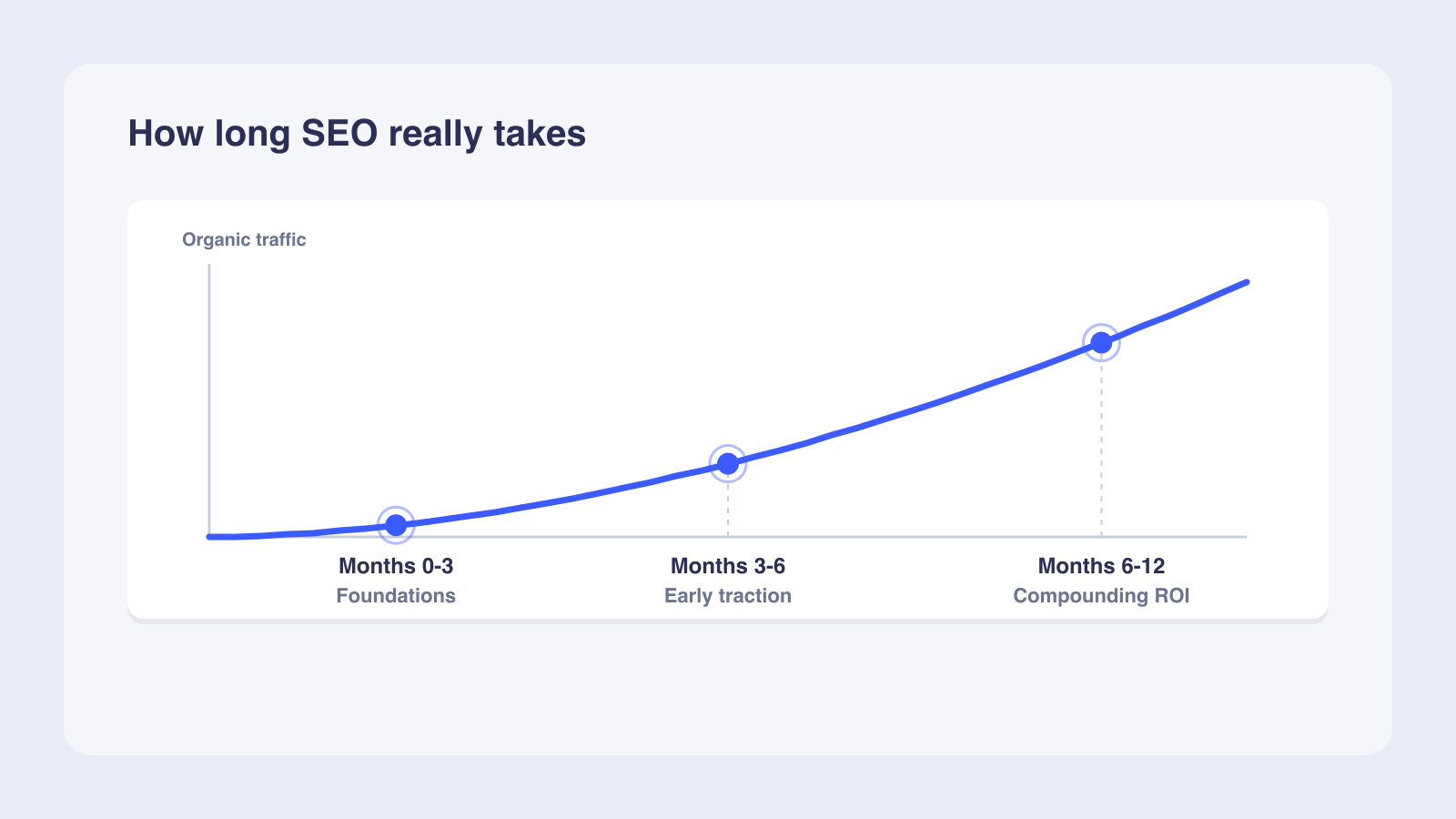
SEO takes about 3 to 6 months to show measurable results for most B2B SaaS companies, and 6 to 12 months or more before it delivers significant ROI. The timeline moves through three phases: months 1 to 3 are foundation work (technical fixes, keyword research, content) where you watch impressions and indexing; months 3 to 6 bring long-tail keyword movement and early traffic; months 6 to 12 and beyond is where traffic, conversions, and ROI compound. How fast you move depends on your domain's age and authority, how competitive your space is, your technical health, content and link quality, and how quickly your team ships the recommendations. Be wary of any provider that guarantees rankings or promises results in weeks.
SEO takes 3 to 6 months to show measurable results for most B2B SaaS companies, with significant ROI taking 6 to 12 months or more. Domain age, existing authority, the level of competition, and the scope of changes all factor in.
How long does SEO take to show results?
Most SEO campaigns show first measurable results, meaning ranking improvements and traffic growth, within 3 to 6 months, according to Search Engine Land's guide on SEO timelines. Early signals such as indexing and impression changes can appear sooner, within the first quarter, but significant ROI typically takes 6 to 12 months or more. Google's Maile Ohye has stated that an SEO typically needs four months to a year to implement improvements and see potential benefit.
- Domain age and existing authority: a brand-new domain almost always improves more slowly. A site that has been live for years with a strong content structure tends to improve faster.
- Competition: highly competitive industries like finance, health, and legal require longer runways before meaningful traffic arrives.
- Scope of changes: large sites with millions of pages take longer to crawl, and JavaScript-heavy sites can take significantly longer to be assessed.
What happens month by month in an SEO campaign
An SEO campaign moves through three stages with different definitions of success. Early signals appear in the first quarter. Meaningful traffic growth follows in months 3 to 6. Business outcomes arrive from month 6 onward.
At each stage, ask whether the work is producing the right kind of progress: first, are technical fixes and quick-win keywords generating impressions? Then, is traffic climbing from long-tail terms? Finally, are conversions and revenue materializing?
| Phase | Timeframe | What happens | Signals to watch |
|---|---|---|---|
| Foundation | Months 1 to 3 | Technical audit, on-page fixes, keyword research, content creation | Impressions, crawl rate, indexing, fewer site errors |
| Early traffic | Months 3 to 6 | Long-tail keywords move, early page-one visibility, modest traffic | CTR, ranking stability, long-tail traffic |
| Compounding ROI | Months 6 to 12 and beyond | Significant traffic, conversions, and ROI as authority builds | Organic traffic, leads, conversions, revenue |
Months 1 to 3: Foundation and first signals
- Technical audits, on-page fixes, keyword research, and content creation dominate this phase.
- Campaigns with a clean technical baseline at launch are more likely to show meaningful growth by month 6.
Months 3 to 6: Keyword movement and early traffic
- Google has typically crawled and processed a meaningful portion of implemented changes by this point.
- Expect increased impressions, early long-tail keyword improvements, and modest traffic shifts.
- Some keywords may climb significantly, with early page-one visibility for lower-competition terms.
Months 6 to 12: Compounding growth and ROI
- Significant traffic, conversions, and ROI materialize as content matures and authority builds.
- The compounding nature of SEO means the second year typically delivers more growth than the first.
- Ranking positions start to reflect a more stable baseline as Google fully processes accumulated changes.
What speeds up or slows down your SEO timeline
The competitive and technical conditions in your space also play a role. So does how quickly your team acts on recommendations.
Domain age and authority
- Ahrefs found that 72.9% of pages in Google's top 10 are more than three years old, and on average the number-one ranking page is five years old.
- Newer domains face a trust-building period while search engines evaluate quality and relevance.
Competition and technical health
- Keywords dominated by high-authority sites can take a year or more to challenge, while long-tail, low-competition terms rank faster.
- Unresolved issues like slow page load times, mobile-unfriendly design, or broken navigation delay indexing and reduce ranking potential.
- By contrast, campaigns entering with a clean technical baseline tend to show meaningful growth by month 6.
Content quality, links, and implementation speed
- Consistent publishing builds topical authority faster than sporadic bursts.
- Quality backlinks from relevant sites accelerate rankings; starting from scratch without backlinks means slower results.
- The speed at which your team implements recommendations directly affects how quickly Google can crawl and assess changes.
Which metrics signal SEO progress before traffic arrives
Traffic is a late-stage metric. Several earlier indicators tell you whether your SEO strategy is working before visitors start arriving in numbers.
Early signals (weeks 1 to 12)
- Increased impressions in Google Search Console, keyword ranking movement, and improved crawl rate are the first signs of progress.
- Site errors reducing after technical fixes, new optimized pages going live, and improved internal linking all indicate forward momentum.
Mid-stage signals (months 3 to 6)
- Click-through rate improvements, ranking stability, and traffic from long-tail keywords show the strategy is taking hold.
- These indicators matter even when overall traffic has not surged yet.
Business outcomes (months 6 and beyond)
- Organic traffic, leads, conversions, and ROI are the metrics that justify continued investment.
- Paid ads deliver immediate visibility but stop when spending stops; SEO compounds over time without per-click costs.
VisibleAuthority helps B2B SaaS companies extend this visibility into AI-generated answers, where buyers increasingly research and compare tools.
Misconceptions that lead to unrealistic SEO timelines
When expectations about how quickly SEO should work do not match reality, businesses misjudge whether a campaign is on track and often switch providers before results compound.
SEO does not deliver instant rankings
- Ahrefs found that only 1.74% of newly published pages reach the top 10 within a year, per the same study.
- Quick wins exist but typically come from low-competition, long-tail terms, not from competitive keywords.
SEO is not a one-time task
- Top-10 positions are unstable and require ongoing optimization, content updates, and link building to maintain.
- Search Engine Land warns against expecting stakeholders to just wait four months and hope for the best; visible, strategic work should happen from month one.
Backlink quality and provider red flags
- Sites without backlinks struggle to rank, but low-quality or spammy links can slow or reverse progress; link quality and relevance matter more than quantity.
- Guarantees of specific rankings or timelines, promises of results in weeks, and lack of transparent reporting all signal a provider to avoid.
- Reputable SEO professionals set realistic expectations and share data openly.
How to plan your SEO investment around realistic timelines
- Start with technical health and quick wins on low-competition terms, then build toward competitive keywords.
- Pair long-term SEO with faster-moving channels like AI answer visibility for earlier momentum.
- VisibleAuthority's 30-Day Visibility Sprint delivers measurable improvements in AI answer visibility within 30 days through mapping, content deployment, and optimization.
Frequently asked questions
How long does it take for a new page to rank on Google?
How long does it take for SEO changes to take effect?
How long does it take for Google to index a new page?
Can SEO show results in 30 days?
Why does SEO take so long to show results?
- SEO takes 3 to 6 months for measurable results; plan for 6 to 12 months before evaluating ROI.
- Track impressions and keyword movement in Google Search Console as early progress signals.
- Avoid providers who guarantee rankings or promise results in weeks.
Next steps
Pair long-term SEO with faster AI visibility. Start with a free AI visibility audit from VisibleAuthority to see where your brand stands in AI-generated answers and get a 30-day plan to improve it.
We'll run your category through the major models and map exactly where you appear, where competitors win, and what it takes to become the recommendation.